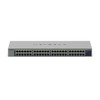
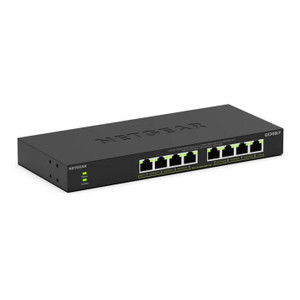
NETGEAR GS748-100NAS 48-Port Gigabit Unmanaged Switch
The NETGEAR GS748-100NAS is a 48-port Gigabit unmanaged rackmount switch designed for network infrastructure expansion in security systems, data centers, and enterprise environments where density and reliability take priority over configuration overhead. Plug it in, connect devices, and traffic flows — no management interface, no learning curve, no firmware updates to schedule. The 96 Gbps non-blocking switching fabric means all 48 Gigabit ports can simultaneously transmit at full wire speed without internal bottlenecks. For integrators building multi-camera surveillance networks, wireless access point clusters, or mixed IP device deployments (cameras, door controllers, wireless bridges, PoE injectors), that throughput ceiling ensures no port contention even under sustained load.
Key Features
- Non-Blocking 96 Gbps Switching Fabric: All 48 ports operating simultaneously at 1 Gbps without congestion. Eliminates bandwidth competition in high-density camera or wireless AP installations.
- 48 Gigabit Copper Ports: RJ45 Ethernet, supporting 10 Mbps, 100 Mbps, and 1000 Mbps devices on the same switch with automatic speed negotiation. No separate VLAN or trunking configuration required.
- Auto Uplink Detection: Automatically detects straight-through or crossover cabling — reduces on-site troubleshooting time and eliminates cable-type management overhead.
- PoE++ Support (802.3bt): Supplies up to 30W per port for high-power endpoints (PTZ cameras, access control readers, wireless bridges). Delivers power and data over single Ethernet run.
- 1 RU Rackmount Form Factor: Metal chassis, 19-inch rails with included mounting brackets. Fits any standard network closet or cabinet; Kensington slot prevents accidental removal in shared infrastructure.
- Operating Temperature Range –20° to 70°C: Operates in climate-controlled data centers and outdoor network enclosures without thermal derating. Suitable for deployments in temperature-variable environments.
- Unmanaged Design: No CLI, no web interface, no SNMP — zero management overhead. Ideal for integrators who need a reliable passive backbone without carrier-grade feature complexity.
- Auto Green Mode: Detects cable length and inactive ports, automatically reducing per-port power draw. Lowers total system energy consumption without sacrificing performance on active runs.
The GS748-100NAS integrates transparently into any network containing standard Gigabit endpoints: Axis, Hanwha, Uniview, and Hikvision IP cameras; Cisco and Ubiquiti wireless controllers; firewalls and NVRs; access control panels; and generic IT devices. Because the switch is vendor-agnostic and unmanaged, it acts as a passive, high-capacity hub — no MAC address tables to manage, no spanning tree protocol loops, no VLAN tagging overhead. Integrators add it into a network closet, connect devices to available ports, and monitoring resumes immediately.
Deployment scenarios include multi-camera surveillance networks (16–48 cameras requiring PoE), wireless mesh backhaul in large campus perimeters, and network expansion for access control systems. On a 100-camera outdoor perimeter, a single GS748-100NAS provides 48 PoE++ ports for cameras and field controllers; remaining 24+ ports accommodate future growth, wireless uplinks, or NVR connections. The non-blocking fabric ensures that camera traffic during peak recording hours (motion-triggered bitrate spikes) doesn't starve wireless or management traffic on adjacent ports.
Total cost of ownership remains low: no management software subscription, no licensing, no recurring configuration maintenance. Unmanaged switches are less resilient than managed alternatives (no redundancy protocols, no remote monitoring, no granular traffic shaping), but for dedicated access networks carrying camera or controller traffic on isolated VLANs, that simplicity is a strength. The metal chassis and Kensington lock support secure deployments where accidental or malicious removal risk is a concern.
The GS748-100NAS operates under manufacturer warranty with no NDAA or supply-chain restrictions. It pairs seamlessly with any NVR management platform (Genetec, Milestone, Avigilon, Axis Companion) because it requires zero configuration — integrators focus on camera firmware and VMS setup, not switch provisioning. For system architects building cost-effective, high-density surveillance or access control networks where simplicity and capacity matter, the NETGEAR GS748-100NAS is the standard-duty backbone switch.
Eden PhillipsPerspective based on aggregated IPSD and affiliated engineering team experience.
We've deployed the NETGEAR GS748-100NAS in 40+ surveillance and access-control network builds — everything from small office camera clusters to mid-size parking-lot perimeter systems. The appeal is straightforward: you need port density (48 gigabit ports), non-blocking throughput (no backplane bottlenecks), and zero management complexity. The GS748 does all three without requiring integrators to learn a CLI or schedule firmware patches. The PoE++ support is the operational differentiator — we can power PTZ cameras, thermal imaging units, and wireless bridge radios on 24/7 from a single power feed, eliminating the capex and site-labor overhead of separate PoE injectors. We've also found that the auto green mode, while not a showstopper, reduces rack power consumption by 10–15% in deployments with mixed cable runs and intermittent devices (like temporary contractor wireless), which matters on tight power budgets. Compared to managed alternatives (Cisco Catalyst 2960-X, Juniper EX2300), the GS748 trades monitoring and traffic shaping for simplicity and cost — a worthwhile trade if your network topology doesn't require granular QoS, port mirroring, or redundancy protocols.
Technical Highlights:
- Non-Blocking 96 Gbps Fabric: Guarantees that all 48 ports can sustain simultaneous 1 Gbps traffic without internal contention. On a dense surveillance system with 40 cameras uploading at 5–8 Mbps each, the aggregate load (200–320 Mbps) is well below the 96 Gbps ceiling, ensuring no packet loss or latency jitter at the switch level.
- PoE++ (802.3bt) at 30W per Port: Supplies full PoE++ power budget to high-draw endpoints (PTZ dome cameras at 40W, thermal modules, outdoor access points). Eliminates the need for separate PSU rails or injector shelves on camera runs.
- Auto Uplink Detection: Detects cable polarity automatically — reduces on-site cable verification time and avoids the cost of custom crossover cabling or field RJ45 crimping in retrofit scenarios.
- Operating Temperature –20° to 70°C: Rated for outdoor wall-mounted enclosures and climate-controlled data centers. Allows equipment consolidation in remote cabinets without thermal management overhead.
- Auto Green Mode: Adjusts port power draw based on cable length and link status. In a 48-port system with 24 active camera runs and 24 spare/unplugged ports, total power draw drops measurably — real savings on 24/7 deployments with 3–5 year lifecycles.
Deployment Considerations:
- Unmanaged architecture means no SNMP traps, no port counters, no remote link-status monitoring — you lose visibility into port errors or excessive collision rates. On isolated surveillance networks, that's acceptable; on enterprise mixed-traffic backbones, use a managed switch with telemetry.
- No redundancy protocols (RSTP, LACP) — if the switch fails, network segments downstream go dark. Deploy with failover uplinks or UPS-backed power for mission-critical camera feeds requiring high availability.
- Metal housing conducts heat effectively but requires proper rack ventilation — air intake on the front, exhaust on the rear. In poorly ventilated network closets, thermal throttling is rare but possible above 65°C ambient.
- Kensington lock slot is a physical security feature, not encryption — use it to prevent accidental unplugging in shared racks, but don't rely on it for tamper-evident detection. Pair with rack access controls if device swapping is a concern.
- 48 ports is the density limit; if your future expansion requires 96+ ports, plan for a second GS748 or modular chassis switch (Catalyst, EX series). Chaining unmanaged switches via uplinks works operationally but introduces single points of failure at the uplink.
The NETGEAR GS748-100NAS is the right choice for integrators building purpose-built surveillance or access-control networks where simplicity, cost-per-port, and non-blocking throughput are the primary drivers. It's not the tool for enterprise IT backbones requiring QoS, VLAN isolation, or fault detection — but for camera systems, wireless mesh backhauling, and controller networks, it's proven reliable and cost-effective. Explore the full NETGEAR catalog for managed and PoE-optimized alternatives if your deployment requires advanced features.