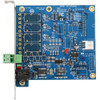
Geovision GV-IO 12 IN Card 55-IO12I-300
The Geovision GV-IO 12 IN Card is a digital input expansion module designed for Geovision DVR and NVR systems requiring additional sensor and alarm integration capacity. It provides 12 independent digital input channels, each capable of monitoring normally-open or normally-closed contact closures from door/window sensors, motion detectors, glass-break sensors, and external alarm panels. On systems with limited onboard IO, this card eliminates the need for expensive external relay modules or third-party gateway hardware, keeping the architecture consolidated on the recorder itself.
Key Features
- 12 Digital Input Channels: Each channel independently monitors a contact closure or dry alarm signal. Supports both normally-open (NO) and normally-closed (NC) sensor logic.
- Plug-in Module Architecture: Installs directly into available IO expansion slot on compatible Geovision DVRs/NVRs. No external power supply or configuration software required beyond basic recorder settings.
- Alarm & Sensor Support: Accepts door/window magnetic switches, PIR motion sensors, glass-break detectors, emergency buttons, and dry-contact alarm outputs from third-party systems.
- Event Triggering: Each input can trigger DVR/NVR recording, notification, relay output activation, or custom rules without additional software licensing.
- Backward Compatibility: Works with Geovision recorder lines that support IO module expansion (check recorder manual for slot availability and firmware version requirements).
- Screw Terminal Connections: Standard 2-wire terminal blocks for each input channel — eliminates proprietary connectors and simplifies field wiring and maintenance.
The GV-IO 12 IN Card consolidates perimeter and facility alarm signals into a single recorder, reducing complexity and cost compared to multi-box alarm aggregation setups. On a typical retail or small warehouse installation, one card typically handles door sensors, emergency buttons, and simple motion detection inputs, leaving the recorder focused on video storage and playback.
Installation is mechanical only — slide the card into an empty IO slot until it seats fully, verify physical contact, and confirm the recorder firmware recognizes the new channels in the system configuration menu. Field wiring uses standard 22-24 AWG twisted-pair copper (alarm or security-rated cable recommended for noise immunity in electrically noisy environments). Each channel draws negligible current and operates independently, so a single failed input does not affect the others.
Integration with Geovision's event management engine means input transitions (e.g., door contact open-to-closed) automatically populate the event log with timestamp and associated video timeline. This is particularly valuable for loss-prevention workflows — an alert can be cross-referenced with video immediately rather than requiring manual search. The card is format-agnostic; it works with both analog and IP-based Geovision systems so long as the recorder has available IO slots and supports expansion module firmware.
Ensure the target DVR/NVR model supports IO card expansion before purchase — not all Geovision products have physical slots. Confirm available firmware version as well; older firmware may require a free update to recognize the new module. For integrations involving third-party alarm panels or specialized sensors (addressable fire loops, 4-20mA analog inputs), consult Geovision technical documentation to confirm input type compatibility. The card supports only digital (contact closure) inputs — analog sensor signals will require a separate analog-input module or external converter. Browse the Geovision catalog for compatible recorder models and complementary IO modules.
Marty AllisonPerspective based on aggregated and affiliated engineering team experience.
We've deployed the Geovision GV-IO 12 IN Card across small and mid-market retail, warehousing, and access-control integration projects. The main advantage — and the reason we recommend it — is consolidation. Many Geovision DVR/NVR customers have existing alarm infrastructure (door sensors, PIR loops, panic buttons) that would otherwise require a separate gateway or monitoring hub. By plugging this card into the recorder, you eliminate that middle box entirely and tie all sensor events directly to video timeline and event logs within the same system. On a 20-camera retail site, that's one less piece of hardware to manage, power, network, and monitor for failure. The cost savings on hardware, cabling, and system integration time often justify the card cost within the first service year. That said, the card is a commodity IO expander — it doesn't add any computation or filtering. If you need addressable fire-panel integration, 4-20mA analog sensor inputs, or complex logic gates across a large sensor network, you'll outgrow this card quickly and should instead architect around an open-protocol gateway (ModBus TCP, OPC-UA, Bacnet) or a dedicated alarm management appliance. For what it does — straightforward contact-closure monitoring tied to DVR/NVR events — it's simple, reliable, and cost-effective.
Technical Highlights:
- 12 Independent Channels: Each input monitored separately with NO/NC selectable logic. No shared interrupt or bandwidth bottleneck — all 12 signals are sampled at the card firmware rate, typically 100ms or faster per cycle. Operationally, this means rapid door-open detection and motion trigger response without lag.
- Direct DVR/NVR Integration: No external software, gateway IP address, or additional licensing. The recorder's native event engine recognizes input state changes and executes configured actions (record, notify, relay) out of the box after slot insertion.
- Screw Terminal Pinout Simplicity: Wiring is two-wire per channel (common ground, signal). No proprietary connectors; field technicians familiar with basic alarm wiring can terminate a new sensor in under 5 minutes per point.
- Low Power Draw: The module draws minimal current from the recorder's internal 5V/12V rail — no external supply needed, which simplifies installation in cabinet-mounted or corner-mounted DVR/NVR locations.
- Event Logging with Timestamp: Every input transition is logged to the DVR/NVR event database with millisecond precision and linked to video playback timeline. This is critical for loss-prevention audits and incident reconstruction.
Deployment Considerations:
- Slot Availability Check: Not all Geovision DVR/NVR models have IO expansion slots. Verify the target recorder model supports IO module installation before purchase. Older compact DVRs often do not have expansion capability.
- Firmware Version Dependency: Confirm the recorder is running a firmware version that recognizes and initializes IO expansion modules. If the card is inserted but not detected, a firmware update may be required — typically free from Geovision but requires a few minutes of downtime.
- Contact Type Matching: The card accepts dry-contact (relay output) and simple switch closures only. If you're integrating a third-party alarm panel with open-collector or 24VDC addressable outputs, verify compatibility or use an external contact translator. Four-wire (power + signal) inputs are not supported.
- Cable Grade in Noisy Environments: Standard alarm cable works fine in typical office/retail settings. In electrically noisy warehouses (heavy machinery, VFD drives), use twisted-pair shielded alarm cable and route away from AC power and motor wiring to avoid false triggers from EMI.
- Scalability Limit: A single card provides 12 channels. If you have more than 12 inputs, you'll need multiple cards in parallel (if slots are available) or a different architecture. Pre-plan your sensor count before installation.
The GV-IO 12 IN Card is the right choice for integrators and end-users running Geovision DVR/NVR systems who need straightforward sensor and alarm integration without introducing external gateways or software complexity. If your deployment is pure contact-closure inputs under 12 channels and you already own or are purchasing a compatible Geovision recorder, this card delivers fast ROI and minimal operational overhead. Explore the Geovision catalog for recorder models and related IO modules.