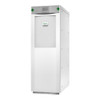
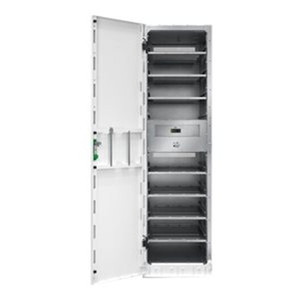
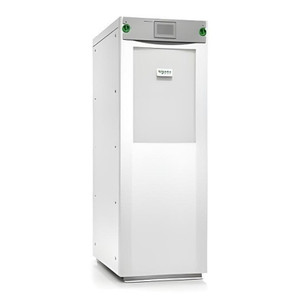
APC by Schneider Electric GVSUPS50K150HS Galaxy VS 50kW Scalable Online UPS
Overview
The APC Galaxy VS GVSUPS50K150HS is a 50kW (50 kVA) three-phase online double-conversion UPS designed for data centers, large commercial facilities, and industrial environments where power continuity is non-negotiable. Its headline advantage is scalability: the unit ships at 50kW but supports growth to 150kW by adding capacity modules — so you commission what you need today without forklift-replacing the UPS when your load expands. Paired with enterprise UPS systems from APC's commercial lineup, the Galaxy VS sits in the mid-range three-phase tier that covers everything from a dense server room to a distributed edge node requiring clean, regulated power.
The GVSUPS50K150HS operates on a 400V output bus, accepts input voltages from 340V to 460V, and handles input frequencies between 40Hz and 70Hz — a wide enough envelope to accommodate generator-supplied power without switching to battery unnecessarily. This is a meaningful spec on sites that run diesel backup: generators notoriously produce frequency sag during startup, and a 40–70Hz input window keeps the UPS in online mode rather than forcing a battery transfer.
Key Features
- Online Double-Conversion Topology: The load never runs directly off raw mains. Power is continuously converted AC→DC→AC, meaning voltage sags, surges, harmonics, and frequency deviations are completely isolated from connected equipment. Unlike line-interactive designs that only switch to battery during extreme events, double-conversion delivers regulated, conditioned power at all times — critical for sensitive server and networking loads.
- 50kW / 50 kVA Output, Scalable to 150kW: The base configuration protects 50kW of IT or facility load. When demand grows, capacity can be extended to 150kW using external battery and capacity modules rather than replacing the frame — avoiding the capital expenditure and downtime of a full unit swap. This makes right-sizing at initial deployment genuinely viable rather than a compromise.
- 400V Output Voltage: Three-phase 400V output aligns with European and international facility power standards, feeding PDUs, server racks, and HVAC equipment directly without step-down transformers. Output voltage holds tight across the full load range — a requirement for modern high-density compute loads that specify narrow input voltage windows.
- 1% Output Voltage THD: Total harmonic distortion on the output side comes in at 1% — well below the 5% threshold that begins to stress power supplies and drives audible transformer hum in quiet environments. For power conditioning applications protecting medical imaging, broadcast, or precision manufacturing equipment, this level of output cleanliness is the spec that justifies a true online UPS over a cheaper topology.
- 3% Input Current THD: Drawing only 3% input current THD from the facility feed means the Galaxy VS itself won't distort upstream power quality or require oversized input wiring to compensate for harmonic loading. Facilities with strict power quality contracts or co-location environments with shared feeds will appreciate this — it's the difference between a UPS that adds harmonic pollution and one that doesn't.
- Wide Input Voltage Range (340–460V): A 120V input window (340V min to 460V max) means the unit rides through browndown conditions and generator frequency excursions without transferring to battery. On sites with marginal utility feeds or those relying on diesel generators during extended outages, this spec reduces battery cycling and extends battery service life.
- 40–70Hz Input Frequency Acceptance: The broadened frequency range — 30Hz wider than a standard 50/60Hz-locked UPS — lets the Galaxy VS stay online during generator startup transients and support installations in facilities that operate on non-standard power infrastructure. Particularly relevant for industrial sites and international deployments where grid frequency stability is not guaranteed.
- ECO Mode Operation: When utility power quality is consistently clean, ECO mode routes power through a high-efficiency bypass path rather than continuous double conversion, reducing conversion losses and cutting heat output. The trade-off is a brief transfer window back to full double-conversion if power quality degrades — acceptable for non-critical secondary loads or in facilities with very stable utility feeds. Engineers should evaluate whether the load criticality justifies running in standard online mode full-time.
- 2.5:1 Crest Factor Handling: A 2.5:1 crest factor rating means the UPS tolerates loads that draw peak currents up to 2.5 times their RMS value — common in switch-mode power supplies across servers, networking gear, and variable-frequency motor drives. Undersized crest factor handling is a common failure mode on cheaper UPS platforms; at 2.5:1, the Galaxy VS handles real-world mixed IT and facility loads without output waveform clipping.
- Pure Sine Wave Output: The output waveform is a true sine wave, not a stepped approximation. Active PFC power supplies in servers, storage arrays, and medical devices require sine wave input to operate correctly and to comply with their own regulatory certifications. Modified sine wave output invalidates those device warranties — the Galaxy VS eliminates that concern entirely.
- 270A Maximum Output Current: At 400V three-phase, a 270A maximum current rating supports dense load configurations including high-draw server rows, chillers, and lighting systems within the 50kW capacity envelope. Knowing the amperage ceiling matters when sizing branch circuit breakers and busbar infrastructure during facility design.
- 68 dB Operating Noise Level: At 68 dB, the unit produces noise comparable to a busy office environment. This is relevant for installations where the UPS shares occupied space — equipment rooms adjacent to offices, edge deployments in retail or healthcare environments. It's not whisper-quiet, but it's manageable without acoustic enclosures in most commercial settings.
- 5,804 BTU/h Heat Dissipation: Thermal load of 5,804 BTU/h (approximately 1,700W) needs to be factored into cooling capacity calculations for the room or enclosure housing the unit. For a data center infrastructure environment where every BTU counts against cooling budget, this figure feeds directly into CRAC/CRAH sizing and hot-aisle/cold-aisle containment design.
- Short Circuit Protection: Built-in short circuit protection prevents a downstream fault from propagating upstream and damaging the UPS itself or connected equipment, reducing the blast radius of load-side wiring or equipment failures.
Integration and Compatibility
The GVSUPS50K150HS is designed for external battery configurations — the UPS frame itself does not include internal battery strings, so runtime is determined by the external battery cabinet capacity you provision separately. This architecture is common in large three-phase UPS deployments where runtime requirements vary widely by site and where battery replacement needs to happen independently of the UPS electronics. Specify compatible external battery modules based on your target runtime at full or partial load.
The 400V output and three-phase architecture integrate with standard European and international facility PDUs and power distribution infrastructure. Input wiring should be engineered to handle the 270A maximum draw with appropriate conductor sizing and upstream overcurrent protection. The wide 340–460V input window simplifies integration on sites using generator transfer switches, which often introduce transient voltage deviations during switchover.
ECO mode behavior and UPS management parameters are configurable — consult APC's EcoStruxure IT platform documentation for network management card integration, SNMP monitoring, and remote management capability. Facilities running parallel UPS configurations should verify module compatibility and firmware revision alignment before commissioning.
Frequently Asked Questions
Q: What is the difference between the GVSUPS50K150HS and a standard 50kW UPS that cannot scale?
A: The GVSUPS50K150HS is specifically designed to grow from 50kW to 150kW by adding capacity modules, without replacing the UPS frame. A fixed 50kW unit requires full replacement when load demands exceed its nameplate capacity. The scalable architecture reduces initial capital outlay and eliminates planned downtime for UPS replacement as your facility grows.
Q: Does the GVSUPS50K150HS include internal batteries?
A: No. The GVSUPS50K150HS is designed for external battery configurations. Runtime depends on the external battery cabinet(s) you provision separately. This is standard architecture for large three-phase UPS installations where runtime requirements and battery replacement schedules are managed independently of the UPS electronics.
Q: What input voltage range does the GVSUPS50K150HS accept?
A: The unit accepts input voltages from 340V to 460V, with an input frequency range of 40Hz to 70Hz. This wide envelope allows the UPS to remain in online double-conversion mode during browndowns, voltage sags, and generator-supplied power with frequency deviations — avoiding unnecessary battery transfers that reduce battery service life.
Q: Is ECO mode safe for critical IT loads?
A: ECO mode routes power through a high-efficiency bypass path when utility power quality is stable, which reduces energy consumption and heat output. However, it involves a brief transfer window back to full double-conversion if power quality degrades. For mission-critical loads such as primary data center servers or medical equipment, most engineers run full double-conversion mode continuously. ECO mode is more appropriate for secondary loads or environments with consistently clean utility feeds.
Q: What is the heat dissipation output of the GVSUPS50K150HS, and how does it affect room cooling planning?
A: The unit dissipates 5,804 BTU/h under load. This figure must be included in the cooling capacity calculation for the room or enclosure. For dedicated equipment rooms, add this to the total heat load from servers, networking gear, and lighting when sizing CRAC or CRAH units.
Q: What noise level does the GVSUPS50K150HS produce?
A: The unit operates at 68 dB — roughly equivalent to a busy open-plan office. For installations in dedicated equipment rooms, this is rarely an issue. For edge deployments in shared or occupied spaces, consider acoustic separation or enclosure treatment if ambient noise is a concern.
The spec I keep coming back to on the GVSUPS50K150HS is the combined 1% output THD and 3% input current THD — those two numbers together tell you this is a unit designed for environments where power quality in both directions matters. You're not just protecting the load; you're protecting the facility feed from the UPS itself becoming a harmonic source. That combination is what separates a serious three-phase online UPS from a box that meets the spec sheet checkbox.
Technical Highlights:
- 50kW → 150kW Scalability: The frame accepts capacity expansion to 150kW without replacement — at 50kW initial load, you're buying headroom at no additional hardware cost today, which is a real argument in budget conversations when load projections are uncertain.
- 340–460V / 40–70Hz Input Window: This is the spec that makes generator integration straightforward. A 120V voltage window and 30Hz frequency window means the unit stays in double-conversion during generator transients rather than transferring to battery — fewer battery cycles, longer battery service life.
- 5,804 BTU/h Heat Load: At 50kW output, 5,804 BTU/h is roughly 3.5% conversion loss appearing as heat — respectable efficiency for a fully online topology. Factor it explicitly into your CRAC sizing; it's easy to underestimate on a multi-UPS installation.
Deployment Considerations:
- The GVSUPS50K150HS ships without internal batteries — external battery cabinets are a separate line item. Size battery strings against your actual runtime target at your real load, not nameplate capacity; oversizing the UPS means runtime calculations at full load are misleading.
- ECO mode is tempting from an efficiency standpoint but is not appropriate for Tier III/IV data center loads or any application where the transfer window to double-conversion would be unacceptable. Evaluate on a per-load basis, not as a facility-wide default.
This unit is the right call for a mid-size data center or mission-critical facility that expects load growth over a 5–7 year horizon and can't afford the downtime or capital cost of a UPS replacement cycle — the scalability to 150kW is the differentiator that makes the GVSUPS50K150HS worth specifying over a fixed-capacity alternative at the same initial wattage.