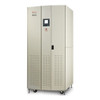
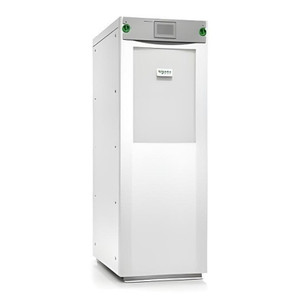
APC by Schneider Electric GVSUPS50K0B4HS Galaxy VS 50kW 3-Phase Online UPS
Overview
The APC by Schneider Electric Galaxy VS UPS — model GVSUPS50K0B4HS — is a 50kW (50kVA) three-phase double-conversion online UPS designed for medium to large commercial and industrial power protection applications. Rated at 400V with support for up to four internal 9Ah smart modular battery strings, this unit delivers zero-transfer-time protection through true online double-conversion topology, meaning your connected equipment never sees raw utility power — every watt passes through the inverter. For data centers, network closets, and critical facility loads where even a millisecond of transfer time is unacceptable, that architecture matters more than cost-per-watt.
The GVSUPS50K0B4HS targets environments running 3-phase distributed IT infrastructure, telecom head-end equipment, industrial automation, or mixed critical loads in the 40–50kW range. The modular internal battery string design supports phased capacity deployment — install what you need now, expand later without replacing the UPS chassis.
Key Features
- Double-Conversion (Online) Topology: The load is continuously powered by the inverter, not raw utility. There is no transfer switch delay — output is clean, conditioned sine wave regardless of input quality. For sensitive medical, financial, or industrial control loads, this eliminates the microsecond gap that can crash equipment on a standard line-interactive UPS.
- 50kW / 50kVA at Unity Power Factor: Output power factor of 1.0 means the kW and kVA ratings are identical — 50kW is the actual usable watts, not a derated figure. Many competing UPS units at 50kVA deliver only 40kW at 0.8 PF. Here you get the full nameplate in real working power, which simplifies load planning and avoids over-provisioning.
- Wide Input Voltage Range (340–460V): The UPS rides through input voltage swings from 340V to 460V before falling to battery. In regions or facilities with unstable utility feeds, this tolerance range significantly extends battery life by absorbing sags and swells on the inverter rather than switching to stored energy. Less battery cycling means longer battery service intervals.
- Input Power Factor of 0.99: A near-unity input power factor minimizes reactive current drawn from the utility feed, reducing stress on upstream wiring, switchgear, and distribution panels. In a 50kW installation, the difference between 0.99 and a typical 0.9 input PF translates directly to reduced panel and cable sizing requirements.
- Three-Phase Input and Output (3Ø/3Ø): Full three-phase in / three-phase out architecture — not a 3-phase input to single-phase output split. This maintains phase balance across the distribution system, which matters for large PDU-fed server rows, CNC equipment, and industrial drives where unbalanced phases cause thermal and efficiency penalties.
- Output Voltage THD ≤3%: Total harmonic distortion at the output is held below 3% under load. This is the threshold most variable-frequency drives, precision test equipment, and sensitive server PSUs require to avoid derating or fault conditions. Cheaper UPS designs often push 5–8% THD on the output, which degrades downstream equipment efficiency.
- 2.5:1 Crest Factor: The UPS handles peak-to-RMS load ratios up to 2.5:1, accommodating the high inrush currents typical of switching power supplies in server racks, motor starters, and UPS-fed PDUs without clipping or fault tripping.
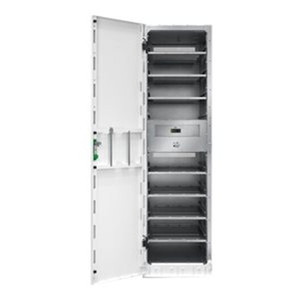
- Up to 4 Internal Modular 9Ah Battery Strings: The chassis supports up to four smart modular battery strings internally. This modular architecture means battery capacity scales independently of the power module — add strings as your backup runtime requirement grows, or replace individual strings without taking the entire UPS offline. The 'smart' battery management provides per-string monitoring and end-of-life alerts.
- Input Frequency Range 40–70Hz: The broad input frequency acceptance (40–70Hz) allows the unit to operate cleanly off diesel generators or utility feeds with frequency excursions, which is common during generator startup or in regions with less stable grid infrastructure. This avoids the UPS switching to battery unnecessarily during generator power events.
- Heat Dissipation 6,151 BTU/h: At full rated output, thermal load is approximately 6,151 BTU/h. Facilities planning room cooling should account for this in HVAC load calculations — at 50kW of IT load plus 6,151 BTU/h UPS waste heat, you are adding roughly 1.8 tons of cooling load from the UPS alone.
- Maximum Output Current 90A: The 90A maximum output current at 415V supports diverse load configurations without requiring transformer uprating for most standard 3-phase distribution panels in this power class.
Integration and Compatibility
The GVSUPS50K0B4HS operates across an output voltage range of 380–415V at 50 or 60Hz, making it compatible with standard European and international 3-phase distribution infrastructure. The unity output power factor and low output THD ensure compatibility with modern high-efficiency server PSUs, variable-frequency motor drives, and precision instrumentation that would reject dirtier waveforms.
For three-phase UPS systems in this power class, upstream infrastructure planning should confirm that the facility's input circuit supports up to 90A at 400V three-phase. The 340–460V input tolerance and 40–70Hz frequency window cover most generator and international utility scenarios without additional conditioning. Pair with compatible power distribution units rated for the output current and voltage to complete the downstream protection chain.
Organizations evaluating APC by Schneider Electric's Galaxy VS line should note that this SKU is configured for internal battery strings only — external battery cabinet configurations are separate SKUs in the Galaxy VS family. Review the UPS selection guide for runtime modeling and battery string sizing before committing to a configuration.
Frequently Asked Questions
Q: What is the actual usable wattage of the GVSUPS50K0B4HS?
A: The GVSUPS50K0B4HS delivers 50,000W (50kW) at a unity output power factor of 1.0. The kVA and kW ratings are identical — 50kVA and 50kW — so there is no derating. You get the full 50kW in real working power.
Q: Does this UPS support three-phase output or does it convert to single-phase?
A: The GVSUPS50K0B4HS provides true three-phase input and three-phase output. It does not convert to single-phase. This maintains phase balance for 3-phase distributed loads including server rows, industrial equipment, and large PDU-fed installations.
Q: How many battery strings can the GVSUPS50K0B4HS support internally?
A: The chassis supports up to four internal 9Ah smart modular battery strings. These can be installed incrementally — you are not required to populate all four positions at installation. Each string is independently monitored for health and end-of-life status.
Q: What input voltage range does the GVSUPS50K0B4HS accept?
A: The unit accepts input voltages from 340V to 460V three-phase at 40–70Hz. This range covers standard 400V European utility feeds and accommodates voltage sags, swells, and generator frequency excursions without unnecessarily switching to battery.
Q: What is the output voltage THD of the GVSUPS50K0B4HS?
A: Output total harmonic distortion is rated at 3% or less. This meets the threshold required by most variable-frequency drives, server PSUs, and precision equipment. Higher THD from lower-quality UPS designs can cause downstream equipment to derate or fault.
Q: What is the UPS topology of the GVSUPS50K0B4HS — is there a transfer time on utility failure?
A: The GVSUPS50K0B4HS uses double-conversion (online) topology. The load is always powered by the inverter; there is no transfer time on utility failure. Output power never passes directly from the utility to the load, eliminating the millisecond gap present in line-interactive or standby designs.