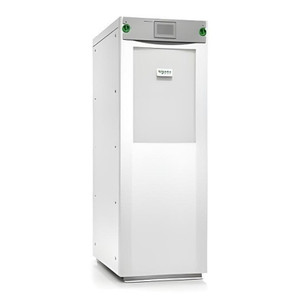
APC by Schneider Electric GVSUPS50KB4HS Galaxy VS 50kW 3-Phase Online UPS
Overview
The APC by Schneider Electric GVSUPS50KB4HS is a 50kW (50 kVA) three-phase, double-conversion online UPS designed for data centers, critical IT infrastructure, industrial control rooms, and large-scale building management systems where a momentary power interruption is simply not acceptable. Unlike standby or line-interactive designs that transfer to battery only when utility power fails, the Galaxy VS operates in continuous double-conversion mode — utility AC is rectified to DC and re-inverted to a clean sine wave at all times. Your critical loads never see raw utility power. This architecture eliminates the transfer gap and means the output is always conditioned regardless of what happens upstream.
With a three-phase UPS topology rated at 50,000W of output power and a unity power factor output, the GVSUPS50KB4HS can power the same load with less apparent power overhead compared to older 0.8 pF designs — a real cost advantage when sizing circuits and transformers. The Galaxy VS is part of the broader APC by Schneider Electric power protection line, a catalog that spans from small rack UPS units to large modular systems for hyperscale deployments.
Key Features
- Double-Conversion (Online) Topology: The Galaxy VS continuously regenerates a clean sine wave output regardless of input condition. There is no transfer time when utility power fails — your servers, storage, and networking equipment never experience a switching transient. For network infrastructure and storage arrays where even 4ms of interruption can cause filesystem corruption, this is the topology to specify.
- 50kW / 50 kVA Output at Unity Power Factor: 50,000W of real output power means you're not losing capacity to power factor penalty. A 0.8 pF unit rated 50 kVA delivers only 40kW — this unit delivers the full 50kW. Size your protected load accordingly and avoid over-buying UPS capacity.
- Wide Input Voltage Range (340–460V): The Galaxy VS accepts input from 340V to 460V at three-phase, accommodating voltage sag and swell conditions common in industrial facilities and older commercial buildings without switching to battery unnecessarily. Fewer battery discharge cycles means longer battery service life and lower replacement costs over the system's operating life.
- Input Frequency Tolerance (40–70 Hz): An unusually wide input frequency window makes the GVSUPS50KB4HS compatible with generator power — generators frequently run off-frequency during startup and load transitions. You won't need a separate voltage regulator between your genset and UPS.
- ECO Mode: When utility power quality is within acceptable bounds, ECO mode routes input power through a bypass path with minimal conversion loss, improving efficiency. For facilities where the utility supply is stable and clean, ECO mode reduces heat dissipation and lowers operating cost. The unit switches back to full double-conversion automatically if power quality degrades.
- 0.99 Input Power Factor: Drawing near-unity power factor from the utility supply means the GVSUPS50KB4HS places minimal reactive load on your facility's electrical distribution. This matters when you have tightly loaded PDUs or when your utility tariff includes power factor penalties.
- 61 dB Noise Level: At 61 dB, the Galaxy VS is suitable for installation in semi-open data hall environments and server rooms adjacent to occupied office space. It is not whisper-quiet, but it won't dominate the noise floor of a properly ventilated server room.
- 6,151 BTU/h Heat Dissipation: Plan your cooling accordingly. At full load, the Galaxy VS contributes roughly 6,150 BTU/h to the room heat load — approximately the output of a 0.5-ton AC unit. Factor this into your CRAC unit sizing and hot-aisle/cold-aisle layout.
- Expandable Smart Modular Battery Strings: The unit ships with 2 internal 9Ah smart modular battery strings. Runtime can be extended by adding external battery modules without replacing the UPS itself. For installations where runtime requirements may evolve — phased data center buildouts, disaster recovery sites with extended hold-time requirements — the expandable battery architecture avoids a costly forklift upgrade later.
- 2.5:1 Crest Factor: A 2.5:1 crest factor rating means the Galaxy VS can handle non-linear loads — switching power supplies, variable frequency drives, UPS rectifiers — without clipping or distorting the output waveform. Most enterprise IT loads are highly non-linear; this spec confirms the unit handles them correctly.
- Three-Phase Input and Output: Both input and output are three-phase, making this a natural fit for three-phase PDUs and three-phase distribution panels common in data centers rated above 20kW per row.
Integration & Compatibility
The Galaxy VS is designed to integrate into standard three-phase electrical distribution at 400V nominal (380–415V output). For organizations running PoE switch infrastructure or high-density compute, pairing the GVSUPS50KB4HS with downstream three-phase PDUs and monitored outlets gives you per-outlet consumption visibility alongside UPS-level power protection. The wide input frequency range (40–70 Hz) makes the unit generator-compatible out of the box — a key requirement for sites with diesel or natural gas backup generation. Smart battery management via the modular battery string architecture supports battery health monitoring, simplifying maintenance scheduling and reducing the risk of a battery failure going undetected in a large installation.
Frequently Asked Questions
Q: What is the output power capacity of the GVSUPS50KB4HS?
A: The Galaxy VS GVSUPS50KB4HS provides 50,000W (50kW / 50 kVA) of output power at unity power factor across three-phase output at 380–415V.
Q: Does the GVSUPS50KB4HS support generator input?
A: Yes. The unit accepts input frequencies from 40Hz to 70Hz, which covers the off-frequency conditions typical of generators during startup and load changes, making it compatible with diesel and gas generator backup systems without additional frequency conditioning.
Q: Can I expand the battery runtime beyond what ships with the unit?
A: Yes. The GVSUPS50KB4HS ships with 2 internal 9Ah smart modular battery strings and supports external battery module expansion. This allows runtime to be increased as site requirements change without replacing the UPS chassis.
Q: What is the input voltage range for the GVSUPS50KB4HS?
A: The unit accepts three-phase input from 340V to 460V, providing tolerance for voltage sag and swell conditions common in industrial and older commercial electrical infrastructure.
Q: What does ECO mode do on the Galaxy VS, and when should I use it?
A: ECO mode reduces energy conversion losses by routing power through a high-efficiency bypass path when utility power quality is stable. It's appropriate for facilities with a clean, stable utility supply. The UPS returns to full double-conversion automatically if power quality degrades, so there's no manual intervention required.
Q: How much heat does the GVSUPS50KB4HS add to my room cooling load?
A: At full output load, the unit dissipates approximately 6,151 BTU/h. This should be factored into CRAC unit sizing and hot-aisle/cold-aisle thermal planning for the room.
The GVSUPS50KB4HS is one of the configurations I'd point to first for mid-size data center deployments sitting between 30kW and 60kW of protected load — specifically because the unity power factor output means you're getting 50,000W of real power, not 40kW masked by a 0.8 pF derating that catches engineers off guard at load time. The 0.99 input power factor is equally clean on the source side, which matters if your facility has power factor penalty clauses in its utility tariff or if you're running near the limits of your service entrance breaker.
Technical Highlights:
- 340–460V Input Range: This is wider than many competing three-phase online UPS units at this power class. In practice it means the Galaxy VS rides through most utility sag events without touching the battery, extending battery service intervals significantly in markets with variable grid quality.
- 40–70 Hz Frequency Acceptance: Generator compatibility without additional conditioning equipment. Most enterprise-grade UPS units accept 45–55 Hz at best; this unit's 30Hz window gives you margin during generator ramp-up and frequency hunting under variable load.
- 2 Internal 9Ah Smart Modular Battery Strings, Expandable: The smart battery architecture means battery state-of-health is monitored continuously, not just checked at periodic manual tests. Combined with the expandable string design, you can add runtime capacity in place without a UPS replacement cycle — useful for facilities that are phasing in additional compute over 18–36 months.
Deployment Considerations:
- At 6,151 BTU/h full-load heat dissipation, plan for dedicated cooling capacity in the UPS room or in the hot aisle. Don't assume the room's general HVAC handles it — model the thermal load explicitly before commissioning.
- The 61 dB operating noise level is manageable in a server room but is audible in a quiet environment. If the UPS is installed in a shared mechanical room adjacent to office space, verify acoustic isolation meets occupant comfort requirements before finalizing placement.
The GVSUPS50KB4HS is a strong specification for colocation edge pods, campus data centers running 3-phase distribution at 400V, and industrial automation control rooms where generator-backed power is the primary resilience strategy and runtime extensibility needs to keep pace with future load growth.