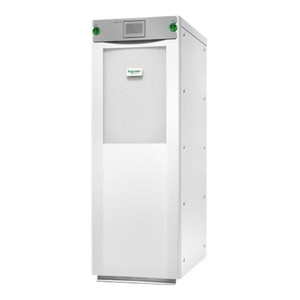
APC by Schneider Electric GVSUPS30K0B4HS Galaxy VS 30kW 400V Modular Online UPS
Overview
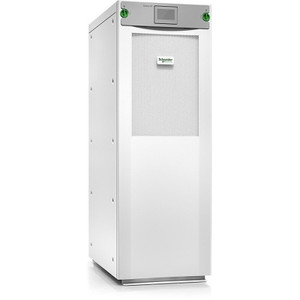
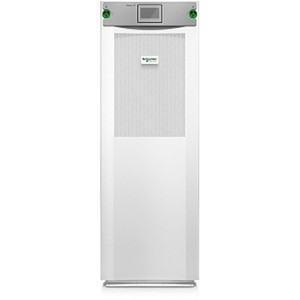
The APC by Schneider Electric GVSUPS30K0B4HS is a 30 kW (30 kVA) three-phase double-conversion online UPS designed for medium-density data centers, critical infrastructure rooms, and enterprise power distribution deployments running 400V three-phase power. Built around a true online double-conversion topology, it delivers continuously clean, regulated output power — every connected load runs off inverter-derived AC at all times, so grid noise, sags, swells, and transients never reach your equipment. Support for up to four internal 9Ah smart modular battery strings means runtime can be scaled incrementally without external battery cabinets, keeping the footprint compact as capacity grows. Internal links to the three-phase UPS category and the broader APC by Schneider Electric power lineup are worth reviewing alongside this product page.
Key Features
- Double-Conversion Online Topology: Unlike line-interactive or standby designs, true double-conversion means the load is always running from the inverter — there is zero transfer time on utility failure. For servers, storage arrays, and network infrastructure where even a 4ms gap can cause a reboot or data write error, this is the topology that eliminates the risk entirely.
- 30 kW / 30 kVA Output at Unity Power Factor: A 30 kW output capacity with a 1.0 output power factor means every VA of UPS capacity delivers a full watt to the load. Many competing units at this class are rated at 0.9 PF, so you'd need a 33 kVA unit to match 30 kW of real load capacity. No oversizing required here.
- 0.99 Input Power Factor: Drawing from the utility grid at 0.99 input PF minimizes reactive current demand — a meaningful factor when utility billing includes power factor penalties or when the upstream generator or PDU has a constrained kVA rating. Less reactive draw also reduces harmonic heating in distribution transformers.
- Wide Input Voltage Window (340–460V): The UPS accepts input from 340V to 460V three-phase before switching to battery. In facilities with noisy or regulated-light distribution, this range absorbs voltage swings that would otherwise trigger unnecessary battery discharge, extending battery service life.
- Input Frequency Range 40–70Hz: Accepting 40–70Hz input means this unit can operate on generator sets with governor droop or frequency excursions outside the standard 50/60Hz ±2Hz tolerance. Critical for generator-backed installations where the gen-set spins up at variable frequency under load step.
- ECO Mode for Efficiency Optimization: When grid quality is within tolerance, ECO mode routes power through a high-efficiency bypass path rather than full double-conversion, reducing heat output and operating costs. Full double-conversion re-engages automatically on any power quality event — you get efficiency savings without sacrificing protection when it counts.
- Output Voltage Regulation ±1%: Tightly regulated output at ±1% means sensitive IT and instrumentation loads see stable voltage regardless of load fluctuation or input disturbance. Loose regulation (±5%) causes repeated micro-reboots on voltage-sensitive server platforms; 1% keeps them stable.
- Output THD ≤3%: Three-percent total harmonic distortion on the output waveform is well within the tolerance of virtually all commercial IT equipment (most specify ≤5%). Clean sine output protects power supplies from elevated operating temperatures caused by harmonic currents — a direct factor in MTBF for rectifiers and capacitors.
- Up to 54A Maximum Output Current: At 30 kW / 400V three-phase, the 54A maximum current rating aligns precisely with the power capacity — no derating surprises when driving loads near full capacity on standard three-phase distribution.
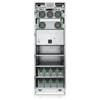
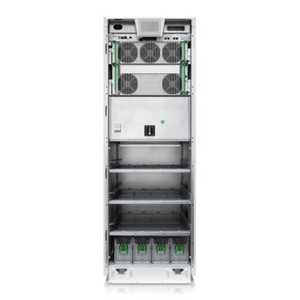
- Modular Internal Battery Scaling (up to 4 Strings): Supporting up to four internal 9Ah smart battery strings lets you add runtime capacity without a separate external battery cabinet. Start with the strings you need at commissioning, add more as runtime requirements evolve — no additional floor space, no external cable runs.
- 2.5:1 Crest Factor Tolerance: A crest factor rating of 2.5:1 means the UPS can handle loads with high peak-to-RMS current ratios — typical of switch-mode power supplies, variable-frequency drives, and unfiltered rectifier front-ends — without the inverter clipping or thermally stressing the output stage.
- Three-Phase Input and Output: Balanced three-phase input and output enables direct integration into three-phase distribution panels and PDUs without phase-to-neutral tapping. Proper three-phase PDU selection upstream and downstream should be part of your pre-commissioning load balancing review.
Integration and Compatibility
The GVSUPS30K0B4HS operates on 400V three-phase input and delivers a regulated 380–415V three-phase output, making it compatible with European and international 400V distribution infrastructure. The 50/60Hz output frequency flexibility allows deployment in either 50Hz (European, Asian) or 60Hz (North American with step-up transformer) environments. Before finalizing the installation, confirm upstream breaker sizing against the 54A maximum current draw at full load. For complete power chain planning — from UPS through PDU to rack — review the power protection planning guide. Battery string configuration should be validated against the target runtime requirement at the actual load percentage; runtime at 30 kW full load will differ from runtime at 15–20 kW partial load, which is the more common real-world operating point in mixed server environments. Consult APC's runtime curves (available via the manufacturer's product page) for string-count-versus-runtime tables.
Frequently Asked Questions
Q: What UPS topology does the GVSUPS30K0B4HS use?
A: It uses true double-conversion online topology. The load runs from the inverter 100% of the time — there is zero transfer time on utility failure, which eliminates the brief power gap that line-interactive and standby UPS designs have.
Q: What is the real-power (watt) capacity of the GVSUPS30K0B4HS?
A: The unit is rated at 30,000W (30 kW) output. Because the output power factor is 1.0, the kVA rating is also 30 kVA — no derating gap between watts and volt-amperes.
Q: How many battery strings does the GVSUPS30K0B4HS support and can they be added later?
A: The unit supports up to four internal 9Ah smart modular battery strings. Additional strings can be installed after initial deployment, so you can start with fewer strings and expand runtime capacity without adding external battery cabinets.
Q: What input voltage range does the GVSUPS30K0B4HS accept before switching to battery?
A: The UPS accepts 340V to 460V three-phase input before transferring to battery, providing a wide window that accommodates typical utility voltage fluctuations and reduces unnecessary battery cycling.
Q: Does the GVSUPS30K0B4HS support ECO mode and what does that mean for efficiency?
A: Yes, ECO mode is supported. When grid power quality is within acceptable limits, ECO mode routes power through a high-efficiency bypass path to reduce energy consumption. The unit automatically reverts to full double-conversion protection if power quality degrades.
Q: Can the GVSUPS30K0B4HS operate with a generator as the input source?
A: The 40–70Hz input frequency acceptance range makes it compatible with generator sets that may exhibit frequency droop or excursions during load steps — a practical consideration for generator-backed critical infrastructure deployments.
The GVSUPS30K0B4HS sits in the sweet spot for mid-density three-phase deployments — 30 kW of double-conversion capacity with an 0.99 input power factor that keeps your upstream distribution clean. I want to call out the 340–460V input window specifically: in facilities where utility voltage regularly rides the low end of tolerance or generator-backed circuits drift during load steps, that window prevents the UPS from hammering its own batteries on what are essentially non-events. A 300–320V window would give you nuisance transfers; 340–460V does not.
Technical Highlights:
- Double-Conversion Topology: Zero transfer time on loss of utility — the inverter is always carrying the load, so there is no gap-induced reboot risk for storage arrays or transaction-processing servers.
- 30 kW at Unity Output PF: Unlike 0.9 PF designs that derate to ~27 kW at 30 kVA nameplate, this unit delivers the full 30,000W to the load — relevant when you are sizing against a real IT load manifest rather than a nameplate number.
- Output THD ≤3% / Voltage Regulation ±1%: Both specs are tighter than the typical commercial requirement of 5% THD and ±3%, which translates directly to lower thermal stress on connected PSU rectifiers and fewer marginal power-related errors on voltage-sensitive instrumentation.
Deployment Considerations:
- The unit accepts up to four 9Ah internal battery strings — confirm your target runtime at actual operating load (not nameplate) before commissioning. Runtime at 15 kW (50% load) will be roughly double that at full 30 kW; plan string count accordingly.
- ECO mode improves efficiency but introduces a finite bypass path — verify with your IT security or compliance team whether ECO mode is permissible in your environment, as some standards (Tier IV DCIM specs, certain financial-sector requirements) mandate 100% double-conversion at all times.
The GVSUPS30K0B4HS is a well-matched fit for medium-density colocation rows, enterprise server rooms, and manufacturing plant control-room power distribution where three-phase 400V infrastructure is already in place and the team needs scalable internal runtime without external battery cabinet sprawl.