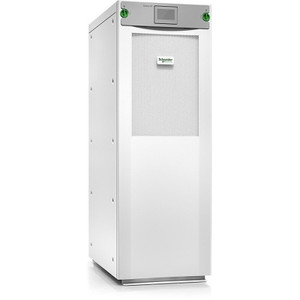
APC by Schneider Electric GVSUPS30KB4HS Galaxy VS 30kW 3-Phase Online UPS
Overview
The APC by Schneider Electric GVSUPS30KB4HS is a 30 kW (30 kVA) double-conversion online UPS engineered for three-phase commercial and industrial power protection. Built on the Galaxy VS platform, it targets data centers, network closets, and critical infrastructure deployments where power quality directly affects uptime — not just during outages, but under the everyday voltage sags, swells, and harmonic distortion that degrade sensitive electronics over time. If you're specifying power protection for a multi-rack server environment, building management system, or industrial control infrastructure running at 400V three-phase, the GVSUPS30KB4HS belongs on the short list.
Unlike line-interactive designs that switch to battery only during significant deviations, a double-conversion (online) topology continuously regenerates a clean sine wave output from the inverter — your load never touches raw utility power. The result is true galvanic isolation from the grid: frequency variations, harmonics, and transients are stripped before they reach your equipment.
Key Features
- Double-Conversion (Online) Topology: The inverter is always in the power path — load equipment runs entirely on conditioned power 100% of the time. Transfer time to battery on mains failure is zero milliseconds, which matters for sensitive servers, storage arrays, and process controllers that fault on even a brief interruption.
- 30 kW / 30 kVA Output at Unity Power Factor: A 1:1 kW-to-kVA ratio means no derating against modern server loads that present near-unity power factor. You get the full 30 kW you're paying for, not a fraction after power factor correction losses.
- 3-Phase Input and Output (380–415 V out / 340–460 V in): The wide 340–460 V input operating window handles real-world utility variance — useful in regions or facilities where voltage regulation is inconsistent. The 380–415 V output range covers standard European and international three-phase distribution, making this a solid fit for 400 V TN-S or TN-C-S systems.
- 0.99 Input Power Factor with 3% THD: Drawing current at near-unity power factor (0.99) and injecting only 3% total harmonic distortion back onto the input feed are both meaningful spec wins for facilities with shared electrical infrastructure. Low THD means the UPS won't interfere with other equipment on the same distribution panel or exceed harmonic limits in buildings with strict power quality requirements.
- ECO Mode: When utility power is within tolerance, ECO mode routes the load through a static bypass with passive filtering — efficiency climbs significantly while still maintaining fast automatic transfer back to double-conversion if conditions deteriorate. This translates directly to lower PUE in environments where efficiency metrics matter.
- 2.5:1 Crest Factor: A 2.5:1 crest factor rating means the UPS handles loads with high peak-to-RMS current ratios — common with switching power supplies in server racks. Undersized crest factor headroom causes output voltage distortion under load; 2.5:1 is a respectable margin for mixed IT environments.
- 40–70 Hz Input Frequency Acceptance: The wide input frequency window (40–70 Hz) accommodates generator sets, which commonly run slightly off nominal frequency during startup and load transients. This makes the GVSUPS30KB4HS generator-compatible without requiring manual reconfiguration.
- Pure Sine Wave Output: Output is a true sine waveform — not simulated or stepped — which is the correct choice for any load with active power factor correction (APFC), motor drives, or medical/industrial equipment that specifies sine wave input. Modified sine or quasi-sine outputs can damage or cause malfunctions in these load classes.
- 61 dB Noise Level: At 61 dB(A), this unit is comparable to a normal conversation level. Relevant when the UPS is co-located with personnel in a shared equipment room rather than a dedicated, acoustically isolated data hall.
- 54 A Maximum Output Current: At 30 kW into a 415 V three-phase load, the 54 A maximum per phase gives you a clear wire sizing reference. Confirm breaker and cable ratings against this figure during panel design — the UPS will deliver up to 54 A continuous per phase under rated conditions.
Integration and Compatibility
The three-phase UPS category covers a broad range of topologies and form factors; the Galaxy VS sits in the mid-range commercial/light-industrial segment within the broader APC by Schneider Electric power protection lineup. For deployments using a building management system (BMS) or data center infrastructure management (DCIM) platform, verify the communication card options for the Galaxy VS platform — network management cards enable SNMP, Modbus, and remote monitoring integration that most enterprise DCIM tools expect. Pair with an appropriately sized power distribution unit (PDU) on the output side to distribute three-phase power to individual racks without single-phase overload risk. For facilities running surveillance infrastructure at scale, reviewing a UPS selection and sizing guide before finalizing runtime requirements will prevent undersizing against actual runtime targets — battery autonomy is determined by the external battery modules attached, not the internal batteries alone at this power class.
Frequently Asked Questions
Q: What is the difference between the GVSUPS30KB4HS and a line-interactive UPS at the same power level?
A: The GVSUPS30KB4HS uses double-conversion (online) topology, meaning the inverter continuously regenerates output power from the DC bus — the load never sees raw utility power. Line-interactive designs only switch to battery when voltage drifts outside a window, leaving the load exposed to harmonics and transients under normal conditions. For sensitive three-phase loads like servers, storage, and process controllers, double-conversion is the correct topology choice.
Q: Is the GVSUPS30KB4HS compatible with generator input power?
A: Yes. The wide input frequency acceptance range of 40–70 Hz is specifically suited to generator operation, where frequency can deviate during startup, load transfer, and load transients. The unit does not require reconfiguration to accept generator input within this range.
Q: What does ECO mode do on the GVSUPS30KB4HS, and when should it be disabled?
A: ECO mode routes the load through a static bypass path with passive filtering when utility power quality is within tolerance, increasing efficiency. If your load requires zero transfer time or your facility has chronically poor power quality (frequent voltage sags, frequent switching events), ECO mode should be disabled so the unit stays in full double-conversion at all times.
Q: What is the input harmonic distortion (THD) of the GVSUPS30KB4HS?
A: The GVSUPS30KB4HS draws current with an input power factor of 0.99 and injects 3% total harmonic distortion (THD) back onto the input feed. This is a low THD figure that keeps the UPS compliant with most facility power quality standards and avoids interfering with other equipment on shared distribution infrastructure.
Q: What output voltage range does the GVSUPS30KB4HS support?
A: The output operating voltage range is 380–415 V (three-phase), which covers standard 400 V international three-phase distribution systems. Input operating voltage spans 340–460 V, providing significant headroom for utility variance without transferring to battery.
Q: Does the GVSUPS30KB4HS support three-phase input and output?
A: Yes — the GVSUPS30KB4HS is a three-phase input, three-phase output UPS rated at 30 kW / 30 kVA. It is not suitable as a single-phase UPS and requires three-phase electrical infrastructure on both the input feed and output distribution side.
The GVSUPS30KB4HS is a 30 kW double-conversion online UPS that I'd specifically recommend for deployments where both power quality and generator compatibility are requirements — and those two needs come up together more often than people expect. The 40–70 Hz input frequency window is the spec that seals it for generator-backed facilities; most UPS units in this class need manual configuration or firmware changes to tolerate the frequency excursions generators produce during load pickup. This one handles it natively.
Technical Highlights:
- 0.99 Input Power Factor / 3% THD: Practically no reactive current drawn from the input feed, and 3% THD injected back — both figures keep you clear of facility harmonic limits and avoid nuisance tripping on sensitive input protection devices upstream.
- 30 kW at Unity Output Power Factor: Modern server and storage loads sit close to unity PF. A 1:1 kW-to-kVA rating means no capacity is lost to derating — 30 kW of real usable power, not a nominal figure that shrinks under real load conditions.
- 2.5:1 Crest Factor: Switching power supplies in dense server racks pull high peak currents relative to their RMS draw. A 2.5:1 crest factor rating means the inverter can handle those peaks without output voltage distortion — a spec that gets overlooked until you commission a fully loaded rack and see waveform quality degrade.
Deployment Considerations:
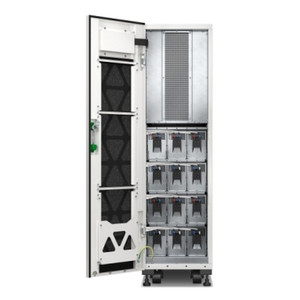
- The two internal 9 Ah batteries in the GVSUPS30KB4HS provide limited runtime at 30 kW — plan for external battery module (EBM) strings if your runtime target exceeds a few minutes. Size the battery cabinet configuration against actual load and target autonomy before procurement, not after installation.
- At 61 dB(A), this unit is audible in shared spaces. If the UPS will be in a room with permanent staff rather than a sealed equipment room, account for acoustic treatment or physical separation in the room layout.
The GVSUPS30KB4HS is the right call for a 400 V three-phase data hall or equipment room where generator backup is in the power path and you need a UPS that handles generator frequency excursions without manual intervention — combined with the 0.99 input PF and 3% THD, it's a clean fit for facilities with strict power quality requirements on shared distribution infrastructure.