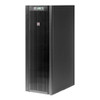
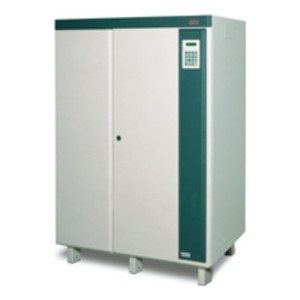
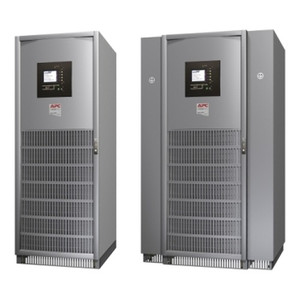
APC by Schneider Electric GVSUPS40KB4HS Galaxy VS 40kW 3-Phase Online UPS
Overview
The APC by Schneider Electric GVSUPS40KB4HS is a 40kW (40 kVA) three-phase, double-conversion online UPS designed for data centers, server rooms, and mission-critical commercial installations where power anomalies cannot be tolerated. Double-conversion topology means the load runs on fully conditioned power at all times — incoming AC is rectified to DC, then re-inverted to clean AC — so utility swells, sags, spikes, and harmonics never reach connected equipment. This is not a standby or line-interactive unit with transfer-time gaps; the load is continuously isolated from the grid at the inverter stage.
With a 400V three-phase input and output architecture, the three-phase UPS slots into standard European and international distribution panels without transformer intervention. Two factory-installed 9 Ah smart modular battery strings ship installed, and the design supports expansion with additional battery modules — allowing runtime to scale as the protected load grows or runtime requirements change, without replacing the base unit.
Key Features
- Double-Conversion Online Topology: Unlike standby or line-interactive designs, double-conversion provides zero transfer time on mains failure — the inverter is always carrying the load, so there is no gap between utility loss and battery support. For servers, network switches, and storage arrays, this eliminates the transfer-time risk that causes unexpected reboots or data corruption during brief outages.
- 40kW / 40 kVA Output Capacity: Handles up to 40,000W of connected load at unity power factor — sized for mid-tier network infrastructure, dense server deployments, or multi-rack consolidations. Running at 60–80% of rated capacity (24–32kW) gives thermal headroom and prolongs inverter life compared to running continuously at ceiling.
- 3% Input THD: Input current total harmonic distortion of 3% is well within IEEE 519 limits and will not stress upstream generators or distribution transformers. Sites with generator backup will appreciate this — high-THD UPS units can cause generator hunting and overheating on weaker gensets.
- Wide Input Voltage Window (340–460V): Accepts input anywhere from 340V to 460V three-phase before switching to battery. On sites with chronic voltage sag or utility instability, a wide window means the unit rides through browndowns on mains rather than cycling batteries unnecessarily — battery cycles are preserved for genuine outages.
- ECO Mode: When grid power is stable and within spec, ECO mode bypasses the rectifier/inverter stage and passes power through at high efficiency, typically reducing losses significantly versus continuous double-conversion. The unit monitors for anomalies and switches back to full conversion in milliseconds. For 24/7 installations, the energy savings over a year are material — worth calculating against site utility costs.
- Expandable Modular Battery Strings: Ships with two 9 Ah smart modular battery strings. Additional strings can be added without replacing the UPS chassis, allowing runtime to be extended as budgets allow or load profiles change. Battery management is handled intelligently — the unit monitors each string independently, which simplifies capacity planning and maintenance scheduling.
- 2.5:1 Crest Factor: A crest factor rating of 2.5:1 means the inverter handles loads with high peak-to-RMS current ratios — common with switching power supplies in servers and network gear — without clipping or output voltage distortion. Lower crest factor ratings (e.g., 1.5:1 common in cheaper units) can cause output distortion under real-world IT loads.
- 54A Maximum Output Current: At 40kW / 400V three-phase, the 54A maximum output current determines downstream circuit breaker sizing and PDU specifications. Confirm distribution panel and PDU ratings match before installation — this is a detail that gets missed in rack planning and causes commissioning delays.
- 61 dB Noise Level: Measured at 61 dB — audible in a quiet office environment but within normal range for a 40kW three-phase unit of this class. Plan installation in a dedicated equipment room or data center floor rather than adjacent to occupied workspace.
- 4,658 BTU/h Heat Dissipation: At full load, the unit dissipates 4,658 BTU/h. For a server room with existing cooling, factor this into the total room heat load for HVAC sizing — the UPS alone is roughly equivalent to adding a 1.4-ton heat load at continuous full operation.
- 50/60 Hz Output Frequency: Supports both 50 Hz and 60 Hz output — relevant for sites operating mixed international equipment or facilities in regions where frequency standard varies.
- Sine Wave Output: True sine wave output on both battery and bypass ensures compatibility with any AC load, including equipment with active power factor correction (APFC) power supplies — a requirement for modern server PSUs that cannot tolerate modified sine or stepped approximations.
Integration and Compatibility
The Galaxy VS platform is designed to integrate with building management systems and data center infrastructure management (DCIM) platforms via standard communication interfaces. The three-phase 400V architecture aligns with IEC distribution standards used throughout Europe, the Middle East, Asia-Pacific, and international deployments. For NVR and surveillance infrastructure installations with high continuous power draws, the 40kW capacity accommodates large multi-camera recording arrays alongside associated network and storage equipment. Pair with compatible three-phase distribution units and automatic transfer switches for a complete power protection architecture. Consult the APC Galaxy VS compatibility matrix for supported network management cards and communication protocols before specifying accessory modules.
Frequently Asked Questions
Q: What is the topology of the GVSUPS40KB4HS — is it a true online UPS?
A: Yes. The GVSUPS40KB4HS uses double-conversion (online) topology, meaning the load runs continuously on inverter-generated power. There is no transfer time on utility failure — the inverter is always active. This is the highest-protection UPS topology available.
Q: Can the battery runtime be expanded after initial installation?
A: Yes. The unit ships with two 9 Ah smart modular battery strings and supports additional battery module expansion. This allows runtime to be scaled without replacing the base UPS chassis.
Q: What is the input voltage range and will it work with generators?
A: The GVSUPS40KB4HS accepts three-phase input from 340V to 460V. Its 3% input THD rating makes it compatible with generator power — low THD prevents generator overloading and hunting issues that affect higher-THD UPS units.
Q: Does ECO mode affect the quality of output power delivered to connected equipment?
A: In ECO mode the unit passes conditioned utility power through at higher efficiency. It monitors continuously and switches to full double-conversion within milliseconds if it detects any anomaly. ECO mode is appropriate for stable utility environments where efficiency is a priority.
Q: What are the cooling and space requirements for this unit?
A: The unit dissipates 4,658 BTU/h at full load and produces 61 dB of noise. It requires a controlled environment — plan for dedicated equipment room installation and factor the heat output into room HVAC capacity calculations.
Q: Is the output waveform compatible with servers using active power factor correction (APFC) power supplies?
A: Yes. The GVSUPS40KB4HS delivers a true sine wave output on both battery and bypass modes, which is required for correct operation of server and networking equipment with APFC power supplies.
The GVSUPS40KB4HS is the unit I reach for when a site needs 40kW of three-phase protection and the load profile includes server PSUs with active PFC — the true sine wave output and 2.5:1 crest factor handle those loads cleanly where cheaper units introduce output distortion. The 3% input THD is the other spec that matters on generator-backed sites: I've seen high-THD UPS units cause generator hunting and thermal trips that the facility team misdiagnoses as a generator fault. At 3% THD, the Galaxy VS won't be the problem.
Technical Highlights:
- Double-Conversion Topology: Continuous inverter operation means zero transfer time on mains failure — no gap, no reboot risk for connected servers or storage. The load never sees the utility directly.
- 340–460V Input Window: A 120V swing on the input window means the unit rides through voltage sags and swells on mains rather than switching to battery unnecessarily — battery cycles are finite, and conserving them extends service intervals.
- 4,658 BTU/h Heat Load: At full capacity this is roughly 1.4 tons of heat — a number that must be included in HVAC load calculations from day one. I've seen commissioning delays caused by HVAC that was spec'd before the UPS heat load was added to the room budget.
Deployment Considerations:
- The 54A maximum output current sets hard requirements on downstream PDU and circuit breaker ratings — verify your distribution panel and rack PDUs are rated accordingly before the unit arrives on site.
- At 61 dB the unit is not suitable for open office or low-noise environments — plan for a dedicated equipment room with appropriate acoustic separation from occupied spaces.
This unit is well-matched to a mid-density data center or large server room build-out — particularly international or European sites on 400V three-phase infrastructure — where the combination of true double-conversion, low THD, and modular battery expansion eliminates the need to replace the base unit as the protected load grows.