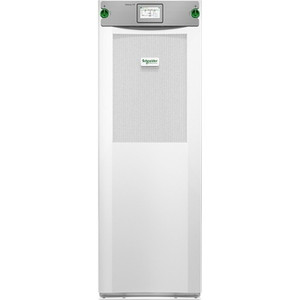
APC by Schneider Electric GVSUPS20K0B4HS Galaxy VS 20kW 3-Phase Online UPS
Overview
The APC by Schneider Electric GVSUPS20K0B4HS is a 20kW (20 kVA) double-conversion online UPS designed for three-phase commercial and industrial power protection applications. Built around a true online double-conversion topology, it places a continuous power conditioning barrier between your load and the utility — meaning your connected equipment never runs directly off raw mains power, even for a millisecond. That matters in environments where voltage swings, frequency instability, and harmonic distortion are real risks: server rooms, datacenter edge deployments, manufacturing control systems, and broadcast or surveillance infrastructure with high-availability requirements.
Rated for 400V nominal input across a 384V–480V operating window, the GVSUPS20K0B4HS handles the normal variation in European and international three-phase distribution without requiring manual tap changes. It supports up to four internal 9Ah smart modular battery strings, giving you scalable runtime capacity within the same chassis footprint.
Key Features
- Double-Conversion (Online) Topology: Unlike line-interactive UPS systems that only intervene on sag or surge, double-conversion continuously regenerates output power from DC — your load sees a clean, stable 400V sine wave regardless of what's happening upstream. For sensitive equipment like PLCs, medical imaging systems, or IP surveillance NVRs, this eliminates the transfer time gap that line-interactive units introduce during switchover.
- 20kW / 20 kVA at Unity-Adjacent Power Factor (0.99): A 0.99 power factor means almost the entire kVA rating converts to usable kW — you get 20kW of real working capacity from a 20 kVA unit. Older UPS designs with 0.8 PF would only deliver 16kW from the same kVA nameplate. That 4kW difference is real headroom you can fill with equipment rather than oversizing the UPS.
- Wide Input Voltage Window (384V–480V, 40–70 Hz): The broad input acceptance range reduces how often the unit has to fall back to battery during utility fluctuations. In facilities where voltage rides low during peak demand (384V is notably tolerant), the inverter stays online rather than draining the batteries unnecessarily — extending battery service life over time.
- Low Input THD (≤3%): At 3% input current Total Harmonic Distortion, the GVSUPS20K0B4HS pulls clean current from the building distribution system. High-THD UPS units (common in older ferro-resonant or line-interactive designs) inject harmonic noise back into the building bus, which can cause nuisance tripping on other breakers and degrade shared power quality. This unit won't do that.
- Low Output THD (≤3%): Output voltage distortion is held to 3% under load — well within the tolerance bands for most sensitive electronics and compliant with IEC 62040-3 Class 1 requirements. For equipment with switch-mode power supplies, high output THD causes unnecessary heat and increased component stress. 3% keeps that risk negligible.
- ECO Mode for Efficiency Optimization: ECO mode allows the UPS to pass utility power through with a bypass path when line quality is within acceptable bounds, switching to full conversion only when needed. Facilities running this unit 24/7 can realize meaningful efficiency gains and lower operating temperatures in ECO mode — relevant in any deployment where the unit runs continuously for years.
- High Crest Factor (2.5:1): A 2.5:1 crest factor means the UPS can handle peak inrush currents up to 2.5 times the continuous RMS rating without clipping. Equipment with large capacitive input stages (servers, VFDs, imaging systems) draws high crest-factor current at startup. This rating provides sufficient headroom to avoid output voltage droop during those inrush events.
- Three-Phase In / Three-Phase Out: Both input and output are three-phase, making this unit appropriate for three-phase distribution panels and three-phase IT equipment. Single-phase output UPS units in this power range require external distribution hardware to serve three-phase loads — the GVSUPS20K0B4HS eliminates that step for three-phase installations.
- Output Frequency: 50/60 Hz: The unit supports both 50Hz and 60Hz output, which is significant for organizations operating in or sourcing equipment for multiple regions. A datacenter edge node that might relocate from a 60Hz North American facility to a 50Hz European site doesn't require a UPS swap.
- Modular Battery Architecture (Up to 4 Internal Strings): Supporting up to four internal 9Ah smart modular battery strings means runtime can be scaled at installation time or expanded later without replacing the UPS chassis. For installations where runtime requirements aren't fully defined at commissioning, this flexibility avoids premature UPS replacement as load profiles evolve.
Integration and Compatibility
The GVSUPS20K0B4HS operates across a 384V–480V three-phase input range and delivers regulated three-phase output between 340V and 460V at up to 54A maximum current. The 50/60 Hz output frequency compatibility makes it suitable for both North American and international three-phase load equipment. Its low input THD profile is compatible with sensitive shared distribution environments where harmonic injection limits are enforced by facility management or utility agreements.
The modular internal battery architecture accepts up to four 9Ah smart battery strings, providing runtime scalability without external battery cabinets for moderate runtime requirements. For deployments needing extended runtime beyond what internal strings provide, this unit is part of the broader UPS and power protection product family which includes external battery enclosure options from APC by Schneider Electric.
When sizing this unit for a specific load, note the 54A maximum output current at nominal 400V — verify that your three-phase distribution panel and branch circuits are rated appropriately for sustained draw at or near that current level. For an overview of the broader power conditioning and UPS category, including single-phase alternatives for smaller loads, see the full category listing. Pairing this UPS with a network management card enables remote monitoring, shutdown scripting, and runtime reporting via SNMP or web interface — a common requirement in managed datacenter and IT closet deployments.
For guidance on sizing UPS systems to load capacity and runtime requirements, the UPS selection guide covers load calculation methodology, battery runtime estimation, and topology selection (online vs. line-interactive vs. standby) for commercial deployments.
Frequently Asked Questions
Q: What is the difference between the GVSUPS20K0B4HS double-conversion topology and a line-interactive UPS?
A: A double-conversion (online) UPS like the GVSUPS20K0B4HS continuously converts AC input to DC and back to AC, so connected equipment always runs off the inverter — never directly off raw utility power. Line-interactive units only intervene during out-of-tolerance events and have a brief transfer time (typically 2–10ms) when switching to battery. For equipment sensitive to voltage transients or frequency instability, double-conversion eliminates that transfer gap entirely.
Q: What input voltage range does the GVSUPS20K0B4HS support?
A: The unit accepts three-phase input from 384V to 480V at 40–70 Hz. This covers normal variation in 400V nominal three-phase distribution systems without triggering battery operation, which helps preserve battery life in facilities with occasional voltage sag.
Q: How many battery strings does the GVSUPS20K0B4HS support internally?
A: The GVSUPS20K0B4HS supports up to four internal 9Ah smart modular battery strings. You can install fewer strings at commissioning and add more later as runtime requirements grow, without replacing the UPS chassis.
Q: What is the maximum output current of the GVSUPS20K0B4HS?
A: Maximum output current is 54A (three-phase). Ensure your distribution panel and downstream branch circuits are rated for sustained draw at that level before installation.
Q: Does the GVSUPS20K0B4HS support ECO mode, and when should I use it?
A: Yes, ECO mode is supported. In ECO mode, the unit passes utility power through a bypass path when line quality is within bounds, engaging full double-conversion only when utility quality degrades. This improves efficiency and reduces heat output during periods of stable utility power — appropriate for facilities with consistently clean power where maximum efficiency is prioritized over unconditional double-conversion isolation.
Q: What is the output voltage Total Harmonic Distortion (THD) of the GVSUPS20K0B4HS?
A: Output voltage THD is 3% or less. This is well within IEC 62040-3 Class 1 requirements and keeps harmonic stress on connected equipment (particularly switch-mode power supplies) at a negligible level.
The GVSUPS20K0B4HS is one of the more deployment-practical three-phase online UPS units I've specified at the 20kW tier — specifically because that 0.99 power factor means you're actually getting 20kW of usable capacity, not the 16kW you'd net from an older 0.8 PF competitor at the same kVA rating. If you're loading this unit to 80% (a reasonable design target), you have 16kW of protected working load, not 12.8kW. That gap determines whether you fit your rack population on one unit or need two.
Technical Highlights:
- Input THD ≤3%: In shared three-phase distribution environments — particularly older facilities with multiple UPS units on the same bus — harmonic injection from power equipment is a persistent source of nuisance tripping and equipment interference. 3% input THD on the GVSUPS20K0B4HS keeps it well below the 5% IEEE 519 limit for most commercial distribution systems.
- 384V–480V Input Window: That 96V of input tolerance is wider than many competing units at this power class. In practice, it means the unit stays on inverter-supported output even during the voltage sags that occur in lightly engineered distribution systems or during utility peak demand periods — rather than unnecessarily cycling the batteries and accelerating their wear.
- 2.5:1 Crest Factor: Server loads with large capacitive front ends, variable frequency drives during spin-up, and switching power supplies all present inrush peaks well above their steady-state RMS draw. A 2.5:1 crest factor provides the instantaneous current headroom to serve those loads without output voltage droop — something a UPS sized purely on kW rating without checking crest factor can fail to deliver.
Deployment Considerations:
- Three-phase in / three-phase out means this unit integrates directly with three-phase distribution panels — but confirm your facility's panel can accommodate a sustained 54A draw before commissioning. At full rated load, this is not a branch circuit installation; it needs a properly rated three-phase disconnect and feed conductors sized for continuous duty.
- ECO mode improves efficiency but does expose connected equipment to brief transfer events when utility quality degrades. For loads that are genuinely sensitive to any mains transient — precision test equipment, certain medical devices, or broadcast-grade hardware — keep the unit in full double-conversion mode and accept the slightly higher heat output.
The GVSUPS20K0B4HS is a strong fit for edge datacenter nodes, high-availability IP surveillance infrastructure (particularly multi-recorder deployments with large storage arrays), and industrial control rooms where three-phase distribution is already in place and the load mix includes equipment with demanding inrush characteristics. It's less appropriate as a single-phase protection solution — for that, the Galaxy VS family offers single-phase variants better matched to rack PDU-fed loads.