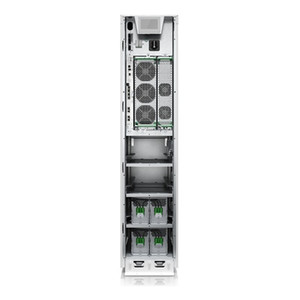
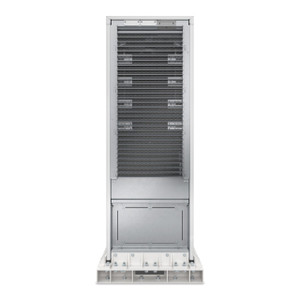
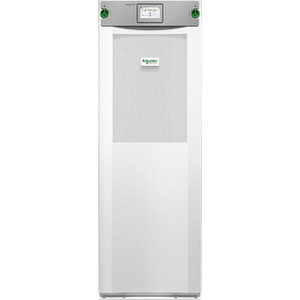
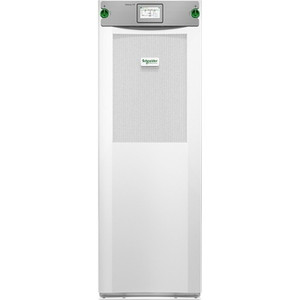
APC by Schneider Electric GVSUPS20KB4HS Galaxy VS 20kW 3-Phase Online UPS
Overview
The APC by Schneider Electric Galaxy VS GVSUPS20KB4HS is a 20kW (20 kVA) three-phase, double-conversion online UPS designed for medium-density data centers, server rooms, and mission-critical edge infrastructure running 400V distribution. Double-conversion topology means your load never touches raw utility power — incoming AC is rectified to DC, then cleanly re-inverted at the output, eliminating voltage fluctuations, frequency anomalies, and transient spikes before they reach connected equipment. This unit ships with one internal 9Ah Smart Modular Battery String and is architected to expand, so you can increase runtime as your load and criticality requirements grow without replacing the base unit.
For security integrators and IT architects sizing UPS and power protection for high-density surveillance server rooms or enterprise network closets, the GVSUPS20KB4HS delivers the clean power foundation and scalability that 24/7 recording infrastructure demands.
Key Features
- Double-Conversion (Online) Topology: Unlike line-interactive designs that switch to battery only during outages, online double-conversion rebuilds the output waveform continuously. Your servers and storage arrays see a perfect sine wave at all times — no micro-interruptions, no transfer time. This matters on NVR and SAN workloads where a 20ms switchover can trigger a drive array rebuild.
- 20kW / 20 kVA Output Capacity: Sized for mid-range server room consolidation. At unity power factor output (20kW = 20 kVA), you get full watt-for-watt loading without derating — relevant when running dense 1U/2U servers with high-efficiency PSUs that present near-unity PF loads.
- Pure Sine Wave Output: The output waveform is a true sine, not a stepped approximation. Active PFC power supplies in rack servers require a clean sine input to regulate correctly; feeding them a simulated sine risks premature PSU failure and void manufacturer warranties on connected equipment.
- Wide 3-Phase Input Range (340–460V, 40–70 Hz): The broad input window accommodates utility voltage sag and regional frequency variation without switching to battery unnecessarily, extending battery life in environments with marginal utility quality. The 40–70 Hz frequency range means this unit adapts to both 50 Hz (EU/APAC) and 60 Hz (US) mains — useful for deployments with mixed infrastructure or data center migration projects.
- 0.99 Input Power Factor: Drawing current at near-unity PF minimizes reactive current demand on your building electrical service, reducing I²R losses in distribution cabling and avoiding power factor penalties on commercial utility billing. On a 20kW UPS running continuously, that's a meaningful efficiency gain over legacy UPS designs with 0.8–0.9 input PF.
- 3% Output Voltage THD: Tight harmonic distortion at the output protects sensitive loads — RAID controllers, GPU compute, and precision timing equipment — from the waveform distortion that degrades component lifespan and introduces data errors in storage systems.
- 3% Input Current THD: Low input harmonic current reduces stress on upstream distribution transformers and panelboards, and keeps you well inside ITHD limits required for compliance with IEEE 519 in facilities with harmonic distortion budgets.
- ECO Mode: When utility power is within tolerance, ECO mode routes the load through a filtered bypass path at higher efficiency — reducing heat output and operating costs during steady-state operation. For deployments where uptime requirements allow a brief transfer time (ECO mode does carry a short switchover), the energy savings over a multi-year deployment are substantial.
- 2.5:1 Crest Factor: Handles loads with high peak-to-RMS current ratios — common in switched-mode PSUs and variable-frequency drives — without output voltage collapse. Undersized UPS units with low crest factor ratings clip these peaks, causing connected equipment to reset or behave erratically.
- 3-Phase Input and Output (36A Max Input Current): Balanced three-phase distribution at 36A maximum input keeps individual phase loading in bounds and integrates cleanly with three-phase PDU and switchgear infrastructure standard in purpose-built server rooms and telecommunications facilities.
- Expandable Smart Modular Battery String: The unit ships with one internal 9Ah battery string. Adding battery strings extends runtime without swapping the UPS chassis — a practical architecture for staged capacity growth as you add servers or increase criticality requirements over time. Runtime scaling is predictable: more strings, more minutes at full load.
- 380–415V Output Voltage Range: Output regulation within 380–415V at 50/60 Hz supports all standard IEC 60309 and C19/C20 three-phase loads deployed across EU, UK, and APAC market infrastructure — no output transformer required in those regions.
Integration & Compatibility
The GVSUPS20KB4HS belongs to APC's Galaxy VS series, which integrates with EcoStruxure IT for remote UPS monitoring, firmware management, and predictive battery health analytics. Three-phase online UPS units in this class are typically paired with modular server rack enclosures and three-phase PDUs for structured power distribution to rack-mounted loads. For surveillance-specific deployments, this UPS provides the runtime headroom needed to support orderly NVR shutdown and video write-completion during extended outages — a critical consideration when protecting evidence-grade footage from filesystem corruption. Consult your UPS runtime planning guide to model battery string count against your actual connected load and target runtime.
Frequently Asked Questions
Q: What is the UPS topology of the GVSUPS20KB4HS?
A: The GVSUPS20KB4HS uses double-conversion (online) topology, meaning connected loads are continuously powered from a clean, inverter-generated sine wave — not directly from utility power. There is no transfer time to battery during a power outage.
Q: Can the battery runtime be extended after purchase?
A: Yes. The GVSUPS20KB4HS ships with one internal 9Ah Smart Modular Battery String and is designed to be expandable. Additional battery strings can be added to increase runtime without replacing the base UPS unit.
Q: What input voltage and frequency range does the GVSUPS20KB4HS accept?
A: The unit accepts three-phase input from 340V to 460V at 40–70 Hz, accommodating both 50 Hz and 60 Hz mains and providing a wide buffer against utility voltage sag before switching to battery.
Q: What is ECO mode and when should it be used?
A: ECO mode routes the load through a high-efficiency bypass path when utility power is within tolerance, reducing energy consumption and heat output during normal operation. It does introduce a brief transfer time if utility power goes out of range, so it is best suited for deployments where that tradeoff is acceptable and energy savings over continuous operation are a priority.
Q: What is the maximum input current draw of the GVSUPS20KB4HS?
A: Maximum input current is 36A (three-phase). Confirm your building electrical service and upstream circuit breaker sizing can support this before installation.
Q: Is the GVSUPS20KB4HS suitable for single-phase loads?
A: No. This unit provides three-phase input and three-phase output (380–415V). It is designed for three-phase distribution infrastructure. Single-phase loads require a step-down transformer or a different UPS model.
The GVSUPS20KB4HS is one of the more deployment-ready three-phase UPS options in the 20kW class, largely because of its 0.99 input power factor and the 340–460V input range — two specs that get overlooked at the quotation stage and cause real headaches during commissioning. I've seen facilities spec a 20kW UPS against a 20kW generator only to discover the low PF of the older UPS is pulling 25kVA of apparent power and tripping the generator's AVR during load step. At 0.99 PF, the GVSUPS20KB4HS pulls close to its rated real power in apparent power, which keeps generator sizing honest.
Technical Highlights:
- Online Double-Conversion: Zero transfer time to battery — critical when NVR storage arrays or RAID controllers are on the load. Even a 20ms switchover on a line-interactive UPS can cause a storage controller to log a fault and initiate an unnecessary rebuild cycle.
- 3% Output THD: Tight harmonic output protects high-sensitivity loads. In a surveillance server room running GPU-accelerated analytics, power quality directly affects GPU lifespan — 3% THD at the output is where you want to be for this class of equipment.
- Expandable 9Ah Battery String: The modular battery architecture means you can right-size runtime at purchase and scale it later as the load grows or criticality requirements change, without swapping the UPS chassis or re-cabling the distribution side.
Deployment Considerations:
- Maximum input current is 36A three-phase — verify upstream breaker and cable sizing before installation. Under-rated distribution is the most common field issue on UPS installs in this power class.
- ECO mode offers efficiency gains during steady-state, but carries a transfer time. Do not enable ECO mode on loads with zero-tolerance for micro-interruptions (e.g., active storage writes on a surveillance NVR mid-recording) unless you have confirmed the connected equipment tolerates the switchover.
For a purpose-built surveillance data center or security operations center running 24/7 with rack-dense NVR and analytics server infrastructure on 400V three-phase distribution, the GVSUPS20KB4HS provides the power quality and runtime expandability foundation that keeps the recording infrastructure available through both utility disturbances and planned maintenance windows.