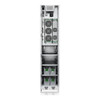
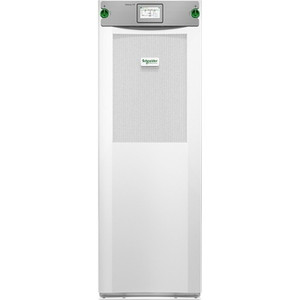
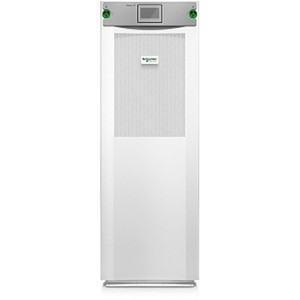
APC by Schneider Electric GVSUPS20KB2HS Galaxy VS 20kW 400V Online UPS
Overview
The APC by Schneider Electric GVSUPS20KB2HS is a 20kW (20 kVA) three-phase double-conversion online UPS built for medium-to-large commercial and industrial loads — data centers, server rooms, broadcast infrastructure, and building automation systems where a momentary sag, surge, or frequency excursion simply cannot reach critical equipment. Unlike line-interactive or standby designs that only engage conversion circuitry on severe events, the Galaxy VS runs full double-conversion continuously, meaning your load never sees raw utility power. For an three-phase UPS in the 20kW class, that topology choice is the single most important spec on the sheet.
The unit ships with one internal 7AH Smart Modular Battery String already installed and is designed to accept additional strings as runtime requirements grow — a meaningful advantage when initial budget is constrained but future expansion is certain. Browse the full APC by Schneider Electric power protection catalog for complementary distribution and monitoring products.
Key Features
- Double-Conversion (Online) Topology: The load is continuously powered from the inverter, not the utility feed directly. Grid fluctuations, brown-outs, and frequency drift are fully isolated — the inverter synthesizes clean output regardless of what the utility delivers. For sensitive electronics, this is the only topology that guarantees zero transfer time on a utility failure.
- 20kW / 20 kVA Output at Unity Power Factor: The 1:1 kW-to-kVA ratio means you get the full rated 20kW of real power — no derating penalty for modern server PSUs and variable-frequency drives that draw near-unity PF loads. Many older UPS designs with 0.8 PF ratings deliver only 16kW from a 20 kVA nameplate.
- Three-Phase Input and Output (400V range, 340–460V input): Accepts the wide European/international three-phase voltage band (340V–460V) that covers typical 400V TN-S distribution. The 380V–415V output range holds your load bus stable even when the utility feeds the high or low end of tolerance. With a 36A maximum input current draw, plan your upstream breaker and cable sizing accordingly — a 50A three-phase circuit is the minimum safe headroom at full load.
- 0.99 Input Power Factor: The Galaxy VS draws near-unity power factor from the supply, which means it imposes minimal reactive burden on your generator or utility feed. Facilities running diesel backup generators see a direct benefit: a 0.99 PF UPS at 20kW pulls roughly 20.2 kVA from the generator versus ~25 kVA for a 0.8 PF design at the same real-power load — that difference matters when generator capacity is constrained.
- 3% Output Voltage THD: The inverter delivers a clean sine wave with total harmonic distortion held to 3% under load. Sensitive medical electronics, industrial PLCs, and precision measurement equipment can be harmed by high-THD power sources. At 3%, this unit stays well inside IEC 62040-3 Class 1 thresholds.
- 3% Input Current THD: Low input THD (3%) means the UPS itself is not injecting significant harmonics back onto the building distribution network — important in facilities with shared transformer capacity or harmonic-sensitive neighboring equipment.
- ECO Mode: When utility quality is within tolerance, ECO mode routes power through a high-efficiency bypass path rather than full double-conversion, cutting operating losses. In a 24/7 data center context, even a 2–4% efficiency improvement at 20kW translates to real annual energy cost reduction. Double-conversion engages automatically the moment utility quality degrades.
- 2.5:1 Crest Factor: The inverter can handle load crest factors up to 2.5:1 without clipping — relevant for equipment with capacitive input stages (rack servers, switching PSUs) that draw brief high-amplitude current pulses even at low average current. Undersized crest factor ratings cause inverter current limiting and output voltage sag under these loads.
- 40–70 Hz Input Frequency Acceptance: The wide input frequency window accommodates both 50Hz and 60Hz utility feeds as well as the frequency excursions common on lightly loaded or islanded generator sets. The output is synthesized at 50 or 60 Hz regardless of input frequency variation.
- Expandable Smart Modular Battery String Architecture: The single internal 7AH string ships installed. As runtime requirements increase — or as a redundancy strategy — additional strings can be added without replacing the base unit. This modularity also simplifies battery maintenance: individual strings can be swapped without a full system shutdown if the design supports hot-swap operation.
Integration & Compatibility
The GVSUPS20KB2HS is designed for integration into three-phase 400V distribution environments common in European, Middle Eastern, and international commercial installations. The wide input voltage range (340–460V) provides compatibility with TN-S, TN-C-S, and IT earthing systems within that band. With three-phase input and output, upstream distribution should be sized for the 36A maximum draw; coordinate with your electrical contractor on upstream OCPD sizing and cable cross-section per local wiring regulations.
For facilities running power conditioning and UPS infrastructure, the Galaxy VS fits naturally as a distributed UPS node feeding a critical sub-panel rather than as a single-point whole-facility UPS. Pair it with appropriate rack PDUs and power distribution downstream to maintain granular circuit-level monitoring. A network management card (sold separately) enables SNMP integration with building management systems and graceful server shutdown orchestration.
Frequently Asked Questions
Q: What is the topology of the GVSUPS20KB2HS — is it true online double-conversion?
A: Yes. The GVSUPS20KB2HS uses double-conversion (online) topology, which means the load is powered continuously from the inverter and is fully isolated from the utility feed. Transfer time on utility failure is effectively zero because the inverter is always active.
Q: What three-phase input voltage range does the GVSUPS20KB2HS accept?
A: The unit accepts three-phase input from 340V to 460V, covering the standard 400V distribution band with full high and low tolerance margins. Input frequency acceptance is 40–70 Hz.
Q: Can I expand the battery runtime after initial installation?
A: Yes. The GVSUPS20KB2HS ships with one internal 7AH Smart Modular Battery String installed and is designed to accept additional battery strings as runtime requirements grow. This modular architecture allows phased investment rather than requiring full runtime capacity upfront.
Q: What is the maximum input current draw at full load?
A: Maximum input current is 36A (three-phase). Plan your upstream overcurrent protection and cable sizing with appropriate headroom — a 50A three-phase circuit is a reasonable minimum for a full-load installation.
Q: Does the GVSUPS20KB2HS support ECO mode operation for energy savings?
A: Yes. ECO mode routes power through a high-efficiency bypass path when utility quality is within tolerance, reducing operating losses compared to continuous double-conversion. The unit automatically switches back to full double-conversion if utility quality degrades outside acceptable thresholds.
Q: What is the output power factor of the GVSUPS20KB2HS?
A: The unit delivers 20kW at a 1:1 kW-to-kVA ratio (20kW / 20 kVA), meaning the output power factor is unity. This ensures modern server and networking loads that draw near-unity PF receive the full 20kW nameplate capacity without derating.
The spec that stands out to me on the GVSUPS20KB2HS is the 0.99 input power factor combined with only 3% input current THD. In practice, that combination means this unit behaves like a near-ideal load on your upstream distribution — it pulls essentially no reactive current and injects minimal harmonic distortion back onto the bus. That matters more than most buyers realize when the upstream source is a generator rather than a stiff utility feed.
Technical Highlights:
- Unity Output PF (20kW / 20 kVA): Full 20kW real power delivery with no derating for modern loads — a 0.8 PF design at the same nameplate would cap you at 16kW usable.
- 3% Output Voltage THD: Stays inside IEC 62040-3 Class 1 thresholds; sensitive instrumentation, medical devices, and industrial control equipment can operate on this output without additional line conditioning.
- Expandable Smart Modular Battery Architecture: The 7AH string ships installed. Add strings post-commissioning as runtime requirements or budget allows — avoids the sunk cost of buying full runtime capacity you may not initially need.
Deployment Considerations:
- At 36A maximum three-phase input current, coordinate with the electrical contractor before commissioning — upstream OCPD and cable sizing needs to be established in advance, not retrofitted after the unit is racked.
- ECO mode efficiency gains are real, but confirm that your load's sensitivity profile tolerates the brief transfer event back to double-conversion during utility quality excursions — some high-sensitivity instrumentation loads warrant running full double-conversion continuously.
This unit is well-positioned for a distributed UPS strategy in a mid-size commercial data hall or industrial control room running 400V three-phase distribution — where you need true online isolation per node rather than a single large centralized UPS serving the whole facility.