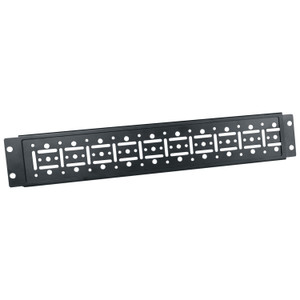
Middle Atlantic LBFR-3650-T Front-to-Rear Telescoping Lacer Bar
Overview
The Middle Atlantic LBFR-3650-T is a front-to-rear horizontal lacer bar designed to route and dress cables inside open-frame or enclosed rack systems with mounting depths ranging from 36 to 50 inches. It ships as a two-piece set, covering the full depth span of most deep-bay AV, IT, and security rack enclosures without requiring additional hardware or custom fabrication. If your rack infrastructure includes Middle Atlantic frames or third-party rails in the 36- to 50-inch depth range, the LBFR-3650-T drops directly into that workflow.
Front-to-rear cable management is frequently the last detail addressed on a rack build and the first thing that creates problems during a service call. A properly laced cable path keeps power and data separated, prevents sag that stresses connector housings, and makes it possible for a technician to trace and swap individual runs without disturbing adjacent equipment. The LBFR-3650-T (often searched as LBFR 3650 T) provides the physical anchor points to do that work correctly the first time.
Key Features
- Telescoping 36 to 50 Inches: The bar extends from a minimum mounting depth of 36 inches to a maximum of 50 inches (127 cm), covering the depth range of most deep-bay rack enclosures used in security head-end rooms, AV infrastructure closets, and data center edge deployments. You set it once at installation depth — no cutting, no custom ordering for non-standard depths within that window.
- Horizontal Component Orientation: Oriented horizontally across the rack width, the LBFR-3650-T provides consistent tie-down points along the full front-to-rear cable run. Horizontal placement keeps cable bundles organized at a fixed height inside the bay, which matters in dense racks where vertical slack management alone leaves cables migrating into adjacent equipment airflow paths.
- Two-Piece Set per Package: Each package includes two lacer bars, so a single order covers both sides of a rack bay or provides redundant anchor points along a long cable run. For multi-bay installations, plan your order quantity on a per-bay basis — two bars per bay is the standard starting point for organized front-to-rear routing.
- Low-Profile 0.5-Inch Width: At only 0.5 inches (1.3 cm) wide, the bar occupies minimal horizontal space inside the rack, leaving clearance for cable bundles of varying diameter without creating a bottleneck at the anchor point. This matters in deep racks where cumulative hardware intrusion from multiple accessories can restrict usable interior width.
- 3.47-Inch Height Profile: The 3.47-inch (8.8 cm) height is sized to fit within standard rack bay geometry without conflicting with equipment panels, power strips, or patch management hardware mounted in adjacent rack units. Verify your specific rack interior clearance before ordering in unusually constrained bays.
- Rack-Mount Compatibility: Designed for rack mounting, the LBFR-3650-T integrates with standard two-post open-frame and four-post enclosed rack systems. It does not require a dedicated rack unit of panel space — it mounts within the bay structure itself, preserving rack unit real estate for active equipment.
Integration and Compatibility
The LBFR-3650-T is built for rack cable management installations where mounting depth falls anywhere between 36 and 50 inches. It pairs naturally with Middle Atlantic rack enclosures and open-frame systems in that depth range, and it is dimensionally compatible with any standard-rail rack meeting that depth specification regardless of manufacturer. Use it alongside horizontal cable managers and patch panels to complete a structured front-to-rear and side-to-side cable dressing scheme. For security head-end builds, pair it with a managed PoE switch rack layout where cable discipline directly affects troubleshooting speed when a camera goes offline.
When planning a full rack cable management system, consult a rack and enclosure planning guide to match lacer bar placement with your cable entry points and equipment layout before installation begins. Adding lacer bars after equipment is fully populated significantly increases installation time and the risk of disturbing live connections.
What's in the Box
- 2x Middle Atlantic LBFR-3650-T telescoping front-to-rear lacer bars
Frequently Asked Questions
Q: What rack mounting depths does the LBFR-3650-T support?
A: The LBFR-3650-T telescopes from a minimum mounting depth of 36 inches to a maximum of 50 inches (127 cm), covering the depth range of most standard deep-bay rack enclosures.
Q: How many lacer bars are included in one order?
A: Each package includes two lacer bars. This is sufficient for a single rack bay using one bar per side, or for two anchor points along a single cable run.
Q: Is the LBFR-3650-T compatible with third-party rack enclosures, or only Middle Atlantic frames?
A: The bar is designed for standard rack mounting and is dimensionally compatible with any rack enclosure with a mounting depth between 36 and 50 inches, regardless of manufacturer.
Q: Does the LBFR-3650-T occupy a rack unit (1U) of panel space?
A: No. The LBFR-3650-T mounts within the bay structure front-to-rear and does not consume rack unit real estate reserved for active equipment or patch panels.
Q: What is the width profile of the LBFR-3650-T inside the rack?
A: The bar is 0.5 inches (1.3 cm) wide, leaving significant clearance for cable bundles and other internal rack accessories alongside it.
Q: Can the LBFR-3650-T be used in both open-frame and enclosed rack systems?
A: Yes. Its rack-mount design is compatible with standard two-post open-frame and four-post enclosed rack systems with mounting depths in the 36- to 50-inch range.
The detail that stands out on the LBFR-3650-T is that telescoping range: 36 to 50 inches of adjustable front-to-rear depth in a single SKU. In a security head-end room where you're mixing 36-inch network racks with 42- or 48-inch AV enclosures, that single part number handles the full spread without sourcing two separate lacer bar SKUs. That's the kind of detail that saves a service call when you're stocking a truck for a multi-rack commissioning day.
Technical Highlights:
- 36–50 in. Telescoping Depth: Adjusts continuously between 36 in. (91.4 cm) and 50 in. (127 cm) — covers the depth range of virtually every deep-bay rack enclosure in commercial security and AV infrastructure without custom cuts or special orders.
- 0.5 in. Width Profile: At just 1.3 cm wide, the bar doesn't pinch cable bundles or crowd other internal hardware. In a fully loaded rack with power distribution, patch panels, and active gear, that narrow footprint matters when you're trying to maintain clean airflow and service access.
- Two-Piece Package: Ships as a set of two, so one order equips a full rack bay — one bar per side — which is the standard configuration for disciplined front-to-rear cable routing in head-end security builds.
Deployment Considerations:
- Plan lacer bar placement before populating the rack. Installing the LBFR-3650-T after active equipment and cabling is in place significantly increases the risk of disturbing live connections and makes proper cable dressing nearly impossible in tight bays.
- The 3.47 in. height profile is designed for standard rack bay geometry, but verify interior clearance in unusually shallow bays or enclosures with non-standard rail spacing before ordering in volume.
The LBFR-3650-T is the right call for a security integrator building out a mixed-depth head-end room where rack depths vary between 36 and 50 inches and clean, serviceable cable runs are a project requirement, not an afterthought.