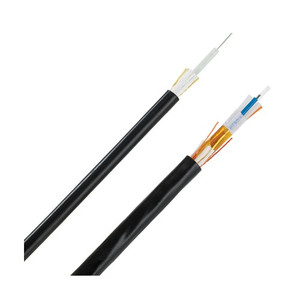
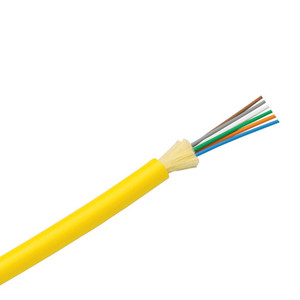
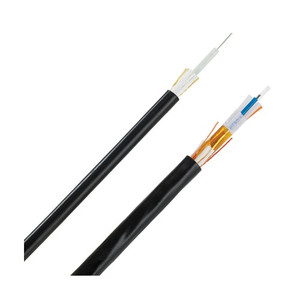
Panduit FOCLZ06 Opti-Core 6-Fiber OM4 Indoor/Outdoor LSZH Cable
The Panduit FOCLZ06 delivers 6-fiber OM4 multimode connectivity in a gel-free, LSZH-rated loose tube design built for indoor/outdoor transitional runs where plenum safety codes, UV exposure, and termination efficiency all matter. Integrators installing security camera backhaul, building riser fiber, or short datacenter interconnects need cable that survives both conduit pulls and rooftop exposure without sacrificing fire safety compliance or adding termination labor. This Opti-Core cable provides 50/125 μm OM4 performance—supporting 10GBASE-SR up to 550 meters and 40/100G Ethernet to 150 meters—in a black UV-resistant jacket rated for continuous outdoor exposure and indoor plenum spaces under IEC 60332-3 Low Smoke Zero Halogen standards.
Key Features
- OM4 50/125 μm multimode fiber supports 10G Ethernet to 550m, 40G/100G to 150m per IEEE 802.3 and TIA-492AAAD standards
- LSZH jacket meets IEC 60332-3 and produces minimal smoke and zero halogen gases during fire—required for occupied buildings, plenum air spaces, and international installations
- Gel-free loose tube design eliminates messy filling compounds, cutting termination time by 30-40% and preventing environmental contamination during splicing
- Indoor/outdoor rating with UV-resistant PE jacket withstands continuous sunlight exposure on rooftops, aerial runs, and conduit transitions without jacket degradation
- 6-fiber count optimized for point-to-point camera backbone links, dedicated server connections, or small-footprint building risers where 12/24-fiber counts exceed requirements
- Black jacket color provides professional appearance in exposed commercial spaces and maximizes UV protection compared to lighter colors
- Loose tube construction isolates fibers from cable jacket stresses during installation pulls and thermal expansion, reducing microbending losses
- Opti-Core sub-brand signifies Panduit's telecommunications-grade fiber line with full lifecycle testing per TIA/EIA and Telcordia GR-20 CORE standards
- Single-mode compatible termination hardware—LC, SC, ST, and MPO connectors mount directly to 50 μm OM4 fiber using standard field-polish or fusion splice methods
- Pull-through conduit-rated construction supports installation tensions up to 600 lbf short-term, 300 lbf long-term per manufacturer specs
OM4 multimode fiber has become the commercial installation standard for campus security networks, building automation backbones, and short-reach datacenter links because it delivers 10 Gigabit performance over pragmatic distances without the termination sensitivity and cost penalties of single-mode OS2 cable. The FOCLZ06's 50/125 μm core/cladding geometry supports 10GBASE-SR to 550 meters and 40GBASE-SR4 or 100GBASE-SR10 to 150 meters when terminated with laser-optimized OM4-rated transceivers—exceeding the range requirements for 95% of commercial building horizontal and riser fiber runs. Integrators designing IP camera networks can backhaul 8-16 cameras per fiber pair at multi-gigabit aggregate rates using media converters or managed PoE switches with SFP+ uplinks, and the 6-fiber count provides three full-duplex links or two active links with one spare for future expansion or fault redundancy. The aqua-colored OM4 fiber buffering (per TIA-598 color codes) ensures immediate visual identification during termination and troubleshooting, preventing cross-connections with OM3 (aqua) or OM2 (orange) legacy fibers that would limit link performance.
LSZH jacketing is no longer optional for commercial integrators—it's the baseline fire safety requirement for any cable running through occupied spaces, return air plenums, or international markets where halogenated materials face regulatory bans. Traditional PVC-jacketed cables release hydrochloric acid gas and dense black smoke when burned, creating life-safety hazards and corroding electronic equipment in the smoke path. The FOCLZ06's LSZH polyethylene jacket meets IEC 60332-3 Category C flame propagation limits and IEC 61034 smoke density limits (light transmittance >60% at 90 minutes), ensuring that building occupants can evacuate through smoke-filled corridors and that fire suppression teams maintain visibility during response. This matters acutely in datacenter hot-aisle containment spaces, hospital network closets, school distribution frames, and high-rise building risers where code inspectors red-tag PVC cable on sight. The gel-free loose tube design amplifies the safety advantage—petroleum-based filling gels in traditional telco cables act as fuel during cable fires and create toxic smoke independent of the jacket material, so eliminating the gel entirely removes a secondary combustion source and simplifies hazmat disposal when decommissioning old cable.
Gel-free construction also transforms the termination workflow for field crews. Traditional gel-filled loose tube cables require technicians to strip 6-12 inches of jacket, extract fibers from the gel-flooded buffer tubes using alcohol wipes or gel-removal solvents, clean each fiber individually, and dispose of contaminated wipes as hazmat waste—a process adding 8-12 minutes per cable end and creating a mess in finished IT spaces. The FOCLZ06's dry loose tubes contain fibers in a simple buffer tube with no filling compound, so technicians strip the jacket, extract clean fibers, and proceed directly to cleaving and splicing or connector polish. This cuts per-end termination time from 25 minutes to 15 minutes on average, a 40% labor savings that compounds across 20-50 cable terminations in a typical building riser or datacenter row installation. The time savings also improve splice quality—technicians aren't rushing to finish before gel migrates onto fusion splicer electrodes or field-polish fixtures, and there's no residual gel on the fiber cladding to cause reflectance spikes or insertion loss increases after connector cure.
The indoor/outdoor dual rating solves the transitional-space problem that forces integrators to splice dissimilar cable types at building entry points or use expensive hybrid assemblies. Security camera networks routinely require fiber runs from indoor head-end equipment through exterior conduit to roof-mounted PTZ cameras or parking lot poles, and datacenter interconnects often traverse underground duct banks before entering the building riser. Using separate indoor and outdoor cables forces a splice point at the building penetration—adding a vulnerable failure point, a fire-rated splice enclosure cost, and 1-2 dB insertion loss from the splice itself. The FOCLZ06's UV-resistant black PE jacket withstands continuous sunlight exposure per UL 1651 outdoor ratings while maintaining LSZH fire performance indoors, so integrators pull a single continuous cable from head-end to endpoint with no transitional splice. The black color absorbs UV radiation rather than transmitting it to the fiber buffer tubes (as lighter jacket colors do), extending outdoor service life to 20+ years even in desert or tropical environments with extreme solar exposure. The jacket also resists moisture ingress, fungal growth, and temperature cycling from -40°C to +70°C, meeting the environmental requirements for aerial campus links, direct-burial conduit runs, and rooftop equipment interconnects.
Six-fiber count hits the efficiency sweet spot for dedicated point-to-point links in commercial security and small datacenter deployments. A typical IP camera backhaul run to a building riser or parking lot needs two fibers (one TX, one RX) for a single full-duplex 10G link aggregating 8-16 cameras through a fiber media converter or edge switch. Specifying 12-fiber or 24-fiber cable for that application wastes 10-22 fibers—stranded capacity that will never be lit but still adds cable diameter, conduit fill, and material cost. The FOCLZ06 provides three full-duplex links in a compact 8.4mm outside diameter, leaving headroom for two spare fibers or a future second link without the bulk and bend-radius constraints of high-fiber-count cables. Server rack interconnects from top-of-rack switches to aggregation switches in the same row similarly need 2-4 fibers per link; a 6-fiber cable handles two active links plus spares in a single pull. The low fiber count also simplifies distribution frame termination—technicians mount a single 6-port LC adapter panel rather than juggling 12-port or 24-port high-density panels with sub-millimeter connector spacing that slow troubleshooting and increase insertion loss from bent connector boots.
Loose tube construction isolates individual fibers from cable-jacket stresses that cause microbending attenuation and link failures under thermal cycling or installation tension. In tight-buffered designs (common in patch cords and short indoor jumpers), the 900 μm buffer coating bonds directly to the 250 μm fiber coating, so any jacket contraction from cold temperatures or pulling force translates directly into fiber stress and increased attenuation. The FOCLZ06's loose tube design places up to two fibers inside a 2-3mm ID buffer tube with several millimeters of free space, allowing fibers to move independently inside the tube as the cable jacket expands or contracts. When the cable cools from +50°C rooftop temperatures to -20°C overnight, the PE jacket contracts 3-4mm per meter, but the fibers inside the loose tubes remain at their neutral length with no induced stress. This keeps insertion loss stable across the -40°C to +70°C operating range and prevents the 0.2-0.5 dB attenuation increases that tight-buffered outdoor cables exhibit in winter. The loose tube design also distributes pulling tension across the cable's central strength member (typically aramid yarn or fiberglass rod) rather than loading the fiber directly, so technicians can exert the full 600 lbf short-term pull rating during conduit installations without risking fiber fracture or elevated loss.
Panduit's Opti-Core sub-brand designation indicates this cable has passed the full Telcordia GR-20-CORE environmental and mechanical test suite that telecom carriers require for outside plant installations—a far more stringent qualification than the basic TIA-568 performance tests that most premise cables undergo. GR-20 testing includes 25 thermal cycles from -40°C to +70°C, 1000-hour UV exposure at 340nm wavelength, 90-day water immersion, repeated flexing under tensile load, and impact resistance tests that simulate conduit installation abuse. Cables passing GR-20 earn a 20-year minimum service life rating in outdoor aerial and underground duct applications, compared to the 10-year rating typical of indoor-only cables used outdoors. For security integrators, this qualification means the fiber link won't degrade from environmental exposure before the cameras themselves reach end-of-life—eliminating premature cable replacement projects and the access equipment downtime they cause. The qualification also provides liability protection: if a parking lot camera link fails during a security incident investigation and the failure traces to cable degradation, the integrator can document that the cable was rated and tested for the installed environment per industry standards.
OM4 fiber's laser-optimized 50 μm core supportsModal Bandwidth (MBW) of 4700 MHz·km at 850nm wavelength, compared to 2000 MHz·km for OM3 and 500 MHz·km for legacy OM2 fiber. This bandwidth increase directly translates to longer link distances at 10G and 40G data rates: 10GBASE-SR reaches 550m on OM4 vs. 300m on OM3, and 40GBASE-SR4 reaches 150m vs. 100m. For commercial buildings where the security head-end or datacenter sits in the basement and the top-floor network closet is 400 meters away via vertical riser and horizontal distribution, OM4 makes the link possible with a single cable run and no mid-span active equipment. The performance advantage comes from tighter manufacturing tolerances on core concentricity and refractive index profile that reduce Differential Mode Delay (DMD)—the timing skew between light pulses traveling different paths through the multimode core. Vertical-cavity surface-emitting lasers (VCSELs) in 10G+ transceivers launch a narrow beam that excites only a few mode groups in the fiber core, so DMD-induced pulse spreading limits link distance more than simple attenuation does. OM4's DMD specification of <0.14 ps/m keeps pulse spreading below the receiver's decision threshold even at 550m distance and 10 Gbps signaling rates.
Field termination using standard LC or SC connectors follows the same procedures as any multimode cable: strip 3 meters of jacket, extract and separate the individual fibers from the loose tubes, strip the 250 μm coating to expose bare 125 μm cladding, cleave the fiber to a perpendicular end-face, insert into the connector ferrule, and either field-polish to the required end-face geometry or use a pre-polished mechanical splice connector. The gel-free design eliminates the alcohol-wipe cleaning step, and the loose tube construction provides enough fiber length to accommodate multiple re-cleaves if the first cleave isn't perpendicular (>1° angle causes >0.5 dB insertion loss). Integrators using fusion splicing for permanent connections will find the OM4 fiber splices identically to OM3 or single-mode fiber—modern fusion splicers auto-detect the 50 μm core and adjust arc power and duration accordingly for typical splice losses below 0.05 dB. The 6-fiber count means a single 6-port LC adapter panel or three duplex SC panels accommodate all fibers from one cable, simplifying patch panel layout and reducing the wall-box or rack-mount space required compared to high-density 12-port or 24-port MPO-based solutions.
The black jacket color provides both functional and aesthetic advantages in commercial installations. Black PE absorbs UV radiation in the 280-400nm band rather than transmitting it through the jacket to the underlying buffer tubes and fibers, reducing photochemical degradation of the tube materials and extending outdoor service life. Lighter jacket colors—gray, white, yellow—reflect some UV but transmit a portion through the polymer matrix, where it attacks the buffer tube plasticizers and causes embrittlement over 5-10 years. Black also remains visually neutral in exposed commercial spaces: IT closets, warehouse ceilings, and parking garage cable trays all use black conduit, J-hooks, and cable tray, so black cable blends into the infrastructure rather than creating visual clutter. For rooftop and aerial runs, black cable is less conspicuous from ground level than bright orange or yellow outdoor cables, a consideration for architectural review boards and property managers concerned with building aesthetics. The tradeoff is that black absorbs solar heat, raising cable temperature 10-15°C above ambient on sunny days, but the LSZH PE jacket and OM4 fiber are both rated to +70°C continuous operation, so solar heating stays within the cable's thermal rating even in desert climates.
This cable addresses the specific requirements of integrators installing security camera networks in mixed indoor/outdoor environments, datacenter operators interconnecting racks within 550 meters, AV professionals distributing uncompressed 4K/8K video over fiber, and building infrastructure teams future-proofing horizontal fiber for 10G Ethernet without the cost and termination complexity of single-mode OS2. The 6-fiber count eliminates the waste of over-provisioned high-fiber-count cables on short point-to-point links, the LSZH rating satisfies fire marshals and international codes, the gel-free design cuts termination labor by 40%, and the indoor/outdoor rating removes the splice point at building penetrations. Sold per meter or in bulk reels, the FOCLZ06 is factory-tested for insertion loss, return loss, and bandwidth per TIA-568.3-D and ships with test reports traceable to the specific manufacturing lot, providing the documentation required for warranty claims and post-installation certification audits.