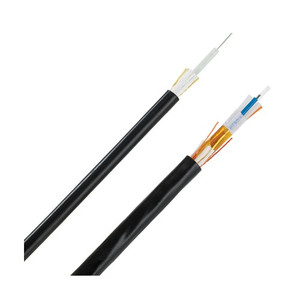
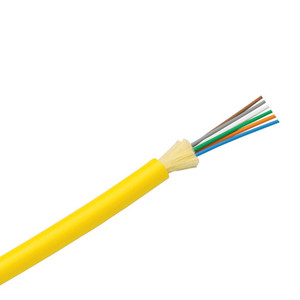
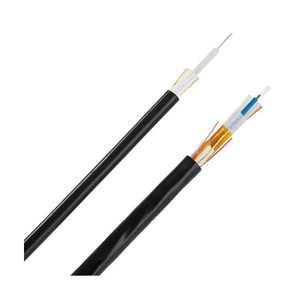
Panduit FSNL948Y Opti-Core 48-Fiber OS2 Single-Mode Indoor/Outdoor LSZH Cable
The Panduit FSNL948Y is a 48-fiber OS2 single-mode loose tube cable engineered for high-density backbone applications where a single cable must traverse both indoor and outdoor environments. The indoor/outdoor rating eliminates the need for transition splices at building entry points, reducing labor and failure points on campus backbone runs, building-to-building interconnects, and datacenter-to-remote-facility links. The LSZH (Low Smoke Zero Halogen) jacket meets international fire safety standards for installations where PVC combustion products are prohibited, while the gel-free loose tube design simplifies field terminations by eliminating the cleanup step that costs 5–10 minutes per splice closure on legacy gel-filled cables.
Key Features
- 48-Fiber OS2 Single-Mode Configuration: 9/125 µm core/cladding diameter supports distances up to 10 km (10GBASE-LR) or 40 km (1000BASE-LX) with typical attenuation ≤0.4 dB/km at 1310 nm, suitable for campus backbones and metropolitan-area surveillance networks
- Loose Tube Gel-Free Construction: Individual fiber strands float in buffer tubes without flooding compound, allowing easier mid-span access and cleaner splice prep while maintaining the mechanical isolation advantages of loose tube architecture
- Indoor/Outdoor Rated Black LSZH Jacket: Single cable rated for both OSP (outside plant) aerial/duct/buried installations and indoor riser/general-purpose spaces, eliminating building-entrance transition vaults; black UV-resistant polyethylene outer jacket prevents photodegradation during decades of outdoor exposure
- LSZH Fire Rating: Low Smoke Zero Halogen jacket produces minimal visible smoke and no corrosive halogen acids during combustion, required by IEC 60332 and many international building codes, and preferred in datacenter hot aisles and hospital telecom rooms where PVC off-gassing is a liability
- High Fiber Density for Conduit Efficiency: 48 strands in a single approximately 0.55-inch diameter cable replaces four 12-fiber cables, reducing conduit fill by 60–70% and leaving room for future pulls in congested pathways
- Color-Coded Buffer Tubes: Loose tubes follow industry-standard 12-color identification schemes (blue/orange/green/brown/slate/white/red/black/yellow/violet/rose/aqua) for rapid fiber pair identification during termination and troubleshooting
Loose tube construction separates individual fibers into buffer tubes—typically six or twelve tubes depending on cable design—with each tube containing multiple color-coded 250 µm coated fibers. This architecture decouples the fiber from the cable's outer jacket: when the cable bends or experiences tensile load, the stress transfers to the strength members (usually aramid yarn or fiberglass rods) rather than the glass fiber itself. The gel-free variant replaces the traditional thixotropic flooding compound with a dry water-blocking tape or superabsorbent powder; if moisture penetrates the jacket (from a damaged sheath or condensation), the tape swells to block longitudinal water migration without the mess of petroleum-based gel. For technicians, this means you can strip the buffer tube, wipe the fibers with isopropyl alcohol, and proceed directly to cleaving and splicing—no gel removal step, no disposal of contaminated wipes, and no risk of residual gel causing splice loss from refractive index mismatch at the fusion joint.
The OS2 specification (ISO/IEC 11801) defines single-mode fiber with maximum attenuation of 1.0 dB/km at 1310 nm and 1.0 dB/km at 1550 nm; premium Panduit Opti-Core fiber typically measures 0.35–0.40 dB/km at 1310 nm and 0.25–0.30 dB/km at 1550 nm, providing substantial link budget margin. At 1310 nm with a 10GBASE-LR transceiver (10 dB budget), a 10 km run on this cable consumes roughly 4 dB in fiber attenuation plus 1.5 dB for six fusion splices (0.25 dB each), leaving 4.5 dB margin for connector insertion loss and future degradation. The 9 µm core diameter supports all single-mode Ethernet standards (1000BASE-LX, 10GBASE-LR/ER, 40GBASE-LR4, 100GBASE-LR4) as well as CWDM and DWDM wavelength-division multiplexing for high-capacity datacenter interconnects or utility-scale surveillance camera backhaul networks carrying hundreds of IP cameras over a single fiber pair using multiplexed wavelengths.
Indoor/outdoor rating is the critical labor saver on any project where fiber crosses the building envelope. Traditional OSP cable (outdoor-only) requires a transition splice at the building entrance: the OSP cable terminates in an entrance vault or weather-tight enclosure, spliced to an indoor-rated riser or plenum cable that continues to the telecom room. Each splice point costs $150–$300 in labor (fusion splicer setup, splice tray population, enclosure sealing) and introduces 0.1–0.3 dB insertion loss plus a potential failure point if moisture enters the vault. The FSNL948Y's dual rating allows a single continuous pull from the outdoor cable entry (aerial drop, underground conduit, or direct-bury with armored variant) through the building riser to the main distribution frame, cutting one splice event and one enclosure from every building-entrance homerun. On a 20-building campus retrofit, that's 20 eliminated splice closures—saving roughly 40 labor-hours and $5,000–$8,000 in materials and truck rolls.
The LSZH jacket is mandatory in many international jurisdictions (EU, Middle East, Asia-Pacific) and increasingly specified in U.S. datacenter and healthcare projects. Standard PVC cable jackets release hydrochloric acid gas and dense black smoke when burning; in a confined telecom room or under raised-floor plenum, that smoke obscures emergency egress routes and the acid condenses on active electronics, causing corrosion failures weeks after the fire is extinguished. LSZH formulations—typically thermoplastic polyolefin compounds—produce 20–40% of the smoke volume of PVC and emit only non-corrosive carbon dioxide and water vapor. The tradeoff is slightly lower abrasion resistance and cold-temperature flexibility compared to PVC, but for indoor risers and general-purpose spaces the LSZH advantage in life safety and equipment protection outweighs the mechanical differences. Note that LSZH is not a direct substitute for plenum-rated (OFNP) cable in air-handling spaces; verify local code requirements—some AHJs accept LSZH in lieu of plenum rating, others require OFNP regardless of jacket chemistry.
Conduit fill calculations favor high-fiber-count cables on any project with pathway congestion. The National Electrical Code (NEC) Article 770 limits conduit fill to 40% of cross-sectional area for new installations (53% for existing conduit with established cables). A 2-inch EMT conduit has 3.36 sq in internal area; at 40% fill you have 1.34 sq in available. Four 12-fiber cables (each roughly 0.35-inch diameter, 0.096 sq in area) consume 0.38 sq in, leaving 0.96 sq in for the 48-fiber pull. A single FSNL948Y (approximately 0.55-inch diameter, 0.24 sq in area) consumes only 0.24 sq in, leaving 1.10 sq in—enough room for a second 48-fiber cable or three additional 12-fiber cables in the same conduit. On retrofit projects where pathways are already congested with copper and coax, the ability to pull 48 or 72 fibers in one shot without abandoning existing cables is the difference between a same-day turn-up and a weekend shutdown for conduit replacement.
Typical deployment scenarios include campus backbone networks linking multiple buildings to a central datacenter (each building gets one or two 48-fiber cables, with 12–24 fibers lit initially and the remainder reserved for future bandwidth growth or redundant paths), building-to-building surveillance camera backhaul (a 48-fiber cable supports up to 24 camera zones with simplex fiber or 12 zones with duplex fiber, using media converters or SFP-based PoE switches at each remote building), and datacenter row-to-row interconnects (each 48-fiber cable can carry 12× 40GBASE-LR4 QSFP+ links or 48× 10GBASE-LR SFP+ links, depending on transceiver choice). In a large commercial property with 15 IP camera closets per floor across a 12-story building, a single 48-fiber riser cable per floor provides two fibers to each closet (duplex uplink) with 18 fibers spare for access control panels, wireless AP backhaul, or future 25G/100G upgrades when camera resolutions increase from 4K to 8K.
The Panduit FSNL948Y complies with TIA-568.3-D single-mode fiber standards, IEC 60793-2-50 Category B6 (OS2) fiber specifications, and IEC 60332-1 flame propagation requirements for LSZH jacket materials. The 48-fiber density future-proofs installations against bandwidth growth while the gel-free loose tube design reduces field termination time by 15–20% compared to legacy gel-filled cables, directly impacting project labor budgets on large campus or datacenter builds. For integrators running high-fiber-count backbones across mixed indoor/outdoor environments under international fire codes, this cable eliminates the transition splice tax and the PVC liability in a single pull.