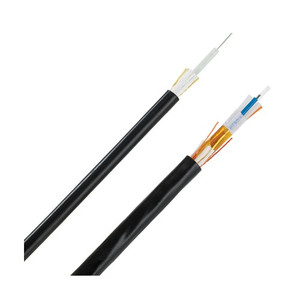
Panduit FSCR906Y Opti-Core 6-Fiber OS2 Indoor/Outdoor Riser Cable
The Panduit FSCR906Y delivers single-mode fiber backbone infrastructure for commercial buildings, datacenters, and campus environments where runs cross environmental boundaries. This 6-fiber central tube cable combines OS2 9/125µm glass with dual indoor/outdoor rating and OFNR riser flame certification, solving the compliance gap installers face when a single backbone route transitions from exterior walls to vertical risers without splice points. At 250µm tight-buffered construction, each fiber terminates directly to standard LC, SC, or ST connectors without fanout kits—cutting labor on both ends of the pull. Security integrators running surveillance networks between buildings and IT teams linking switch stacks across floors get one SKU that meets NEC Article 770 riser requirements and survives moisture exposure during the outdoor segment, eliminating the dual-cable vulnerability of indoor-only plenum runs that fail at building-entry points.
Key Features
- OS2 single-mode fiber (9/125µm) supports 10G/40G/100G Ethernet and 16/32G Fibre Channel over distances to 10 km without amplification
- Indoor/outdoor rating eliminates splice-point failure risk when backbone routes cross building envelopes or traverse exterior walls between telecom rooms
- OFNR riser flame certification (UL 1666) meets NEC 770.154(A) for vertical cable trays and conduit between non-plenum floors
- 6-fiber count fits small-to-medium backbone deployments: three duplex links for redundant uplinks, storage replication, and out-of-band management
- 250µm tight-buffered fibers terminate directly to fusion-spliced pigtails or field-installable connectors without buffer-tube stripping—20-minute labor savings per end on 6-fiber count
- Central tube design maintains 1.5 mm bend radius under no-load conditions and 20× cable diameter (typ. 30 mm) during installation pulls—survives tight 90° conduit elbows without attenuation spikes
- Black polyethylene jacket resists UV degradation during outdoor aerial or conduit exposure; indoor-rated jacket would chalk and crack within 18 months of sunlight exposure
- Panduit Opti-Core sub-brand delivers batch-tested insertion loss ≤0.3 dB/km at 1310 nm and ≤0.2 dB/km at 1550 nm, guaranteeing margin on 10GBASE-LR links operating near the 10 km spec limit
OS2 Single-Mode Performance for Multi-Gigabit Infrastructure
The FSCR906Y uses ITU-T G.652.D-compliant OS2 fiber with 9µm core diameter, optimized for laser-based transceivers in 10GBASE-LR, 40GBASE-LR4, and 100GBASE-LR4 deployments. At 1310 nm wavelength, chromatic dispersion stays below 3.5 ps/nm·km, and attenuation measures ≤0.4 dB/km per OS2 spec (Panduit Opti-Core typically ships ≤0.3 dB/km). A 2 km building-to-building run accumulates just 0.6 dB fiber loss, leaving 6.9 dB margin against the 7.5 dB 10GBASE-LR budget—enough to absorb four fusion splices (0.1 dB each), two connector pairs (0.75 dB each), and still pass with 5.5 dB margin. Contrast with OM3 multimode's 300-meter 10G limit: any datacenter with edge switches in a separate building or surveillance head-end in a remote guard shack exceeds multimode range, forcing costly media converters. OS2 single-mode eliminates that conversion tax and future-proofs for 100G upgrades using the same installed fiber—40GBASE-LR4 and 100GBASE-LR4 transceivers operate on the identical 9/125µm glass without re-cabling.
Indoor/Outdoor Rating Solves Building-Entry Compliance Gaps
Most riser cables carry indoor-only jackets that fail NEC 770.154(C) and local amendments when the route exits the building envelope. A typical scenario: datacenter in building A, switch stack in building B, 60-meter conduit run that crosses an exterior wall for 15 meters between structures. Installers using indoor-only OFNR cable technically violate code at the outdoor segment (moisture ingress voids the flame rating), while outdoor-only cables lack riser certification for the vertical portions. The workaround—splice indoor and outdoor cables at the building-entry point—adds two splice enclosures, 12 fusion splices, and two potential failure points where moisture or mechanical stress concentrates. The FSCR906Y's dual rating eliminates the splice: pull one continuous cable from the basement riser to the outdoor conduit and back into the remote building's riser without code violations. The polyethylene jacket meets outdoor UV and moisture resistance requirements, while the internal construction and flame-retardant buffer coatings satisfy UL 1666 vertical-tray flame testing. Inspectors reviewing NEC Article 770 compliance see one cable type on the pullout schedule instead of a splice-based hybrid.
OFNR Riser Flame Certification for Vertical Cable Trays
The FSCR906Y carries an Optical Fiber Nonconductive Riser (OFNR) rating per NEC 770.154(A) and UL 1666 vertical-tray flame test protocol. During UL 1666 testing, cable samples mounted in a vertical tray are exposed to a 154,000 BTU/hr gas-burner flame for 30 minutes; riser-rated cables must self-extinguish and limit char to 8 feet of vertical spread. This certification permits installation in vertical runs between floors that do not share plenum return-air spaces—the majority of riser conduit and cable-tray applications in commercial buildings. Security integrators running fiber from a ground-floor head-end to rooftop camera switches, or IT teams linking basement datacenters to top-floor telecom rooms, can pull OFNR cable through non-plenum risers without the cost premium of plenum-rated (OFNP) cable. Note the key restriction: OFNR is prohibited in environmental air-handling spaces (ducts, plenums) per NEC 770.113(B); those installations require OFNP. The FSCR906Y's riser rating fits vertical conduit, j-hooks in non-plenum shafts, and ladder-rack risers in stairwells—covering ~70% of vertical fiber routes in typical office and industrial facilities.
6-Fiber Count for Redundant Backbone and Segmented Networks
Six fibers provide three duplex links, a practical count for small-to-medium backbone deployments that require physical path diversity without the cost and bulk of 12- or 24-fiber cables. Common allocation: two fibers for primary 10G uplink (SFP+ TX/RX pair), two fibers for redundant uplink to a secondary aggregation switch (spanning-tree or MLAG failover), and two fibers for out-of-band management or dedicated storage replication traffic. Surveillance integrators gain flexibility to run one fiber pair for live camera traffic (primary network) and a second pair for a separate recording/archival VLAN that isolates high-bitrate NVR writes from the production LAN. Datacenter operators allocate one pair per failure domain: primary east-west traffic, secondary north-south gateway link, tertiary backup replication to off-site SAN—each on isolated fiber pairs to prevent a single connector failure from cascading across all links. The 6-fiber count also simplifies termination labor compared to high-density 24- or 48-fiber cables: a single 6-port LC cassette or six individual SC simplex connectors completes the job in 45 minutes with fusion splicer and cleaver, versus 2+ hours for 24-fiber breakout and testing.
250µm Tight-Buffered Construction for Direct Termination
Each OS2 fiber in the FSCR906Y is individually coated with a 250µm tight buffer—an extruded polymer layer applied directly over the 125µm cladding. This construction allows direct termination to field-installable connectors (Panduit FXLC, Corning UniCam, etc.) or fusion-spliced pigtails without intermediate buffer-tube stripping or fanout kits. Contrast with loose-tube cable designs common in outdoor-only applications: 250µm fibers float inside a larger buffer tube filled with gel or dry water-blocking compound; termination requires stripping the tube, cleaning gel, threading fibers into a breakout kit, and then connectorizing—adding 15–20 minutes of prep per cable end. Tight-buffered 250µm construction on the FSCR906Y cuts that step entirely: strip the outer jacket, expose six color-coded 250µm fibers, cleave to length, and insert directly into connectors or splice to pre-terminated pigtails. This labor savings compounds on projects with dozens of backbone runs—six 6-fiber cables save 3+ hours of termination labor compared to equivalent loose-tube designs. The tight buffer also provides mechanical protection during handling: installers can strip and re-route individual fibers at patch panels without risking microbend attenuation that occurs when bare 125µm cladding is bent too tightly.
Central Tube Design Balances Flexibility and Bend-Radius Protection
The FSCR906Y uses a central-tube architecture: all six 250µm fibers are bundled inside a single protective tube at the cable core, surrounded by strength members and the outer jacket. This design delivers a compact 6 mm overall cable diameter (typical) and a minimum bend radius of 30 mm (20× diameter) during installation pulls—tight enough to navigate 2-inch conduit 90° sweeps and tight j-hook runs in crowded cable trays without exceeding the bend-radius limit that would cause attenuation spikes or fiber fracture. Under no-load conditions (cable at rest in a patch-panel enclosure), the minimum bend radius relaxes to 15 mm, permitting tight coiling inside wall-mount fiber enclosures or slack loops in telecom rooms. Strength members—typically aramid yarn (Kevlar) strands—run longitudinally along the tube and absorb tensile load during pulls, preventing stress transfer to the glass fibers. Maximum rated pulling tension is 600 N (135 lbf) for the FSCR906Y; a typical 100-meter conduit pull with two 90° bends generates ~200 N tension, leaving 3:1 safety margin. Installers should attach pull tape to the strength members (not the jacket or tube) using a cable grip or kellems grip to distribute load evenly and avoid jacket shear that could compress the central tube and micro-bend the fibers.
Black Polyethylene Jacket for UV and Moisture Resistance
The outer jacket is black polyethylene (PE) compounded for outdoor UV stability and moisture resistance. Polyethylene withstands continuous sunlight exposure for 20+ years without chalking, cracking, or losing flame-retardant properties—critical for aerial runs on building exteriors or conduit entries where the cable exits underground vaults and transitions to above-grade j-hooks. Indoor-only PVC jackets degrade under UV within 18 months, turning brittle and splitting at bend points; the resulting moisture ingress corrodes splice points and attenuates fibers through water absorption in the buffer coatings. The FSCR906Y's PE jacket also resists hydrolysis in wet conduit environments (groundwater seepage, condensation in buried ducts), maintaining jacket integrity and flame rating even after years of submersion. The black pigment provides additional UV blocking compared to natural or gray PE, and offers visual differentiation from indoor-only yellow (singlemode) or orange (multimode) cables during inspections. Note that polyethylene has a higher coefficient of friction than PVC; use fiber-specific pulling lubricant (polywater J, Ideal Yellow 77) on pulls longer than 50 meters to prevent jacket abrasion and reduce pulling tension.
Panduit Opti-Core Sub-Brand: Batch-Tested Performance Specs
Panduit's Opti-Core product line undergoes batch-level insertion-loss and return-loss testing before shipment, guaranteeing performance tighter than generic OS2 spec limits. Typical Opti-Core results: ≤0.3 dB/km attenuation at 1310 nm and ≤0.2 dB/km at 1550 nm, compared to OS2's ≤0.4 dB/km and ≤0.3 dB/km limits. That 0.1–0.15 dB/km margin translates to 150–200 meters of additional link budget on a 1 km run—enough to absorb an extra connector pair or splice without exceeding transceiver receiver-sensitivity limits. Opti-Core cables also ship with traceable test results: batch number and attenuation data printed on the jacket at meter intervals, enabling installers to document certified performance for customer acceptance testing or warranty claims. This traceability matters on projects requiring third-party OTDR certification (common in government and healthcare datacenter builds), where the customer's test house validates installed performance against manufacturer specs. Generic fiber ships with no per-batch data, forcing installers to test every reel before installation or risk field failures that void project acceptance.
Deployment Scenarios: Building Backbone, Campus Distribution, and Surveillance Networks
The FSCR906Y fits three high-volume deployment patterns. Building backbone (vertical riser): IT teams run 6-fiber riser cables from basement datacenters to telecom closets on floors 2–10, providing redundant 10G uplinks for edge switches and future 40G expansion without re-cabling. A 12-story office building requires eleven 6-fiber risers (ground to floor 12), each averaging 40 meters vertical + 10 meters horizontal routing = 550 meters total per riser. Campus distribution (building-to-building): Security integrators run outdoor-rated fiber between a central head-end and remote buildings housing camera switches or access-control panels. A corporate campus with five buildings in a 200-meter radius uses four 6-fiber FSCR906Y runs (star topology from central NOC), each carrying two fiber pairs for surveillance and two pairs for data network extension. The outdoor segments cross parking lots in buried conduit; the indoor segments rise through non-plenum risers to equipment rooms—one cable type for the entire route. Datacenter east-west fabric: Larger datacenters use 6-fiber cables for top-of-rack to spine-switch connections in leaf-spine architectures, where each rack gets one 6-fiber run providing three redundant 10G or 40G uplinks to separate spine switches. A 20-rack datacenter with three spine switches consumes 20× 6-fiber FSCR906Y cables, totaling 1,200 fibers (600 duplex links) for full mesh redundancy.
Installation Best Practices: Pulling Tension, Bend Radius, and Termination
Observe maximum pulling tension of 600 N (135 lbf); use a calibrated fish-tape tension gauge or cable-pulling dynamometer on runs longer than 75 meters or routes with more than two 90° bends. Attach pull tape to aramid strength members using a cable grip (Kellems-style mesh grip sized for 6 mm cable diameter) and apply fiber-rated pulling lubricant to reduce friction in conduit. Maintain minimum bend radius of 30 mm (1.2 inches) during pulls; standard 2-inch PVC conduit 90° sweeps have a 6-inch centerline radius, providing 5:1 margin against the 30 mm limit. At splice enclosures and patch panels, relax bend radius to 15 mm for slack storage inside enclosures, but avoid tight coiling below 10 mm—microbending at sub-minimum radius causes 0.2–0.5 dB attenuation spikes that appear during OTDR testing as non-reflective events. For termination, strip outer jacket 1 meter from cable end using a fiber jacket stripper (no utility knives; scoring the jacket risks nicking buffer tubes). Expose six 250µm tight-buffered fibers, clean with isopropyl alcohol, and cleave using a precision cleaver (Fujikura CT-50, Sumitomo FC-6S) to achieve <0.5° end-face angle and <0.5µm cleave-length deviation. Fusion-splice to pre-terminated LC or SC pigtails using a core-alignment splicer (typical splice loss 0.05–0.1 dB), or field-install connectors using anaerobic adhesive (3M Hot Melt) and polish to <0.2 dB insertion loss. Test each fiber pair with an OTDR set to 1310 nm and 1550 nm wavelengths; accept links showing ≤0.5 dB total insertion loss per connector pair and ≤0.3 dB per fusion splice.
The Panduit FSCR906Y ships by the foot as bulk cable, compatible with standard fiber enclosures, patch panels, and pigtail assemblies from Panduit, Corning, Leviton, and Commscope. Use this cable on projects requiring NEC-compliant riser installations, dual indoor/outdoor environmental rating, and OS2 single-mode performance for 10G/40G/100G networks—delivering one SKU that eliminates splice points, reduces termination labor, and survives 20-year outdoor exposure without jacket degradation.