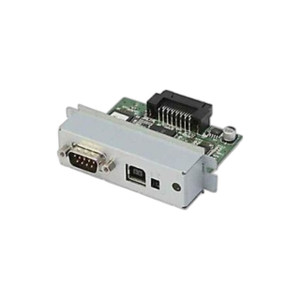
Epson C32C824561 USB/Serial Interface Board
The Epson C32C824561 is a USB/Serial interface board engineered for Epson receipt printer platforms requiring dual communication pathways. Operating at 3.3V, this modular board solves the integration challenge when a point-of-sale environment must support both legacy serial connections and modern USB simultaneously on the same hardware. Deploy this when retrofitting communication infrastructure without replacing the entire printer unit.
Key Features
- Dual Interface Support: USB and serial (RS-232) connectivity on a single board. Eliminates the need to choose between legacy terminal equipment and current POS systems.
- 3.3V Operating Voltage: Designed specifically for Epson receipt printer platforms. Voltage mismatch with 5V systems will cause component failure — verify printer specifications before installation.
- 600 dpi Print Resolution: Supports high-fidelity receipt and label printing on compatible Epson models. Improves barcode readability and text legibility for transaction records and compliance documentation.
- Modular Form Factor: Seats directly into Epson printer interface slots. Enables in-field communication pathway upgrades without full printer replacement or lengthy procurement cycles.
- 1-Year Manufacturer Warranty: Factory coverage against defects in materials and workmanship. Does not cover installation damage or voltage-related failures.
- Legacy and Modern POS Integration: Bridges serial-only legacy systems (older terminals, control boards) with USB-based modern POS software and devices. Useful during staged POS migrations.
Compatibility & Integration
The C32C824561 integrates exclusively with Epson receipt printer platforms engineered for modular interface expansion — it is not a universal retrofit. Compatibility is model-specific and depends on the printer's internal slot configuration, firmware version, and physical form factor. Before ordering, verify your printer's documentation or contact Epson technical support to confirm compatibility. Installing this board into an incompatible printer risks damage to both the board and the printer's main logic board.
USB connectivity follows standard HID or CDC protocols supported by Windows, Linux, and macOS POS environments. Serial connectivity operates at standard RS-232 voltage levels and baud rates (typically 9600–115200 bps). Most modern POS software (Square, Toast, Clover, and on-premises NVR / point-of-sale systems) recognizes both interfaces immediately upon detection. If your POS system is older or uses proprietary driver requirements, test the board in your environment before deploying across multiple units.
Installation & Environmental Considerations
The 3.3V operating voltage is non-negotiable — installing this board into a system expecting 5V interface cards will cause immediate failure and is not repairable under warranty. Locate the designated interface slot in your Epson printer (consult the service manual for slot location, orientation, and grounding requirements). Power down the printer before installation. Seat the board firmly into the slot, secure any retention clips, and verify LED indicators (power, communication status) light correctly before powering on and loading media.
This interface board is designed for indoor point-of-sale environments (retail counters, restaurants, ticketing kiosks). It is not rated for high-heat, high-humidity, or dusty environments. Avoid direct exposure to liquid splash or solvent fumes. If your receipt printer is mounted in a kitchen or warehouse, verify environmental durability with Epson before deployment. Standard POS enclosures and mounting racks provide adequate protection for most retail settings.
Why Choose This Board
Upgrading receipt printer communication infrastructure often triggers an entire hardware refresh — the Epson C32C824561 defers that capital expenditure by enabling dual-path connectivity on existing hardware. For integrators managing heterogeneous POS environments (some sites still running serial terminals, others on modern cloud-based systems), this board eliminates the operational overhead of maintaining two separate printer platforms. The 3.3V specification aligns with Epson's modern receipt printer roadmap, making this board compatible with current inventory. Consult the product datasheet for pinout and electrical specifications.
Marty AllisonPerspective based on aggregated IP Security Depot and affiliated engineering team experience.
We've deployed the Epson C32C824561 across retail, quick-service restaurant, and ticketing environments where POS system migrations were staged over months or years. The real value proposition is time-to-integration: instead of scheduling a full printer replacement, swap the interface board in an afternoon and unlock both serial and USB support on hardware already installed in the field. This matters most when the incumbent POS system (a legacy terminal or proprietary countertop device) runs serial-only, and you're rolling out a new cloud-based system on USB. The dual-path approach lets you pilot the new system on a subset of terminals without decommissioning the old infrastructure immediately. On the operational side, we've seen integrators reduce their spare-parts inventory by treating this board as a communication bridge rather than committing to a full printer SKU strategy. The 3.3V spec is critical — voltage mismatch is the most common failure mode we encounter. Always verify the printer service manual and test on a non-production unit first.
Technical Highlights:
- USB and Serial on One Board: Eliminates the operational complexity of maintaining two separate printer models for different POS environments. On large deployments (50+ locations), this consolidation cuts spare-parts costs and simplifies training for field technicians.
- 3.3V Operating Voltage: Modern Epson receipt printer platforms use 3.3V logic — older boards expect 5V. Mixing voltages destroys the interface board and potentially the printer's main logic board. Verify your printer's voltage specification in the service manual before ordering.
- 600 dpi Resolution Support: Receipt printers at 600 dpi deliver crisp barcode scans and clear text legibility. For compliance-heavy environments (pharmacies, financial services), that resolution translates to auditable receipt quality and reduced manual data entry downstream.
- Modular Retrofit Design: Avoids the procurement delay and capex of a full printer replacement. On a 100-unit retail chain, this represents weeks of time-to-deployment and tens of thousands in avoided hardware spend.
- Standard Interface Protocols: USB HID and CDC, RS-232 serial — both are well-documented and widely supported in POS middleware (Ingenico, Oracle MICROS, Toast, on-premises NVR integration points). No custom drivers needed for most environments.
Deployment Considerations:
- Compatibility is model-specific to the Epson printer chassis — do not assume this board works on all Epson receipt printers. Cross-reference the printer's service manual and Epson's compatibility matrix before ordering. A single wrong model can waste a technician visit.
- 3.3V voltage is non-negotiable. If you're pulling a 5V interface board out of an older Epson TM series, this C32C824561 will not be a direct swap. Verify firmware version as well — some older printers cannot address a 3.3V board even with compatible hardware slots.
- Installation requires the printer to be powered down and the interface slot to be accessible. On wall-mounted or recessed POS terminals, the access panel may be tight. Budget extra time if mounting space is constrained.
- Serial connectivity defaults to 9600 baud on most Epson models. If your POS system or legacy terminal requires a different baud rate, consult the printer's dip-switch settings or firmware configuration. Some older systems cannot negotiate baud rates dynamically.
- USB cable length and shielding matter in electrically noisy retail environments (near wireless routers, LED displays, or HVAC). Use shielded USB cable and keep runs under 10 feet for maximum stability. If distances exceed 15 feet, add a powered USB hub or switch to serial connectivity.
- Test the board in your specific POS environment before rolling out to production. Some legacy POS applications have driver quirks or timeout behaviors that don't manifest until real-world load testing.
The Epson C32C824561 is the right choice for integrators managing heterogeneous POS installations or staging multi-phase system migrations where dual communication pathways avoid hardware replacement cycles. It's not suitable for new-build greenfield deployments where a single modern USB-only receipt printer would suffice. For deployments that require it, this board typically saves weeks of coordination and thousands in capex. Explore the full Epson catalog for compatible receipt printer models and alternative interface options.