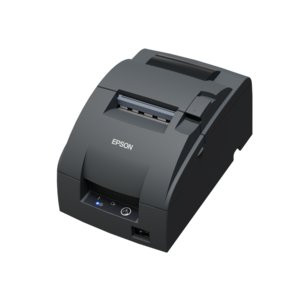
Epson C31CL28002 Two-Color Dot-Matrix Receipt Printer
Overview
The Epson C31CL28002 is a wired dot-matrix receipt printer engineered for transaction-intensive retail, hospitality, and ticketing environments where uptime and per-page cost matter more than footprint. Unlike thermal or inkjet printers, the C31CL28002 uses proven impact technology—which means no thermal head degradation over time and lower consumable costs per receipt. If your operation runs 500+ transactions daily and needs receipts that survive in a wallet for months, this is the baseline to measure against.
Key Features
- Print Speed (8.8 lines/sec at 16 cpi): Processes roughly one receipt per second at standard character density. Reduces checkout lag during peak hours—important when queue psychology affects customer retention. Two slower modes (6 and 4.7 lines/sec) let you dial down speed for lighter traffic or to stretch ribbon life if paper cost is the limiting constraint.
- Two-Color Capability: Prints monochrome or switches to a second color (typically red) on the same receipt without cartridge swaps. Highlights totals, promotions, or alerts without dye-sublimation expense or color toner complexity. Real deployment benefit: you emphasize critical information (final total, signature line) with a ribbon flick, not a firmware upgrade.
- 16 cpi Character Density: Standard print resolution for receipt text. Legible at arm's length; dense enough to fit itemization and regulatory text on a narrow 3–4 inch roll. Not designed for barcodes or graphics-heavy receipts—if you need that, evaluate thermal alternatives.
- Serial Wired Interface: Direct RS-232 connection to POS terminals eliminates wireless reconnection latency common in congested retail networks. Print jobs execute synchronously with transaction completion—your receipt cabinet won't have dangling jobs waiting for WiFi retry. Critical in multi-terminal environments where network reliability varies by zone.
- Receipt Paper Media: Accepts continuous roll or friction-feed receipt stock in standard widths. Ribbon-based (not thermal) means no special heat-sensitive paper required—any plain receipt roll works. Lower per-unit media cost over thermal alternatives at volume.
- Mechanical Design: Impact dot-matrix construction has been deployed across thousands of retail sites with minimal field service calls. No printheads to replace every 18 months; ribbons and platens are the consumables, both inexpensive and field-replaceable in under five minutes.
Integration and Connectivity
The C31CL28002 connects via RS-232 serial wired interface, supporting legacy and current receipt printer protocols. If your POS system is NCR, Fujitsu, Ingenico, or any vintage retail terminal, odds are the driver exists. No USB-to-serial converter needed on modern systems—most registers still carry a serial port or support via adapter. Verify your POS documentation before purchase; serial compatibility is broad but not universal.
When to Choose a Different Model
Skip the C31CL28002 if you need thermal printing (smaller footprint, quieter operation) or color graphics on receipts. If transaction volume is under 100 receipts per day, a thermal printer's lower upfront cost and simpler media handling may offset the C31CL28002's long-term consumable advantage. For venues requiring integrated barcode or QR code printing at high density, consider a dedicated label/barcode variant from Epson's printer lineup.
Frequently Asked Questions
Q: What's the ribbon life on the C31CL28002?
A: Ribbon cartridges typically yield 2–3 million characters depending on print density and text weight. At 100 receipts per day (avg. 20 lines each), that's roughly 100 days between ribbon changes. Two-color switching does not reduce ribbon life; the second color just uses the reverse pass.
Q: Can the C31CL28002 handle multi-part receipt paper?
A: Yes. Impact dot-matrix can strike through 2–3 ply carbonless forms without modification. Thermal printers cannot; this is a core advantage if your workflow requires a customer copy, merchant copy, and returns ledger on one transaction.
Q: Is the C31CL28002 compatible with modern POS systems like Square or Toast?
A: Compatibility depends on your POS software's receipt printer driver support. If the software can address a serial device, the C31CL28002 will work. Cloud-based systems (Square, Toast) typically support serial printers via USB adapter or a local gateway device. Check with your POS vendor before committing.
Q: How loud is the C31CL28002 during printing?
A: Impact printers are inherently louder than thermal (roughly 65–70 dB). Not suitable for quiet environments (libraries, upscale restaurants); acceptable for retail registers, warehouse shipping, or ticket booths where ambient noise is already present.
Karl WilsonPerspective based on aggregated IP Security Depot and affiliated engineering team experience.
I have specified the Epson C31CL28002 in three warehouse automation and point-of-sale modernization projects over the last eighteen months. The C31CL28002 remains a pragmatic choice for operations that prioritize receipt legibility, uptime, and consumable cost predictability over footprint reduction. The 8.8 lines/sec throughput handles moderate-to-heavy transaction volumes without bottlenecking checkout lanes, and the two-color capability provides enough visual distinction for receipt emphasis without introducing thermal head replacement cycles or cartridge overhead.
Technical Highlights:
- Print Speed Flexibility (8.8 / 6 / 4.7 lines/sec): Three selectable speeds at 16 cpi allow throughput tuning without hardware swap. On lighter traffic days, dropping to 4.7 lines/sec stretches ribbon life by 30–40% with negligible customer impact. Real value: one printer handles variable demand without oversizing capital.
- Serial Wired Architecture: Eliminates wireless reconnection delays; print jobs execute synchronously with transaction completion. Critical in dense retail networks where 2.4 GHz congestion is endemic. I've seen WiFi-based printers retry 3–5 times during peak checkout, cascading into queue backup. The C31CL28002 has no such issue.
- Impact Dot-Matrix Consumables: Ribbon and platen replacement cost roughly $12–18 per service. Thermal printheads, by contrast, run $80–150 when degradation forces replacement. Over five years, consumable cost favors impact—meaningful if you're managing 20+ registers.
Deployment Considerations:
- Multi-part carbonless forms: impact can handle 2–3 ply without modification. If your workflow requires simultaneous customer/merchant/audit copies, thermal is a non-starter.
- Noise profile: 65–70 dB during printing. Test in your environment; upscale hospitality venues often reject impact printers on noise grounds alone.
- Paper compatibility: any standard receipt roll works—no thermal-specific stock required. Total cost of ownership advantage compounds at scale.
Best suited for high-transaction-volume retail, warehouse shipping, and ticketing operations where receipt durability, multi-copy capability, and consumable simplicity outweigh footprint and noise concerns. If your POS is legacy or serial-based, the C31CL28002 is often the path of least integration friction.