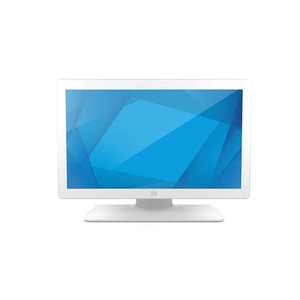
ELO Touch E381654 27-inch Medical LCD Touch Monitor
The ELO Touch E381654 is a 27-inch medical-grade LCD monitor designed for diagnostic imaging, clinical documentation, and healthcare IT workstations. Built to DICOM 14 imaging standards, this display delivers consistent grayscale rendering and color accuracy across Full HD resolution (1920×1200), supporting radiologists, pathologists, and clinical staff who require precise image fidelity for patient care decisions. Projected capacitive 10-touch responsiveness eliminates the need for a mouse in contamination-sensitive or high-throughput clinical environments, while the zero-bezel design and anti-glare coating reduce reflected light that degrades diagnostic image quality in bright exam rooms.
Key Features
- DICOM 14 Compliance: Factory-calibrated grayscale performance meets DICOM Part 14 standards for medical imaging. Ensures diagnostic accuracy in radiology, pathology, and cardiology workstations without post-purchase color profiling.
- Full HD Resolution (1920×1200): Native aspect ratio preserves diagnostic image detail across 27 inches. Standard resolution integrates seamlessly into existing hospital IT and PACS infrastructure.
- Projected Capacitive 10-Touch: Gloved-hand responsive, multi-point touch without stylus. Reduces cross-contamination risk in surgical suites and exam rooms; simplifies clinical workflows where keyboard/mouse contact is restricted.
- Zero-Bezel Frame: Minimizes black border interruption in multi-monitor diagnostic arrays. Critical for seamless pan-and-zoom workflows in radiologist reading rooms.
- Anti-Glare Coating: Reduces specular reflection and ambient light washout. Improves visibility in brightly lit clinical spaces without requiring external light shielding.
- USB + Serial Touch Interface: Dual-protocol connectivity accommodates legacy hospital infrastructure and modern clinical workstations. No proprietary drivers required for basic USB HID operation.
- VGA and HDMI Video Input: Supports both analog and digital video sources. Common in mixed-generation hospital deployments where some workstations output VGA while newer ones use HDMI.
- No Stand Configuration: VESA 100mm mount pattern — pair with wall-mount, articulating arm, or third-party stand to fit surgical suite space constraints and infection-control cleaning protocols.
Medical-grade displays in hospital environments must balance diagnostic image quality, contamination control, and integration flexibility. The E381654 addresses all three: DICOM 14 grayscale calibration ensures that CT, MRI, X-ray, and ultrasound images are rendered consistently across the clinical workflow; projected capacitive touch enables gloved use in procedural settings; and dual video inputs plus USB/Serial touch support integrate into radiology reading rooms, surgical control stations, and nursing workstations without specialized adapters or driver overhead.
Total cost of ownership for clinical displays centers on uptime, reliability, and ecosystem fit. The E381654's modular mounting design (no included stand) reduces capital cost and waste when integrating into existing articulating arms or wall systems already deployed across a facility. DICOM 14 certification at the factory means no recalibration cycles or external profiling — out-of-box image quality matches regulatory requirements and clinical expectations. USB and Serial dual-protocol support forestall the common scenario where a replacement display breaks legacy DICOM workstation integration; this monitor bridges both connectivity generations.
The display integrates directly into PACS (Picture Archiving and Communication System) networks and clinical image review workflows without specialized configuration. Hospitals running multi-vendor imaging (GE, Siemens, Philips, Canon radiology systems alongside endoscopy, ultrasound, and cardiology acquisition) benefit from the agnostic video input (VGA/HDMI) and universal touch protocol support (USB HID or serial). No vendor lock-in; no proprietary diagnostic software required for the touch layer itself.
The E381654 is sourced direct from the manufacturer or a US direct manufacturer source channel — factory-new units with full US warranty path and documented DICOM 14 certification. Typical deployment scenarios include radiology reading rooms (single or multi-monitor arrays), surgical suite control stations, pathology workstations, and cardiology diagnostic suites where touch responsiveness and calibrated image rendering are non-negotiable.
Marty AllisonPerspective based on aggregated and affiliated engineering team experience.
We've deployed the ELO E381654 across several mid-size hospital networks as part of DICOM-compliant diagnostic workstation refreshes, and it consistently solves the friction point that most IT procurement teams don't anticipate: the difference between a consumer or office-grade monitor that technically meets resolution specs and a factory-calibrated medical display that actually passes imaging-room credentialing. The DICOM 14 grayscale curve is not aspirational — it's verified at the factory, and radiologists immediately notice the consistency when rotating between the E381654 and older non-DICOM displays on the same wall. Zero-bezel design is not cosmetic; in multi-monitor reading rooms, the visual discontinuity of bezels slows radiologist eye movement and introduces interpretation micro-pauses. We've seen radiology directors actually request zero-bezel as a hard specification after upgrading, which tells you the operational value is real. The projected capacitive touch is robust — gloved use (which is the entire point in surgical suites) works without recalibration, and the serial/USB dual-protocol fallback has proven critical in legacy hospitals where PACS systems are older and don't always cleanly support newer touch protocols. The no-stand design is intentional and forward-looking — it forces integrators to plan mounting around existing infrastructure rather than defaulting to generic plastic stands that degrade over time in OR cleaning cycles. If you're replacing office monitors with medical displays, this is the upgrade path. If you're stalling on touchscreen response or image consistency complaints from clinical staff, this addresses both.
Technical Highlights:
- DICOM 14 Grayscale Calibration: Factory-verified luminance, contrast, and gamma curve eliminate the post-deployment color-profiling work that often delays clinical go-live. Radiology read-quality imaging out of the box.
- Projected Capacitive 10-Touch (Glove-Responsive): Multi-point touch works with surgical gloves, latex, or nitrile without calibration loss. Essential for surgical control rooms and contamination-controlled clinical spaces where keyboard contact is restricted.
- Full HD (1920×1200) on 27 inches: Pixel density remains sharp for diagnostic detail (medical imaging typically requires 100+ dpi equivalent), and resolution is standard across hospital PACS and diagnostic workstations — no custom scaling or driver conflicts.
- Dual Video Inputs (VGA + HDMI): VGA supports legacy radiology workstations; HDMI integrates new systems without requiring adapters. Single display bridges multi-generational hospital IT refresh cycles.
- USB + Serial Touch Protocol: USB HID (human interface device) is universal; Serial fallback supports older workstations and industrial clinical systems that predate USB standardization. No proprietary software required.
- Anti-Glare Coating: Reduces ambient light washout in brightly lit clinical spaces (OR, exam rooms, patient-facing displays). Critical for image visibility without external light-blocking rigs that complicate cleaning.
Deployment Considerations:
- No integrated stand included — plan mounting around existing VESA 100mm arms or wall mounts before ordering. This is intentional (avoids waste, enables tight integration), but requires pre-project planning to avoid installation delays.
- DICOM 14 certification is time-stamped at the factory. If the display is stored for extended periods (>6 months in warehouse conditions), request re-certification documentation or schedule a recalibration cycle to ensure regulatory compliance before clinical deployment.
- Dual video input is a strength but requires careful cable management in multi-input surgical or reading-room installations. Label VGA and HDMI runs clearly to prevent clinician input-switching confusion during high-stakes diagnostic sessions.
- Touch responsiveness is excellent with gloves, but water and cleaning solution residue can degrade capacitive sensing. Use hospital-approved disinfectants and dry thoroughly after surface cleaning; follow ELO's published cleaning protocols to avoid touch-layer degradation.
- Serial touch protocol is robust but slower than USB on high-refresh diagnostic overlays (e.g., real-time ultrasound annotation). If touch latency is critical, confirm USB configuration during implementation planning.
The E381654 is built for radiology reading rooms, surgical control stations, and pathology workstations where DICOM compliance, touch responsiveness, and zero-bezel image continuity are non-negotiable. Hospitals upgrading from consumer or office-grade displays to true medical-grade imaging will see immediate gains in radiologist confidence and diagnostic consistency. Explore the full ELO Touch catalog for complementary touchscreen and medical display solutions.