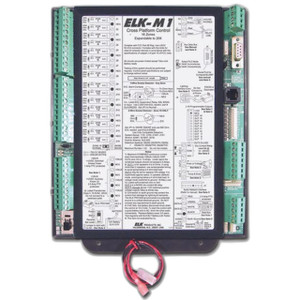
ELK Products ELK-M1GSYS4S M1 Gold 4-Door Access Control System
Overview
The ELK-M1GSYS4S is a professional integrated access control and alarm system controller designed for small to mid-scale security deployments requiring coordinated management across multiple entry points. The M1 Gold architecture consolidates access control and alarm functionality into a single controller, eliminating the need to manage separate systems and reducing design complexity during installation and commissioning. This 4-door configuration with 999-user capacity scales from single-facility deployments to multi-location operations where credentials and policies are managed centrally.
Key Features
- 4-Door Capacity: Manages up to 4 independent doors with individual control and monitoring — practical for office buildings, warehouses, and retail locations with distributed entry points. Individual door control means you can enforce different access policies per entry without adding extra hardware.
- 999-User Maximum: Supports enterprise-scale credential databases without requiring a larger controller or external directory server. This capacity handles organizational growth and temporary access (contractors, vendors) without system replacement.
- Multiple Credential Formats: Flexible reader compatibility lets you deploy proximity cards, keypads, biometric readers, or hybrid systems based on facility requirements rather than controller limitations. Mixed-credential environments are common in warehouses and multi-tenant buildings, and the ELK-M1GSYS4S accommodates this without workarounds.
- Multiple Reader Types Supported: Hardware-agnostic reader interface integrates standard access hardware (proximity, keypad, biometric) directly. You specify readers based on security posture and user workflow, not controller constraints.
- Standard Electric Strike and Electromagnetic Lock Support: Compatible with industry-standard access hardware for both fail-safe (unlocked on power loss) and fail-secure (locked on power loss) configurations. No third-party interface modules required in most installations, reducing bill-of-materials cost and troubleshooting complexity.
- 12VDC Operation: Single power supply architecture simplifies cabinet power distribution and aligns with typical security integrator electrical practices. One 12V feed eliminates the need for auxiliary power conversion stages.
- Unified Access and Alarm Management: Consolidated controller consolidates access and alarm events in one managed platform. This matters during incident response — a door-forced alarm and access log are tied to the same event timeline, reducing confusion and accelerating investigation.
- Centralized User Management: Single credential and access policy repository across all 4 doors reduces administrative overhead and policy drift across entry points. Revoking a user credential is a one-step operation.
Integration and Compatibility
The ELK-M1GSYS4S operates within a professional integrated architecture that consolidates access control and alarm management. The system's support for multiple reader types and credential formats allows installers to specify reader hardware based on facility requirements rather than controller limitations. Standard electric strikes and electromagnetic locks integrate directly, eliminating the need for third-party interface modules in most installations. The 12VDC power supply design accommodates typical cabinet power distribution practices found in security integrator environments.
With 999-user capacity, the system scales from small single-facility deployments to multi-location operations where user credentials are managed centrally. Credential format flexibility ensures the ELK-M1GSYS4S (often searched as ELK M1GSYS4S) adapts to existing access control investments or new technology selections without controller replacement. Integration with access control systems from multiple vendors is supported through the controller's standard reader interface architecture.
Typical Applications
The 4-door configuration suits office buildings, small retail locations, warehouses, and facilities with distributed entry points requiring coordinated access control and alarm response. The user capacity and credential flexibility make the system appropriate for organizations with turnover, temporary access needs, and evolving security requirements. Facilities transitioning from badge-only to multi-factor access (card + keypad or biometric) can do so without hardware replacement. Warehouse environments with time-zone access control (dock area 24/7, office area business hours) benefit from the individual door policy management and unified event logging.
When to Choose a Different Model
If your deployment requires more than 4 doors, consider the ELK Products higher-capacity variants in the M1 Gold family. If credential management across multiple buildings requires cloud synchronization or advanced audit trails, evaluate whether a networked access control platform better fits your architecture. For facilities with fewer than 2 doors and minimal user turnover, a simpler single-door controller may reduce unnecessary complexity and cost.
Frequently Asked Questions
Q: What credential formats does the ELK-M1GSYS4S support?
A: The system supports multiple credential types including proximity cards, keypad entries, biometric readers, and hybrid systems. The hardware-agnostic reader interface lets you mix credential technologies at different doors based on your security policy — for example, card-only at the front door and card+PIN at the server room.
Q: Can I manage the ELK-M1GSYS4S remotely or does it require on-site access?
A: The system provides centralized user management and policy control from a single interface. Consult the manufacturer documentation for remote access capabilities and any required network integration components.
Q: Does the ELK-M1GSYS4S integrate with existing alarm monitoring services?
A: The unified access and alarm architecture consolidates door events and alarm conditions in one controller. Integration with monitoring centers depends on your signaling protocol (binary inputs/outputs, IP). Verify compatibility with your current monitoring service before deployment.
Q: What happens if power is lost — do doors remain locked or unlock?
A: The system supports both fail-safe (unlocked on power loss) and fail-secure (locked) electric strikes and electromagnetic locks. Your security policy and local fire code determine which configuration to deploy at each door. The 12VDC architecture allows battery backup integration if required.
Q: Can I add more doors later without replacing the controller?
A: The ELK-M1GSYS4S supports up to 4 doors. If your facility expands beyond that, you would need to evaluate higher-capacity models in the ELK Products M1 Gold family.
Q: Is there a warranty on the ELK-M1GSYS4S?
A: Warranty terms are provided by the manufacturer at time of purchase. Contact your vendor or ELK Products directly for current warranty coverage details.
Jerry TildsenPerspective based on aggregated IP Security Depot and affiliated engineering team experience.
I evaluated the ELK-M1GSYS4S during a recent mid-market facility upgrade where the customer needed coordinated access and alarm management across four building entry points. The integrated architecture simplified both the design phase and the deployment timeline — we avoided managing separate access and alarm controllers. The model number ELK-M1GSYS4S delivers credential flexibility and user scalability without forcing hardware standardization across the site.
Technical Highlights:
- 999-User Capacity: Removes practical limits on organizational growth and temporary access provisioning. In a 200-person facility with contractor rotation, you're not scrambling to archive old credentials or buy a second controller.
- Multiple Reader Type Support: Means you deploy the right authentication method per door — card readers at the lobby, card+PIN at the server room, biometric at the executive suite. No firmware limitations forcing a one-size-fits-all approach.
- Unified Access + Alarm Event Log: When someone forces a door open, the access violation and alarm trigger are timestamped to the same event. During incident investigation, you're not correlating logs across two separate systems; everything is tied together.
- 12VDC Single Power Supply: Simplifies cabinet architecture and aligns with standard security rack power distribution. One 12V feed per controller, fewer potential points of failure in the power chain.
Deployment Considerations:
- The 4-door limit is real — if your facility has more than 4 managed entry points, you need to size the system correctly upfront or plan for a larger model upgrade later.
- Credential format flexibility is a strength, but it means installer responsibility to specify compatible reader hardware during procurement. The controller won't force standardization, but your integration design must account for mixed technologies.
- Centralized user database means one policy repository — but also means a single point of policy enforcement. Ensure backup and redundancy planning if this is a critical facility.
Best fit: office buildings or warehouses with 2–4 primary entry points, moderate user turnover, and a mix of credential technologies. The consolidated architecture earns its place when access and alarm response need to be tightly coordinated.