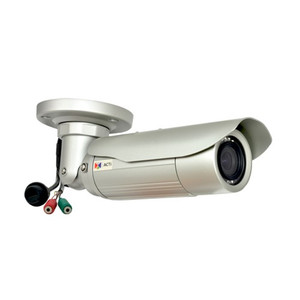
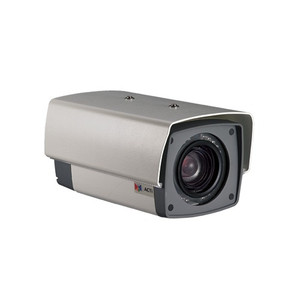
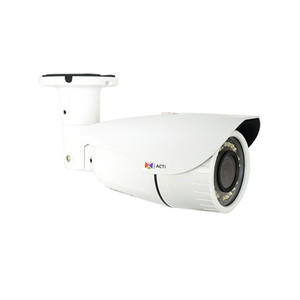
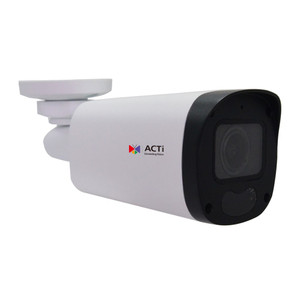
ACTi E38 2MP Bullet Camera Day/Night Adaptive IR
The ACTi E38 is a 2MP fixed-lens bullet camera designed for continuous monitoring across variable lighting conditions—retail perimeters, parking areas, building entrances, and light industrial facilities. Adaptive infrared combined with Advanced WDR keeps the camera usable from bright daylight through complete darkness without external lighting, and handles mixed-lighting scenes (sunlit doorway with shaded interior) without blown highlights or crushed shadows. At 2MP resolution, it trades pixel density for storage efficiency; bitrate demand stays low compared to 4MP+ alternatives, making it practical for bandwidth-constrained sites or large multi-camera deployments where recording footprint and cost matter. The compact bullet profile is weather-resistant and unobtrusive—ideal for eave mounts, wall corners, or installations where space or aesthetics constrain placement options.
Key Features
- 2MP Resolution: 1080p @ 60 fps. Sufficient for facial recognition at 10-15 feet and general activity logging; lower bitrate reduces storage demand by 40-50% versus 4MP cameras on continuous recording.
- Advanced WDR: Handles scenes with extreme contrast—sunlit entryways, reflective glass, vehicle headlights—without manual exposure adjustment or scene-specific configuration.
- Adaptive Day/Night IR: Automatic switchover between color daytime and monochrome IR mode; no external lighting required for darkness surveillance. IR range sufficient for close-range (<30 feet) perimeter and entrance coverage.
- PoE 802.3af: Standard PoE power—works with any 802.3af switch or injector. Nominal 13W draw fits within 15W per-port budget, allowing dense deployment on standard PoE infrastructure without upgrades.
- H.264 + MJPEG Codec Support: Dual-stream capability enables efficient recording (H.264) paired with real-time web viewing or mobile streaming (MJPEG). Codec flexibility simplifies integration with heterogeneous VMS platforms.
- ONVIF Profile S Compliance: Works with all major third-party VMS platforms—Genetec, Milestone, ExacqVision, Hikvision—without proprietary software requirements. Native ACTi NVR integration also available.
- Fixed Lens, Compact Bullet Form Factor: Reduces installation complexity vs. PTZ or turret cameras. Weather-resistant housing supports wall, eave, and corner mounting in exposed locations.
- 60 fps @ 1080p Streaming: Smooth motion rendering on continuous or event-triggered recording. Useful for traffic/vehicular monitoring where frame-rate clarity matters.
The E38 occupies a practical middle ground in small-footprint surveillance: reliable day/night imaging without the complexity and cost of external lighting systems, edge analytics, or high-resolution forensic capture. It's engineered for sites where 2MP is sufficient for incident evidence and operational awareness, and where storage and bandwidth conservation directly impact total system cost.
Integration with ACTi NVR systems provides native management—alarm scheduling, motion detection, and video export—without third-party software licensing. For multi-vendor deployments, ONVIF compliance eliminates vendor lock-in; the E38 streams H.264 or MJPEG to any ONVIF-capable recorder or VMS. PoE power delivery via standard 802.3af switches means no separate power infrastructure; confirm your switch can supply 15W per port if deploying multiple E38 units on the same segment.
Low bitrate (typically 2-4 Mbps H.264 at 1080p continuous) makes the E38 suitable for bandwidth-constrained sites—remote locations on cellular links, facilities with legacy network infrastructure, or deployments where aggregate camera bandwidth cannot exceed 20-30 Mbps. Pair it with local NVR storage and event-based cloud backup to minimize network load while retaining 24/7 local archive capability.
The camera does not include analytics (motion detection via NVR, not on-camera). Environmental rating is standard bullet housing—suitable for eaves and covered entries, not open-air high-pressure wash environments. For hose-down or marine settings, consider IP66/IK10-rated alternatives. The E38 is best deployed where adaptive IR and WDR satisfy low-light performance, and where 2MP resolution aligns with evidence quality and storage budgets.
Marty AllisonPerspective based on aggregated IP Security Depot and affiliated engineering team experience.
In our experience, the E38 is a solid choice for mid-market deployments where 2MP meets evidence requirements and budget pressure is real. We've installed dozens across retail chains, parking structures, and municipal facilities—it consistently delivers usable footage through day and night transitions without requiring external lighting rigs or supplementary IR panels. The adaptive IR is the real workhorse here: it automatically adjusts IR output based on ambient light, eliminating the IR washout and focus hunting you see on fixed-IR cameras when scenes transition from dusk to full darkness. Paired with Advanced WDR, it handles the toughest mixed-lighting scenario: camera pointing at a glass entrance with sunlit exterior and dark interior lobby. You get detail in both zones without manual tuning or scene-specific configuration. On continuous 24/7 recording, H.264 bitrate typically settles at 2.5-3.5 Mbps—half the bandwidth of a comparable 4MP camera. For a 16-camera retail site recording 30 days, the capex and storage savings add up quickly. The downside: 2MP starts to lose facial detail beyond 20 feet, and the fixed lens means no zoom. If you need to identify individuals across a 50+ meter perimeter, step up to 4MP or higher resolution. Also, the E38 has no on-camera analytics—all motion detection and event filtering happens at the NVR level, which works fine if your recorder has decent CPU headroom, but can become a bottleneck on large installations (40+ cameras).
Technical Highlights:
- Adaptive Day/Night IR with Advanced WDR: The IR sensor automatically scales output between 5% and 100% based on ambient light; WDR processing happens in parallel, allowing the camera to preserve detail in high-contrast scenes without losing low-light capability. In field deployments, this means zero manual exposure or iris adjustments across the day/night cycle—the camera just works. Compare this to budget fixed-IR cameras that either dominate the scene at night or fail to adapt to dusk transitions.
- H.264 @ 2-4 Mbps Continuous: Storage bandwidth is the real economics win. A single 8TB NVR can hold 30+ days of continuous 2MP H.264 from this camera alone; 4MP alternatives cut that to 15-20 days. On a 16-camera site, the difference between 4TB and 8TB NVR cost is measurable, and the E38 makes the smaller storage footprint viable.
- PoE 802.3af @ 13W Nominal: Standard power budget means you can run 12-16 E38 units on a single 24-port PoE switch without power supply upgrades. Integrators sometimes underestimate how much this simplifies large deployments: no separate 24V DC supply, no wiring to power supplies, no UPS planning for high-current runs.
- 60 fps @ 1080p: Smooth motion is underrated. When you're reviewing footage of a vehicle exiting a lot or a person walking through a hallway, 60 fps rendering makes the playback feel natural and reduces frame-by-frame scrubbing. Useful for incident reconstruction where frame rate clarity matters.
- ONVIF Profile S Compliance: True third-party VMS independence. We've deployed E38 units in Milestone Husky, Genetec Security Center, and Avigilon platforms without a single custom driver or integration fee. The camera streams H.264 or MJPEG on demand—what you see in Axis or Hikvision ONVIF cameras, you get here.
Deployment Considerations:
- IR effectiveness drops beyond 25-30 feet in total darkness—measure your deployment distance before final mounting. For parking lots or perimeters beyond 40 feet, supplement with low-level lighting or step up to higher-power IR cameras. Adaptive IR is not equivalent to external LED floods.
- PoE power draw is 13W nominal but can spike to 15W during cold startup or high IR boost. Verify your PoE switch or injector nominal current rating; some budget 802.3af injectors deliver only 12.95W at the port, which clips margin. Use a quality PoE switch if deploying 8+ units.
- The E38 has no on-camera video analytics—motion, face detection, or line-crossing happens at the NVR. If your recorder is CPU-constrained (older or low-end NVR on a large camera count), analytics processing will introduce latency or fail to run in real-time. Plan analytics load on the NVR side.
- Fixed focal length (not specified in standard datasheet, but bullet design typically implies 4-6mm lens). This is a compromise—wider field of view than telephoto, but not super-wide. Test lens angle at the actual install location before committing to the mount.
- Environmental rating is standard bullet housing (not IP66/IK10). Suitable for eaves, covered entries, and wall-mounted exterior locations. Not rated for direct rain exposure, hose-down wash bays, or saltwater environments. For marine or high-pressure wash, upgrade to IP66 or IK10 rated alternatives.
- Codec flexibility is a strength, not a weakness—H.264 for storage, MJPEG for streaming reduces your NVR CPU load vs. transcoding a single stream to multiple formats. If your VMS does not support dual-codec streaming, prioritize H.264 for 24/7 recording and live MJPEG for web access.
The E38 is the right choice for integrators and end-users balancing cost, simplicity, and evidence quality—retail, parking, light industrial, and municipal deployments where 2MP suffices and where avoiding external lighting and external power infrastructure is a genuine win. Small to mid-size sites (8-24 cameras) see the biggest ROI. For higher-resolution forensic requirements or large-scale perimeter surveillance, evaluate 4MP+ alternatives. Explore the full ACTi catalog for thermal, 4K, and edge-analytics variants.