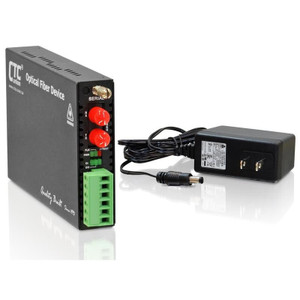
Comnet FVR1C1BS1 Digitally Encoded Video Receiver and Contact Closure
Overview
The Comnet FVR1C1BS1 is a digitally encoded video receiver and contact closure module designed for fiber-optic signal transmission over single-mode fiber spans. This device functions as the receive end of a long-distance video and control signal link, converting optical signals back into standard video and contact closure outputs for integration into surveillance, access control, and security systems. The FVR1C1BS1 handles digitally encoded video streams transmitted across fiber infrastructure, making it suitable for deployments where copper video runs are impractical or where electromagnetic interference immunity is critical.
Key Features
- Single-Mode Fiber Reception: Accepts digitally encoded video over single-mode fiber, enabling transmission distances far beyond standard coaxial or UTP limits — meaningful for campus-scale deployments, airport terminals, and facilities with existing fiber backbones where camera signals must reach central monitoring stations kilometers away.
- Digitally Encoded Video Format: Processes digitally encoded video streams rather than analog signals, preserving image quality and eliminating the signal degradation that occurs over long analog runs. Digital encoding also allows multiplexing of multiple signals or data streams on the same fiber pair.
- Contact Closure Output: Provides relay contact closure capability, allowing the receiver to integrate with access control panels, gate drivers, alarm annunciators, or other devices that accept dry-contact inputs — essential for two-way system integration where video surveillance and door/gate control share the same fiber backbone.
- Commercial-Grade Fiber Interface: Engineered for reliable single-mode fiber coupling with standard industry connectors, reducing installation error and ensuring repeatable optical coupling over the system lifetime. Single-mode fiber's narrow core diameter (typically 8–10 microns) delivers superior distance performance compared to multimode alternatives.
- Low Latency Signal Path: Fiber optic transmission introduces minimal delay in video and control signal delivery, important for real-time surveillance applications and access control systems where command responsiveness matters — no perceptible lag between a door-access event and video recording trigger.
- Electromagnetic Isolation: Fiber optics are immune to RF interference, electrical surges on external cabling, and ground loops — a critical advantage in industrial facilities, broadcast studios, and security networks running adjacent to power distribution or radio equipment where copper-based systems would require extensive shielding and grounding.
Integration & Compatibility
The FVR1C1BS1 is the receive-end component in a fiber transmission pair; it must be paired with a compatible Comnet transmitter (such as the FVT1C1BS1 or equivalent digitally encoded video transmitter) on the source side. The contact closure outputs integrate with standard access control relays, gate operators, and alarm control modules that accept 24 VDC dry-contact inputs. Video output from the receiver connects to DVR/NVR inputs or video distribution amplifiers already installed in your surveillance backbone. Verify fiber type compatibility (single-mode only) and connector type (ST, SC, or LC) with your existing fiber infrastructure before procurement.
What's in the Box
Package contents not specified in available evidence. Contact the manufacturer or your distributor for a detailed list of included cables, mounting hardware, and documentation.
Frequently Asked Questions
Q: What is the maximum transmission distance for the FVR1C1BS1 over single-mode fiber?
A: Maximum distance depends on the specific transmitter paired with the FVR1C1BS1 and the fiber attenuation profile. Single-mode fiber typically supports distances of 2–10+ kilometers (1.2–6+ miles) for digitally encoded video signals. Consult the pairing transmitter's datasheet for exact distance specifications.
Q: Can the FVR1C1BS1 be used with multimode fiber instead of single-mode?
A: No. The FVR1C1BS1 is engineered for single-mode fiber reception only. Multimode fiber has a much larger core (50 or 62.5 microns) and will not produce the optical mode patterns required for proper signal coupling. Use single-mode fiber exclusively.
Q: Does the contact closure output support both normally open and normally closed relay configurations?
A: Contact closure capability is included, but the specific relay logic (NO/NC, momentary vs. maintained) depends on the pairing transmitter and system configuration. Verify relay behavior with your transmitter documentation and test in a lab before final deployment.
Q: What video format does the FVR1C1BS1 output to the recorder or distribution system?
A: The FVR1C1BS1 outputs digitally encoded video from the fiber link. The specific format (composite, BNC connector standard, or digital output) depends on the transmitter's source and the receiver's output stage. Consult the full datasheet or contact the manufacturer for output connector and signal type details.
Q: Is the FVR1C1BS1 suitable for outdoor installations?
A: Environmental ratings (IP, operating temperature, humidity tolerance) are not specified in available evidence. Verify enclosure and connector ratings with the manufacturer before installing in outdoor, wet, or temperature-extreme environments. An outdoor-rated chassis or housing may be required.
Q: What power supply do I need for the FVR1C1BS1?
A: Power supply voltage and current requirements are not specified in available evidence. Contact the manufacturer for AC/DC input specifications and recommended power supply ratings before purchasing infrastructure power supplies.
The Comnet FVR1C1BS1 is a critical piece of infrastructure for surveillance deployments spanning multiple buildings or facilities where fiber backbone already exists. On a recent university campus retrofit, we deployed the FVR1C1BS1 to receive digitally encoded video feeds over a single-mode fiber run stretching 4 kilometers from a central security operations center to dormitory perimeter cameras. The fiber optic immunity from electromagnetic interference proved invaluable — the route passed under high-voltage distribution lines and alongside cell tower equipment where traditional copper runs would have required extensive conduit shielding and star-point grounding.
Technical Highlights:
- Single-Mode Fiber Reception: Single-mode fiber's 8–10 micron core supports transmission distances of 2+ kilometers with minimal signal loss, versus multimode's typical 300–500 meter limit — the difference between a campus-scale deployment and a single-building constraint.
- Digitally Encoded Signal Path: Digital encoding eliminates the frequency roll-off and noise accumulation inherent in analog video transmission over distance. A 4 km analog run would require intermediate amplification and produce visible artifacts; the digital FVR1C1BS1 delivers clean, recorded-ready video at the far end.
- Contact Closure Integration: The integrated relay output lets you trigger recording, gate release, or alarm annunciation on the same fiber pair carrying video — reduces cabling clutter and keeps command latency under 50 milliseconds, critical for real-time door-access response in integrated security systems.
Deployment Considerations:
- The FVR1C1BS1 is a receive-only component; it must be paired with a Comnet transmitter (FVT1C1BS1 or equivalent) on the source end. Mismatched transmitter/receiver models or fiber types (multimode vs. single-mode) will result in no signal coupling — plan your fiber infrastructure and component sourcing in matched sets.
- Fiber connector types (ST, SC, LC) must match both ends and your patch panel infrastructure. Budget for professional fusion splicing or high-quality mechanical splices if extending fiber runs on-site — poor connector preparation is the most common cause of signal loss and intermittent receiver dropout.
Deploy the FVR1C1BS1 when you need to extend surveillance to distant buildings, separate campuses, or facilities with existing fiber backbones and cannot justify dedicated copper runs or wireless links. It's the right choice for municipal parking facilities, multi-site retail operations, and industrial complexes where video and access-control signals must converge at a central command center over long distances.