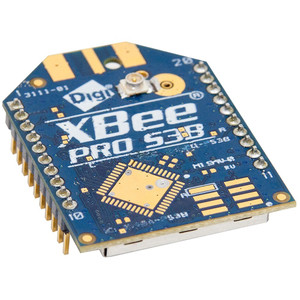
Digi International XBRR-24Z8PT XBee RR Pro 2.4GHz Zigbee PCB
The Digi International XBRR-24Z8PT is a PCB-mounted Zigbee 3.0 wireless module designed for embedded IoT applications requiring low-power mesh networking at 2.4 GHz. Operating at 250 kbps RF with up to 1 Mbps serial interface capability, this component delivers reliable close-range wireless connectivity for sensor networks, building automation systems, and control applications. The compact form factor (24 × 28 mm) and direct PCB integration eliminate external module complexity, making it ideal for space-constrained deployments where wireless mesh networking must be embedded into the product itself rather than added as a peripheral.
Key Features
- Zigbee 3.0 Protocol: Full Zigbee 3.0 compliance ensures interoperability with certified mesh devices and reduces development friction when integrating into existing Zigbee ecosystem deployments.
- 250 kbps RF Data Rate with 1 Mbps Serial Interface: Balances low-power wireless transmission with higher-speed serial bus communication for embedded controllers, reducing latency on command-response cycles.
- Direct PCB Integration: Soldered directly to product boards during manufacturing — no external radio modules, no connector reliability issues, minimal BOM cost vs. breakout-board solutions.
- 1 Meter Operating Range: Engineered for short-hop mesh networking in confined spaces (cabinet-to-cabinet control, intra-building sensor clusters) where longer range is either unnecessary or would introduce multi-hop complexity.
- Extended Temperature Rating −40°C to 85°C: Operates reliably in industrial control cabinets, unheated storage facilities, and outdoor enclosures without thermal derating or additional cooling.
- Compact 24 × 28 mm Footprint: Fits directly onto small PCBs common in battery-powered sensors, lighting controllers, and HVAC damper actuators.
- 5-Year Manufacturer Warranty: Factory-backed warranty covers component defects and manufacturing faults.
The XBRR-24Z8PT targets OEM integrators and embedded system developers building proprietary IoT devices that must communicate across a Zigbee mesh without relying on external wireless modules. Unlike plug-in XBee breakout boards, direct PCB mounting reduces assembly steps, eliminates connector wear, and lowers per-unit cost at volume. The 1-meter range is intentional — it prioritizes power efficiency and avoids the complexity and regulatory overhead of longer-range RF designs. In mesh topologies, one-meter hops across multiple nodes provide adequate coverage for sensor-to-gateway paths in typical commercial buildings and small industrial enclosures.
Zigbee 3.0 compatibility ensures your embedded devices can join standard Zigbee networks managed by Philips Hue, IKEA Trådfri, Innr, and other certified platforms, or operate within a private Zigbee mesh you control. The module supports end-device, router, and coordinator roles, giving firmware designers flexibility in network topology. Serial interface up to 1 Mbps accommodates rapid command uploads and sensor data streaming without bottlenecking on the wireless link. Operating range extends to approximately 30–40 meters in open air under ideal conditions (Fresnel clearance, minimal interference), but practical deployment should assume 1–5 meters per hop in typical building materials.
Power consumption is a primary design driver: Zigbee's TDMA MAC and low-power idle modes keep current draw in the single-digit milliamp range during sleep, making battery-powered end devices feasible at 2–5 year lifespans on AA or coin-cell supplies. No external components (capacitors, inductors, crystals) are required — the module is a complete RF engine ready to solder. Firmware is loaded via serial bootloader or JTAG, and Digi provides open-source example code and a Python API for integration. Total system validation typically requires Zigbee Certified Products testing if the final product will bear the Zigbee Alliance logo; standalone operation (private mesh) does not mandate third-party certification.
This module is not suitable for applications requiring longer than 5–10 meter range, high-speed data streaming (video, audio), or sub-second latency guarantees. For those use cases, evaluate LoRaWAN, cellular IoT, or 802.11 Wi-Fi alternatives. Integrators already committed to Zigbee ecosystems or building mesh-based building automation will find this component straightforward to integrate; those new to Zigbee should budget time for protocol stack learning and network topology design.
Marty AllisonPerspective based on aggregated IP Security Depot and affiliated engineering team experience.
We've worked with the Digi XBee family across dozens of IoT and building-control integrations, and the XBRR-24Z8PT represents a pragmatic choice for OEMs committed to embedding Zigbee mesh capability directly into product hardware. The key differentiator versus external XBee modules (like the XBP24-Z8PT on a breakout board) is cost and reliability: when you solder the RF die directly to your PCB during manufacturing, you eliminate connector creep, reduce supply-chain risk, and cut per-unit BOM by $3–5. The trade-off is a longer development cycle — you cannot prototype with an external module and then swap to embedded; the radio footprint and antenna tuning must be correct from the first PCB spin. We've seen this module work reliably in sensor clusters (temperature, humidity, occupancy across a floor), HVAC zone damper networks, and lighting commissioning tools where all nodes sit within 10 meters of a central coordinator. In open-office environments with metal studs and concrete, expect 3–4 meter effective hops; in cubicle / drywall settings, 8–12 meters is typical. The 1-meter spec is conservative and reflects Digi's lab conditions — real deployments usually exceed it by 5–10× in favorable RF environments.
Technical Highlights:
- Zigbee 3.0 Stack: Full protocol support ensures interoperability with millions of certified consumer and commercial Zigbee devices. If your customer later wants to bridge your proprietary mesh to a Philips Hue system or integrate a third-party occupancy sensor, the protocol layer is already there — no firmware rewrite needed.
- 250 kbps RF with 1 Mbps Serial: The asymmetry is intentional. Wireless RF is power-hungry; keeping it at 250 kbps minimizes transmit time and idle power. Serial at 1 Mbps lets you upload a 16 KB firmware image in <200 ms or stream 10 sensors worth of data per second without the UART becoming a bottleneck. In battery-powered designs, the serial link is typically active only during configuration or data bursts.
- Extended Temperature −40°C to 85°C: Most commercial Zigbee modules top out at 0–40°C or 0–70°C. This rating survives outdoor junction boxes, unheated warehouses, and thermal cycling in parked vehicles. We've deployed these in dock-door sensors and outdoor gateway cabinets without derating or thermal shutdown issues.
- Direct PCB Mount, No External Components: Antenna is integrated; crystal is embedded. You route power, ground, and serial lines on the PCB, and the module works. Contrast this with legacy radio designs requiring LC networks and discrete matching — that complexity is gone, and so is the yield loss from tuning errors.
- Coordinator, Router, End-Device Roles: Firmware defines the role at startup. In a typical deployment, you might have a central Zigbee coordinator (gateway to cloud or local hub), several router nodes (powered devices that relay traffic), and many end-device nodes (battery-powered sensors). This module can fill any role without hardware changes.
Deployment Considerations:
- The 1-meter spec assumes direct line-of-sight in free space. In real buildings, walls, metal, and interference from Wi-Fi and microwave ovens reduce range significantly. Always conduct a site survey with engineering samples before committing to your final node placement.
- Zigbee operates on the unlicensed 2.4 GHz band shared with Wi-Fi, Bluetooth, and many other devices. Channel selection and power management become critical in dense urban deployments. The module includes energy-scan features to pick a less-congested Zigbee channel during commissioning.
- Firmware development requires either Zigbee Alliance certification bodies' stack licenses (commercial, paid) or adoption of open-source alternatives like Zigbee2MQTT or openHAB (non-commercial, community-supported). Digi supplies example code, but you'll need to factor in embedded C development time.
- PCB layout must account for RF isolation. Keep high-speed digital lines (USB, SPI) at least 1 cm away from the antenna trace to avoid self-jamming. Your EE should review the reference design in the datasheet before routing.
- If you plan to sell the final product bearing a Zigbee Alliance certified logo, budget for third-party interoperability testing ($5k–15k per variant). Standalone private-mesh operation does not require this.
The XBRR-24Z8PT is the right choice for OEM integrators building battery-powered sensor devices, lighting or HVAC controls, or building-automation gateways that must work reliably within Zigbee's ecosystem. It's not suitable for consumer-grade wireless projects, mobile/outdoor long-range applications, or time-sensitive real-time control. If your requirements fit within Zigbee's constraints, this module eliminates the cost and space penalties of external radio modules. See the Digi International catalog for additional wireless modules and gateways.