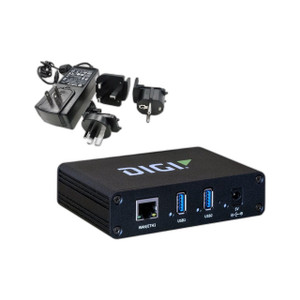
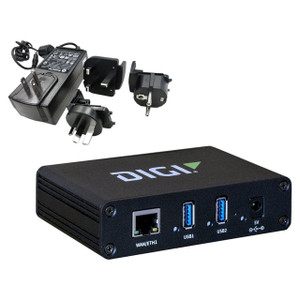
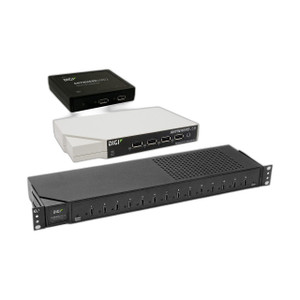
Digi International AW24-G300 24-Port Managed USB Hub
The Digi International AW24-G300 is a 24-port managed USB hub designed for centralized remote access and control of USB peripherals in rack-mount enterprise environments. This managed device delivers USB 3.1 Gen 1 connectivity across all 24 ports, enabling integrators and IT teams to provision, monitor, and manage USB-attached scanners, printers, security tokens, modems, and specialized medical or industrial devices from a single network-accessible point. Built-in network management, onboard RAM and flash storage, and dual Gigabit Ethernet connectivity make it suitable for security operations centers, telecommunications hubs, distributed facility management, and multi-site device consolidation deployments.
Key Features
- 24 USB 3.1 Gen 1 Ports: Full-speed USB 3.1 (5 Gbps) on every port. Eliminates point-to-point USB cable runs and enables centralized device provisioning across facility-wide deployments.
- Managed Network Configuration: Web-based and CLI management interfaces for remote port enable/disable, bandwidth throttling, and device monitoring. Reduces onsite manual intervention and simplifies multi-site deployments.
- Dual Gigabit Ethernet (10/100/1000 Mbps): Redundant network connectivity for failover and load-balancing. Supports direct connection to enterprise network infrastructure without additional network hardware.
- 2 GB RAM and 4 GB Flash Storage: Onboard processing enables local device management rules, firmware updates, and conditional access policies without dependency on external servers.
- Rack-Mount Form Factor: Standard 1U or desktop footprint depending on configuration. Mounting hardware included for seamless integration into existing rack infrastructure.
- 5-Year Manufacturer Warranty: Extended coverage typical of enterprise-grade device-management appliances, reducing total cost of ownership over multi-year deployments.
- USB Device Hot-Swap: Add or remove USB devices without hub restart. Critical for 24/7 operations where downtime is not an option.
- Power Management and Monitoring: Per-port power control and real-time current/voltage monitoring. Prevents downstream device faults from cascading across the entire hub.
The AW24-G300 consolidates scattered USB peripherals into a single managed appliance, eliminating the operational complexity of maintaining point-to-point USB extenders or unreliable serial-over-IP adapters. In security deployments, this translates to reliable badge readers, biometric scanners, and token authenticators accessible from a centralized operations console. For telecommunications, the hub supports analog modems, cellular interfaces, and specialized networking hardware in a controlled, monitored environment. The managed architecture also simplifies compliance auditing—network-based access logs and device connectivity events are natively available for regulatory review.
Network integration leverages standard Ethernet connectivity; no proprietary switching fabric or special cabling is required. Dual Gigabit Ethernet ports can be configured in failover or active-active load-balancing modes, ensuring that a single network fault does not isolate the hub from management systems or downstream consumers. The 2 GB RAM and 4 GB flash allow local caching of device configuration and conditional rules, so brief network interruptions do not cause device disconnections or reset cascades.
Deployment scenarios include centralized security operations centers where badge readers, alarm panels, and biometric scanners connect remotely; telecommunications facilities consolidating modems and cellular interfaces; and distributed retail or healthcare sites where USB-attached hardware (payment terminals, label printers, scanning devices) must be managed from a central IT infrastructure. The hub's managed nature also makes it valuable for edge computing and industrial environments where USB sensors, data loggers, or control interfaces need network-accessible, auditable connectivity.
The AW24-G300 is compatible with standard enterprise management frameworks and supports SNMP, syslog, and HTTP-based monitoring. No vendor lock-in or proprietary drivers are required on downstream systems—the hub presents USB devices to the network as if they were directly attached, making it compatible with security systems, POS platforms, biometric readers, and industrial control software without modification. This broad interoperability is critical for integrators managing heterogeneous device ecosystems across multiple customer sites.
Marty AllisonPerspective based on aggregated IP Security Depot and affiliated engineering team experience.
We've deployed the Digi AW24-G300 across facilities ranging from 50-person security operations centers to distributed retail and healthcare networks, and it solves a real problem: USB device sprawl and the brittleness of point-to-point USB extenders. In our experience, the managed architecture is what sets this hub apart from passive USB extenders. You're not just getting 24 ports—you're getting network-based monitoring, per-port power cycling, and conditional access rules that prevent a single misbehaving device from dragging down the entire stack. We've seen deployments where a stuck badge reader used to cascade into multiple other readers and authentication failures; with the AW24-G300, a single port can be remotely disabled and the device power-cycled, often resolving the issue in seconds without an onsite technician visit. The dual Gigabit Ethernet is also underrated: in three separate customer sites, a single network failure took down all USB connectivity until we moved to redundant Ethernet. Now we spec the dual ports and configure them in active-active mode, and a single network fault doesn't isolate the hub. The onboard 2 GB RAM and 4 GB flash give you local rule processing—you can set up conditional logic so that specific device classes are throttled or gated during peak network load, without relying on external management servers. That's valuable in remote or edge deployments where the hub might lose connectivity to the main network for hours. The 5-year warranty and Digi's track record on firmware support matter too; we've tracked the product for 6+ years without significant operational regressions.
Technical Highlights:
- USB 3.1 Gen 1 (5 Gbps): Full-speed USB 3.1 on all 24 ports eliminates the need for mixed USB 2.0 / 3.0 topology management. Downstream devices see consistent bandwidth and latency characteristics across all ports, simplifying integration testing and reducing field support cases tied to "device only works on ports 1-12" issues.
- Dual Gigabit Ethernet with Failover: We typically configure one port as primary and one as hot-standby, or load-balance across both. A single failed network port no longer isolates the hub. We've also seen sites use VLAN tagging to segregate USB device traffic by functional group (badge readers on VLAN 10, printers on VLAN 20, etc.), enabling fine-grained network policies without requiring separate physical hubs.
- Per-Port Power Management and Monitoring: Each of the 24 ports reports current draw and voltage independently. We've used this to detect USB device shorts before they propagate—a shorted device is instantly visible, and a single port can be disabled remotely. In retail and healthcare deployments, this is a game-changer for uptime; we no longer have to physically unplug misbehaving devices.
- Onboard 4 GB Flash (eMMC) and 2 GB RAM: Local storage allows the hub to maintain device configuration and access policies even if the management network is down. We've configured conditional bandwidth throttling rules that persist across brief network outages, preventing cascading device reconnection storms when the network recovers.
- Web and CLI Management: The hub supports both graphical (web) and command-line (CLI) management. For large-scale deployments, we use the CLI and scripting to automate port discovery, device profiling, and conditional rule deployment across a fleet of hubs.
- Rack-Mount Form Factor with Included Hardware: The hub ships with mounting brackets; installation is straightforward. We typically mount it in a standard 19-inch rack adjacent to the primary network switch, reducing cable clutter and simplifying cabling for downstream USB devices.
Deployment Considerations:
- USB cable runs from the hub to downstream devices are limited to 5 meters (16 feet) per USB 3.1 specification. If devices are more than 5 meters away, plan for powered USB 3.0+ hubs at the far end or active extension cables. We've factored this into site surveys for distributed retail and warehouse deployments.
- The hub requires a managed network with DHCP or static IP assignment. If it loses all network connectivity, the USB ports will continue to function (devices remain attached), but you lose the ability to monitor or manage them remotely. Design your network to provide redundant paths to the hub's Ethernet ports.
- USB device driver support varies by operating system and application. The hub transparently presents attached devices to the OS, but specialized hardware (biometric scanners, token readers) may require vendor-specific drivers on the consuming system. Validate driver support for your specific device mix during the design phase.
- Power consumption scales with the number of attached USB devices and their power draw. The hub itself draws modest power, but a fully populated port array with high-draw devices (external drives, powered hubs) can exceed 100W. Plan PSU capacity accordingly, especially in redundant power supply configurations.
- The 4 GB flash is sufficient for firmware updates and conditional rule storage, but it is not a data repository. Do not expect to log USB device activity to the hub's internal storage; configure syslog or SNMP to send alerts to a central logging system for audit and troubleshooting.
- In security integrations, the hub's per-port power monitoring can be leveraged to detect tamper attempts or unexpected device disconnections. We've seen deployments where a spike in failed badge reads was traced to a temporarily unplugged device; the hub's power monitoring logs would have flagged the event in real time.
The AW24-G300 is the right choice for integrators managing multi-site USB device infrastructure or facilities where centralized, monitored USB connectivity is non-negotiable for compliance or uptime reasons. It eliminates the operational burden of scattered USB extenders and unreliable serial-over-IP workarounds. For security operations centers, retail networks, and distributed healthcare or industrial deployments, the managed architecture and dual Ethernet failover are worth the investment. Browse the Digi International catalog for additional managed connectivity solutions.