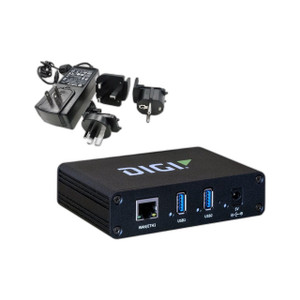
Digi International AW02-G300 Managed Remote USB Hub
The Digi International AW02-G300 is a managed remote USB hub designed to extend USB 3.1 Gen 1 device access across Ethernet networks without physical proximity to the host. Built for IT teams and security integrators managing distributed deployments—surveillance systems with edge-connected license-plate readers, access control units with USB scanners, or mobile device charging stations—the AW02-G300 centralizes connection control and monitoring from a single management interface. Gigabit Ethernet uplink and managed firmware architecture enable secure, authenticated access to remote USB peripherals across campus or multi-site infrastructure.
Key Features
- USB 3.1 Gen 1 Ports: Two USB 3.1 Gen 1 (5 Gbps) ports. Full-speed throughput for barcode scanners, thermal imaging cameras, license-plate recognition hardware, and other high-bandwidth USB peripherals without local host proximity.
- Managed Architecture: Network-based device management and centralized monitoring. Firmware updates, access policies, and connection logs are administered from a single control console, eliminating manual device-by-device configuration.
- Gigabit Ethernet Connectivity: Single RJ-45 port supporting 10 M / 100 M / 1 G auto-negotiation. Operates on standard Ethernet infrastructure; PoE optional depending on deployment model.
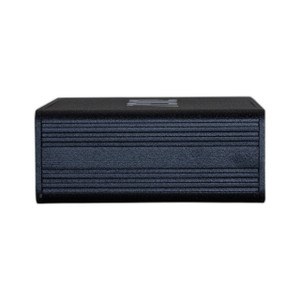
- Desktop Surface-Mount Form Factor: Compact 0.84 lb chassis designed for edge mounting, control-room placement, or cabinet integration without requiring rack rails or cable trays.
- 512 MB RAM, 4 GB eMMC Storage: Embedded flash supports local caching of device configuration and firmware images, reducing dependency on continuous network access for initialization.
- 5-Year Manufacturer Warranty: Extended warranty coverage includes hardware defects and manufacturing support, reducing replacement logistics across multi-site deployments.
The AW02-G300 bridges the gap between USB device ecosystems and networked infrastructure. In security and access-control applications, this means remote barcode scanners, RFID readers, or mobile credential devices can be deployed at gates, checkpoints, or vehicle entry lanes without requiring full computing infrastructure at each site. The host application (NVR, access control panel, or edge analytics server) communicates with the remote hub over standard Ethernet, eliminating USB cable runs that are often impractical beyond 5 meters.
Managed operation differentiates the AW02-G300 from passive USB extenders. Centralized authentication, per-port enable/disable, and real-time connection status reporting reduce troubleshooting time and enforce consistent security posture across distributed devices. Teams can revoke access to a misbehaving scanner or temporarily disable a port without physical site visits. Firmware updates are staged centrally and deployed to all hubs in a batch, ensuring consistent driver compatibility across the fleet.
Integration with standard Ethernet switching infrastructure means the AW02-G300 fits seamlessly into existing campus LANs, PoE-powered distribution systems, or isolated operational technology (OT) networks. The gigabit uplink accommodates USB traffic spikes from multiple simultaneous device accesses—critical when barcode throughput or RFID scan rates demand predictable latency. Embedded management firmware supports industry-standard protocols, enabling integration with SNMP monitoring dashboards or enterprise inventory systems.
The AW02-G300 is intended for integrators and IT teams managing branch offices, parking facilities, gate houses, or distributed access-control nodes where USB device proliferation would otherwise require custom cabling or multiple local computers. If your deployment involves 10+ remote USB device access points or geographically dispersed facilities with shared backend infrastructure, the managed architecture and centralized monitoring justify the investment over passive USB repeaters.
Marty AllisonPerspective based on aggregated IP Security Depot and affiliated engineering team experience.
We've deployed the AW02-G300 across parking-lot LPR systems, multi-site access-control clusters, and edge analytics deployments where barcode or biometric readers needed to communicate with central servers over IP. The real win isn't the USB speed—most peripheral traffic is low-bandwidth—it's the managed control plane. In a 15-site deployment where each gate house has a barcode scanner and RFID reader, pushing firmware updates and access policies from one management console eliminates the nightmare of coordinating manual resets across scattered locations. The 512 MB RAM and 4 GB flash mean the hub can cache device firmware and maintain local policy even if Ethernet drops for a few minutes, which is critical for access control where a downed reader costs money in delay and creates a security gap.
Technical Highlights:
- USB 3.1 Gen 1 (5 Gbps) Ports: Overkill for most barcode scanners and RFID readers (which consume <100 Mbps), but essential when cameras, thermal imagers, or high-throughput document scanners are in the mix. Future-proofs against device upgrade cycles and prevents bottleneck complaints downstream.
- Gigabit Ethernet Uplink: Supports multiple simultaneous USB device accesses without latency pileup. In a scenario where a parking gate is scanning LPR images (50–100 Mbps per vehicle stream) while an access reader polls credentials (1–10 Mbps), the gigabit headroom keeps both flows clean. Contrast with Fast Ethernet (100 Mbps) alternatives, which can stall under concurrent load.
- Managed Firmware with eMMC Flash: Updates are staged centrally and deployed to dozens of hubs in a batch. Local flash caching means the device doesn't require constant WAN connectivity to initialize—critical for branch-office and OT-network deployments where WAN is unreliable.
- 5-Year Warranty: Reflects Digi's confidence in manufacturing quality and parts availability. In distributed deployments, a failed hub is a site outage; the extended warranty reduces RMA turnaround pressure and ensures replacement stock or expedited shipping.
Deployment Considerations:
- USB device drivers must be installed on the host system (NVR, access-control server, or edge computer) once; subsequent hubs reuse the same driver, so multi-site rollouts don't incur per-site driver licensing overhead.
- Network latency under 50 ms is typical for LAN deployments; WAN or high-jitter links (satellite, congested VPN) can introduce perceptible delays in interactive USB device use (human-facing HID devices). Test WAN deployments with actual device traffic before committing to remote access for real-time applications.
- PoE power supply is not standard with the AW02-G300; most installations use AC mains or dedicated 12V / 24V power supplies local to the hub. Plan power provisioning alongside Ethernet infrastructure to avoid surprise site visits for dual-service drops.
- Managed operation requires network connectivity to the management server; hub ports will remain functional during management service downtime, but access policies and firmware updates will queue until the connection is restored. Design redundancy or failover paths if your access-control or LPR system depends on real-time policy updates.
The AW02-G300 is the right choice for integrators building multi-site access-control, LPR, or edge-analytics deployments where centralized device management and firmware control justify the step up from passive USB extenders. Choose this hub if you're managing 3+ remote locations with USB peripherals and you need audit trails, policy enforcement, and staged updates across the fleet. See the Digi International catalog for additional managed connectivity and remote-access solutions.