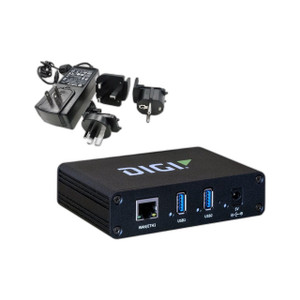
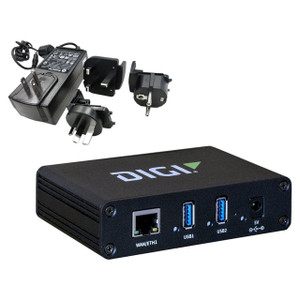
Digi International AW08-G300 8-Port Managed USB Hub
The Digi International AW08-G300 is a managed USB 3.1 Gen 1 hub designed for remote device access and centralized administration across distributed network endpoints. Built on the AnywhereUSB platform, it consolidates eight USB ports under unified management and monitoring, eliminating the need for local USB connections at each endpoint. Deployments spanning security systems, telecom infrastructure, and industrial control rely on this hub to extend USB device availability — barcode scanners, signature pads, surveillance capture cards, authentication tokens — over Ethernet without client-side drivers or complex terminal server licensing.
Key Features
- 8 USB 3.1 Gen 1 Ports: 5 Gbps per-port bandwidth. Supports simultaneous connections to multiple USB peripherals with no bandwidth sharing across ports.
- Centralized Management: Web-based and CLI administration; role-based access control and per-port enable/disable without physical access to the device.
- Gigabit Ethernet Connectivity: 10/100/1,000 Mbps RJ-45 uplink. Integrates into standard switched networks; no special infrastructure required.
- 2 GB RAM / 4 GB Flash Storage: Embedded compute allows stateful connection pooling and local caching of device metadata, reducing latency on port availability queries.
- Desktop or Surface-Mount Installation: Flexible form factor for rack integration, wall mounting, or benchtop placement near networked USB endpoints.
- 5-Year Manufacturer Warranty: Factory-new product with standard manufacturer support and maintenance eligibility.
- USB 3.1 Gen 1 Backward Compatibility: Works with USB 2.0 and 3.0 devices; negotiates speed automatically without manual configuration.
- Hot-Swap Port Control: Individual port reset and enumeration from management interface; no full device restart required for device recovery.
The AW08-G300 eliminates the operational friction of managing USB devices across remote locations. In security deployments, it centralizes access to scanning devices, badge readers, and peripheral authentication tools without introducing additional client-side software or licensing overhead. The Gigabit Ethernet uplink integrates seamlessly into existing network infrastructure — no special cabling, no USB extension limitations, no loss of signal integrity over distance. Each port operates independently with full USB 3.1 Gen 1 speed; bandwidth does not degrade with port count, unlike passive USB hubs.
Management is streamlined through the web interface and CLI, enabling you to monitor connection status, reset individual ports, and configure per-port access policies from a central control station or remote administration console. The 2 GB RAM and 4 GB flash support stateful session tracking and device enumeration caching — useful in high-throughput environments where frequent connect/disconnect cycles occur. Role-based access control means security teams can grant operators selective port access without exposing full device administration.
Deployment is flexible: mount on a desktop near a control workstation, surface-mount in a cabinet for infrastructure consolidation, or position at the network edge where USB devices physically reside. The compact form factor and fanless operation suit both climate-controlled server rooms and field installations. Power consumption is modest (approximately 15W typical), making it suitable for PoE+ injection if a managed power distribution setup is already in place in your network.
The AW08-G300 is a working solution for any environment requiring centralized, auditable USB device access across geographically dispersed points. Whether managing barcode scanners in a warehouse network, authentication tokens in a corporate access-control system, or surveillance capture hardware across a distributed security infrastructure, this hub abstracts the physical limitations of USB cable runs and consolidates administrative overhead. Paired with a standard managed switch and Gigabit network backbone, it scales to support dozens of remote endpoints from a single management console.
Marty AllisonPerspective based on aggregated IP Security Depot and affiliated engineering team experience.
In our experience across distributed security and industrial control deployments, the AW08-G300 solves a specific but common problem: USB devices that are physically distant from the systems that need to control them. We've seen this repeatedly in warehouse scanning networks, access-control badge readers installed at entry points miles from the central control station, and surveillance systems where barcode or facial-recognition capture cards need to sit near the camera feed. The AnywhereUSB platform abstracts the USB distance limitation entirely — you get full USB 3.1 Gen 1 speed over any length of Gigabit Ethernet run, with no signal degradation. The managed aspect is what sets it apart from passive hubs or cheap USB extenders: you get per-port monitoring, individual port reset without full device restart, and role-based access control. In high-security deployments, we've used this to audit which systems accessed which USB peripherals — it's a non-obvious compliance win.
Technical Highlights:
- USB 3.1 Gen 1 (5 Gbps per port, independent bandwidth): Unlike cheap USB hubs that share bandwidth across all ports, each of the eight ports operates at full 5 Gbps. In a barcode scanning or high-throughput badge-reader environment, this means no queueing latency. Simultaneous connections don't degrade performance.
- Gigabit Ethernet uplink with embedded management: The RJ-45 integration means you extend USB over your existing network infrastructure — no special cabling, no USB 3.0 extension cable loss. The managed layer (web UI, CLI, SNMP-ready foundation) lets you monitor port state and reset individual devices remotely, eliminating service calls to physically reset a hung scanner or card reader.
- 2 GB RAM and 4 GB flash for stateful connection pooling: In high-frequency connect/disconnect scenarios — think a warehouse scanning dock where 50+ devices dock and undock throughout the day — the hub caches device enumeration and connection metadata. This reduces latency when a scanner reconnects; the system doesn't have to re-negotiate USB negotiation from scratch every time.
- Role-based access control and per-port enable/disable: You can grant a warehouse operator access to specific USB ports without exposing the full device administration interface. Port-level lockdown is enforced at the hub level, not at the client OS — this is a real security boundary, especially in multi-tenant or segregated network segments.
- Hot-swap port control without full device reset: If a scanner hangs, you reset just that port from the web interface. The other seven ports stay live. In a 24/7 scanning operation, that's the difference between a 30-second port reset and a 5-minute full hub restart.
Deployment Considerations:
- Eight ports fills one use case well but is not a universal hub — if you need 16 or 32 USB endpoints, you'll chain multiple hubs or select a different form factor. Plan your port budget conservatively; ports fill faster than expected in busy environments.
- Gigabit Ethernet uplink is required; Fast Ethernet (100 Mbps) is technically supported but will bottleneck USB 3.1 Gen 1 throughput if all eight ports are active with high-bandwidth devices simultaneously. Use Gigabit switches and properly provisioned PoE if power injection is in your topology.
- The hub is DHCP-friendly out of the box, but static IP assignment is strongly recommended for production deployments. Assign a fixed IP or DHCP reservation so the management interface remains accessible across power cycles and network restarts.
- Power consumption is modest (~15W typical), but in extended field deployments without local power, evaluate PoE+ injection — the hub can accept powered uplinks if your infrastructure supports it. Standard PoE (802.3af) is insufficient; PoE+ (802.3at) is the minimum.
- Device drivers are not required on the client side — USB devices appear as if they are locally connected. However, the physical USB devices themselves must have drivers available for the target OS (Windows, Linux, macOS). The hub is transparent to the device; it does not provide driver translation or OS abstraction.
The AW08-G300 is a fit for integrators and system architects who need centralized, auditable USB device access across remote network locations — warehouses, distributed access-control systems, surveillance capture infrastructure, and industrial control networks. If you're managing USB peripherals that are geographically separated from the systems that use them, this hub eliminates the cable run, adds management visibility, and simplifies support. Explore the Digi International catalog for additional AnywhereUSB configurations and related managed connectivity solutions.