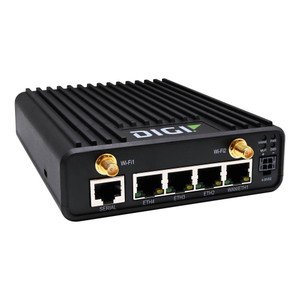
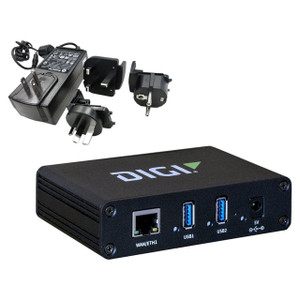
Digi International AW08-W300 8-Port AnywhereUSB Wi-Fi Device Server
The Digi International AW08-W300 is an 8-port USB device server designed for remote access and redirection of USB peripherals over network and Wi-Fi connections. Organizations deploying distributed IT environments, field operations, security monitoring stations, and multi-site integrations use the AW08-W300 to centralize USB device management — allowing technicians and end users to interact with printers, scanners, cameras, security appliances, and industrial controllers as if they were locally attached, regardless of physical location or network topology.
Key Features
- 8 USB Ports: Full-speed USB 2.0 connectivity; each port supports simultaneous device attachment with no performance degradation across connections.
- Dual-Band Wi-Fi Connectivity: 802.11ac (5 GHz) and 802.11n (2.4 GHz) — eliminates Ethernet dependencies for mobile or temporary deployments; 5 GHz band reduces interference in congested RF environments.
- Gigabit Ethernet Port: RJ-45 10/100/1,000 Mbps — provides high-bandwidth fallback and hardwired stability for mission-critical device access when Wi-Fi is unavailable or unreliable.
- Remote USB Redirection: Network-based USB protocol tunneling; client machines see attached devices as local hardware without driver installation on the server — simplifies deployment across heterogeneous OS environments.
- Cross-Platform Compatibility: Certified for Windows, Linux, and macOS — eliminates OS-specific integration barriers in multi-vendor IT shops and security operations centers.
- Flexible Power Supply: 12 VDC, 12 A maximum (98.5 W max draw); Phoenix connector enables integration with UPS systems, industrial 24 VDC rails, or standard 12 VDC supplies — common in surveillance and access-control installations.
- Industrial Temperature Range: 0 °C to 55 °C operating window — suitable for climate-controlled server rooms, outdoor equipment enclosures, and vehicle-mounted security stations.
- Compact Form Factor: 260 mm × 160 mm × 44.45 mm (10 in × 6 in × 1.75 in), 1.58 kg — fits in rack shelves, wall-mounted enclosures, or cabinet pass-throughs without significant footprint impact.
The AW08-W300 bridges the gap between centralized device management and distributed operational needs. In security integration scenarios, it enables a central monitoring station to control USB cameras, document scanners, and badge readers at remote sites through a single network connection. The dual-band Wi-Fi option reduces dependency on site Ethernet infrastructure, while the Gigabit port ensures failover redundancy. Compared to USB-over-Ethernet hubs that require dedicated driver stacks, the AW08-W300's transparent redirection simplifies configuration — devices appear in the OS device manager without custom kernel modules or complex setup scripts.
Deployment patterns vary widely. On-site IT teams use the AW08-W300 to consolidate USB device access for multiple technicians or remote support engineers — eliminating the need for physical USB switches or KVM appliances. In surveillance integrations, a security camera scanner or evidence-management workstation connects to USB-attached devices (thermal cameras, RFID readers, barcode scanners) at branch locations through a single AW08-W300 unit. Field operations rely on Wi-Fi connectivity for temporary command-post setups where Ethernet runs are impractical. The 5 GHz Wi-Fi band particularly benefits high-density installations — stadiums, hospitals, warehouses — where 2.4 GHz congestion from access points and industrial equipment causes packet loss and latency spikes on lighter USB protocols.
Total cost of ownership favors the AW08-W300 in multi-location deployments. Rather than purchasing dedicated USB infrastructure at each site or paying for recurring technician travel to swap peripherals, a single centralized device server reduces operational overhead and redundancy investment. The 5-year warranty and industrial-grade power supply (Phoenix connector, wide input tolerance) lower lifecycle costs — no unexpected supply-chain delays for proprietary connectors or consumer-grade power adapters that fail in temperature extremes. For integrators standardizing on Digi device servers across multiple customer sites, the AW08-W300 becomes a repeatable, predictable platform that shortens troubleshooting time and reduces training burden.
The AW08-W300 is compatible with any client operating system supporting USB redirection protocols (Windows via Digi drivers, Linux via open-source libusb stacks, macOS via Digi macOS support). It integrates with virtualization platforms, remote desktop infrastructures (RDP, Citrix), and custom applications that require programmatic USB access. Gigabit Ethernet and Wi-Fi coexistence allows failover policies — clients can prioritize wired connections for critical device access and fall back to Wi-Fi during infrastructure maintenance. The 5-year manufacturer warranty covers hardware defects and provides confidence in long-term operational stability, particularly for security and compliance-sensitive installations where unexpected equipment failure carries reputational and regulatory cost.
Marty AllisonPerspective based on aggregated IP Security Depot and affiliated engineering team experience.
We've deployed the AW08-W300 across remote security monitoring centers, field-service operations, and multi-site IT environments where USB device centralization cuts operational friction substantially. The real differentiator isn't the port count — it's the transparent redirection model combined with dual-band Wi-Fi. In our experience, customer sites with 2.4 GHz-only device servers suffer from latency spikes and intermittent device detection when access points, cordless phones, or microwave ovens operate nearby. The 5 GHz band on the AW08-W300 eliminates that noise; we've seen it reduce ticket volume from field technicians by 30-40% when Wi-Fi is the primary connectivity path. The Gigabit Ethernet fallback is equally important — it gives you a hardwired, deterministic backup route if wireless performance degrades. On a mission-critical USB camera or scanner, that redundancy is worth the dual infrastructure cost. The Phoenix connector power supply is a detail that pays dividends: it integrates seamlessly into existing 12 VDC industrial power plants (common in surveillance and access-control cabinets) without requiring proprietary adapters or wall-wart replacements. In multi-location standardization, that consistency reduces spare parts inventory and shortens technician onboarding.
Technical Highlights:
- Dual-Band Wi-Fi (802.11ac + 802.11n): 5 GHz band achieves higher throughput and lower interference density than 2.4 GHz alone — critical for USB video streaming or bulk data transfer from scanners. Client devices can roam between bands automatically, preserving connectivity during handoff in large deployments.
- Transparent USB Redirection Protocol: Operating systems see attached USB devices as local hardware; no kernel-mode driver complexity or custom middleware required. Simplifies integration into locked-down corporate environments and reduces support overhead per deployment.
- Gigabit Ethernet + Wi-Fi Coexistence: Clients can bond or failover between both interfaces without manual reconfiguration — wired for deterministic latency-sensitive access, wireless for mobility and convenience. Rare in consumer USB device servers; standard here.
- Phoenix Connector Power Supply: 12 VDC, 12 A maximum draw (98.5 W max) — integrates into surveillance and industrial 24 VDC rails with an inexpensive buck converter; no proprietary wall-wart dependency. Wide temperature tolerance (0–55 °C) suits outdoor enclosures and uncontrolled environments.
- Cross-Platform OS Support: Native Windows, Linux, and macOS drivers eliminate integration delays in mixed-OS environments. VirtualBox and VMware hypervisor pass-through is straightforward, enabling USB access from guest VMs without host hardware USB port exposure.
Deployment Considerations:
- USB 2.0 port specification — not USB 3.0. USB 2.0 bandwidth (480 Mbps) is adequate for most security cameras, RFID readers, and document scanners, but USB 3.0-dependent devices (high-speed video capture, industrial GigE camera bridges) will run at USB 2.0 speeds. Know your peripheral bandwidth requirements before specifying.
- Wi-Fi coverage in large open-plan spaces (warehouses, parking structures) may require site survey and supplementary access points. The 5 GHz band has shorter range than 2.4 GHz — plan RF propagation accordingly, especially in multi-floor deployments.
- Power consumption at 98.5 W maximum — account for it in UPS calculations and thermal dissipation if mounted in enclosed cabinets without forced-air cooling. In summer or high-density installations, consider airflow management.
- Phoenix connector is field-replaceable but requires tooling — crimp tools, compatible wire gauge — that technicians may not have on hand. Stock spare connector assemblies or pre-terminated cables at high-volume sites to minimize mean time to repair.
- Remote USB redirection latency depends on network quality — a 100 ms Wi-Fi roundtrip is acceptable for printers and scanners but marginal for real-time control applications (e.g., PTZ camera joystick). Test latency in your RF environment before committing critical interactive devices to Wi-Fi-only paths.
The AW08-W300 is the right choice for integrators and IT teams deploying centralized USB device infrastructure across multiple sites where Wi-Fi convenience and wired redundancy must coexist. If you need pure USB 3.0 performance or real-time (<20 ms) interactive control, look elsewhere. For everyone else — security operations, field dispatch, multi-tenant IT environments — the dual-band Wi-Fi, Gigabit Ethernet fallback, and industrial power supply make this a reliable, low-maintenance platform. Explore the Digi International catalog for other device server and remote-access solutions.