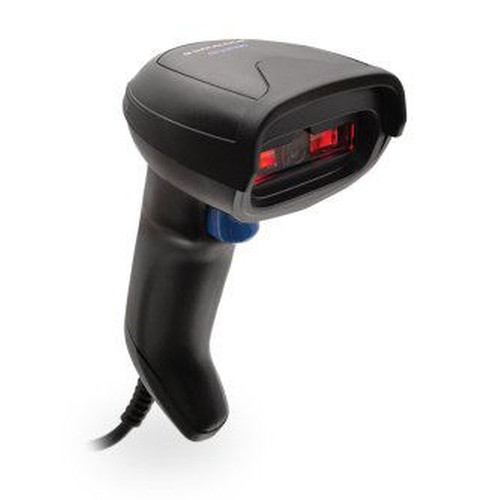
Datalogic GD4290-BK 2D Area Imager Barcode Scanner
The Datalogic GD4290-BK is a handheld 2D area imager scanner designed for retail, warehouse, and light industrial barcode capture. This wired device combines rapid 1D and 2D barcode decoding with reliable operator feedback, supporting integration into point-of-sale, inventory management, and enterprise asset-tracking systems without proprietary middleware requirements.
Key Features
- 2D Area Imager Technology: Captures both 1D and 2D barcodes in a single scan, eliminating the need for dual-scanner deployments in mixed-barcode environments. Area imaging outperforms laser-based scanners when handling damaged, aged, or poorly printed barcodes — a common scenario in warehouses with legacy inventory labels.
- Snappy Decoding Engine: Processes linear codes, 2D matrix codes, postal codes, and composite codes with minimal latency. The decoder handles low-contrast and distorted barcode images, reducing scan rejections and operator frustration during high-volume operations.
- Green Spot Visual Feedback: Delivers instantaneous good-read confirmation through an illuminated indicator. This tactile feedback loop cuts scanning errors by confirming successful reads immediately, critical in fast-paced retail checkout and warehouse receiving operations where operator attention is divided.
- Multi-Interface Connectivity: Supports USB, RS-232, and Keyboard Wedge protocols. This flexibility allows deployment into legacy POS terminals, industrial control systems, and modern workstations without requiring intermediate adapters or protocol converters — meaningful savings on integration labor and future-proofing against system migrations.
- Lightweight, Compact Form Factor: Weighs 222 g (0.49 lb) and measures 64 x 160 x 89 mm (2.5 x 6.3 x 3.5 inches). The reduced weight minimizes hand fatigue during extended scanning sessions, improving operator accuracy and productivity during peak periods. The compact profile fits easily into retail register stations and mobile cart applications.
- Durable Construction & Warranty: The GD4290-BK carries a 5-year limited warranty, reflecting proven field reliability across retail and warehouse deployments. Extended care options are available for organizations requiring multi-year cost predictability and support continuity.
Integration & Compatibility
The scanner integrates directly into existing barcode scanner deployments via standard USB (for powered connections) or RS-232 serial (for legacy industrial equipment). Keyboard Wedge mode enables transparent integration into any workstation running terminal emulation or web-based POS without software modifications — the scanner acts as a virtual keyboard, injecting barcode data into active windows. This approach accelerates time-to-deployment in retail environments where IT resources are constrained.
The Gryphon I 4500 family is suitable for organizations standardizing across multiple facility locations. Single device type reduces operator training overhead, simplifies spare-parts inventory management, and streamlines technical support workflows. HD variants within the Gryphon I 4500 series address specialized small-barcode applications, allowing a single product family to serve both standard and high-resolution scanning requirements.
Deployment Scenarios
The GD4290-BK is well-suited for retail point-of-sale environments, warehouse receiving and put-away operations, inventory cycle counting, light manufacturing asset tagging, and office document capture workflows. Wired connectivity is preferred in stationary or semi-mobile applications where cable management is practical and power reliability is required. Organizations requiring untethered mobility should evaluate wireless variants within the Gryphon I product line.
Frequently Asked Questions
Q: What barcode formats does the GD4290-BK decode?
A: The scanner reads 1D linear codes (Code 39, Code 128, UPC/EAN, Codabar, Interleaved 2 of 5, and others), 2D matrix codes (QR, Data Matrix, PDF417), postal codes, and composite codes. Refer to the manufacturer documentation for the complete supported symbology list.
Q: Is the GD4290-BK wireless?
A: No. The GD4290-BK is a wired scanner with USB, RS-232, and Keyboard Wedge connectivity. If wireless scanning is required, consider wireless variants within the Datalogic Gryphon series.
Q: What power requirements does the GD4290-BK have?
A: The scanner draws power from the host interface — USB connections provide power directly from the host device, while RS-232 deployments may require a separate power supply depending on the host system configuration.
Q: Can the GD4290-BK integrate with existing POS systems?
A: Yes. Keyboard Wedge mode allows the scanner to inject barcode data into any active window on a connected workstation, making integration possible without middleware. USB and RS-232 options also support direct connection to legacy industrial terminals and modern point-of-sale platforms.
Q: What is the warranty period on the GD4290-BK?
A: The scanner includes a 5-year limited warranty covering defects in materials and workmanship. Extended care and support options are available from the manufacturer.
Q: How does the Green Spot feedback improve scanning accuracy?
A: The illuminated good-read indicator provides immediate visual confirmation of successful barcode capture, eliminating ambiguity and reducing the likelihood of duplicate scans or missed reads in high-velocity environments.
Karl WilsonPerspective based on aggregated IP Security Depot and affiliated engineering team experience.
The Datalogic GD4290-BK represents a mature, field-proven 2D imaging platform that prioritizes operational reliability over feature novelty. The shift from laser-based scanners to area imaging delivers tangible gains in real-world retail and warehouse environments — the GD4290-BK handles aged, crumpled, and low-contrast barcodes that would reject on older laser hardware, cutting rescans and operator frustration. The Green Spot feedback mechanism is deceptively powerful: instant visual confirmation of successful capture eliminates the ambiguity that leads to duplicate scans or missed items in high-volume operations.
Technical Highlights:
- 2D Area Imager: Outperforms laser-based scanners when reading damaged or poorly printed barcodes. The imaging approach captures the entire barcode area in a single read, making it forgiving of label wear and print quality degradation — a realistic constraint in warehouse and retail environments with high label turnover.
- Multi-Interface Support (USB, RS-232, Keyboard Wedge): Eliminates integration complexity. Keyboard Wedge mode is particularly valuable: the scanner emulates a keyboard, allowing transparent injection of barcode data into legacy POS terminals and modern workstations without custom middleware or driver development. USB and RS-232 support direct connection to industrial control systems and legacy equipment without adapter expense.
- Lightweight at 222g (0.49 lb): Extended handheld use induces operator fatigue over 8-hour shifts. The sub-quarter-pound weight reduces hand strain during peak-volume periods (checkout rushes, cycle-count operations), directly improving accuracy and throughput over full shifts. Compare this to heavier scanners where fatigue drives scanning errors after 4–5 hours.
Deployment Considerations:
- The GD4290-BK is wired only — cable management is a practical constraint in mobile or outdoor applications. Stationary POS terminals, warehouse receiving docks, and office document processing are ideal fits; mobile cart operations or untethered inventory picking may require wireless variants.
- RS-232 deployments on legacy industrial systems may require separate power supplies if the host device cannot supply power via the serial connection — verify power availability during site surveys.
The GD4290-BK is the right choice for retail and warehouse operations where mixed 1D/2D barcode environments, label quality variability, and operator efficiency matter. The 5-year warranty and available extended care options provide cost predictability for multi-site standardization — a meaningful advantage when managing device lifecycles across 20+ locations. Wired connectivity remains the practical standard for high-velocity checkout and receiving workflows where cable permanence eliminates battery management overhead.