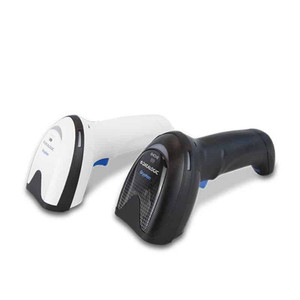
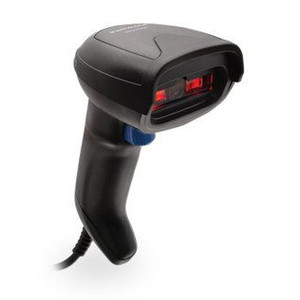
Datalogic GBT4500-BK-WLC 2D Area Imager Scanner
The Datalogic Gryphon I 4500 (GBT4500-BK-WLC) is a wired 2D area imager scanner built for retail, office, and light industrial environments where consistent barcode capture reliability matters more than wireless flexibility. This handheld device eliminates battery management overhead and RF interference concerns by relying on hardwired USB, RS-232, or Keyboard Wedge connectivity — a practical choice for fixed scanning stations and high-density retail deployments.
Key Features
- 2D Area Imager Engine: Captures both 1D linear and 2D barcodes (including postal codes and composite codes) in a single read. This is a genuine advantage over laser scanners when dealing with damaged, poorly printed, or unconventional barcode formats — area imagers read the entire barcode field simultaneously rather than sweeping a single laser line, so they're more forgiving of label quality issues.
- Snappy Decoding: Fast image-to-data processing reduces scan lag, critical in high-throughput environments like retail checkout or warehouse receiving where operator productivity depends on speed. No perceptible delay between trigger pull and result.
- Green Spot Good-Read Feedback: Integrated visual confirmation (green light) signals a successful read without requiring the operator to glance at a separate screen or wait for audible confirmation. This improves accuracy by reducing null scans and re-scans — especially valuable in repetitive picking or checkout workflows.
- Wired Connectivity (USB, RS-232, Keyboard Wedge): Multiple protocol options mean the GBT4500-BK-WLC integrates into legacy POS systems, modern endpoints, or industrial controllers without additional middleware. No wireless pairing, no battery charging dock, no RF site survey — just cable and go. Ideal for stationary or cart-based scanning stations.
- Lightweight and Ergonomic: At 222 grams (0.49 lb) and compact 64 × 160 × 89 mm form factor, the scanner won't fatigue operators during extended shift use. Weight and grip matter in retail and warehouse settings where someone holds the device hundreds of times per shift.
- Enterprise Durability and Support: 5-year limited warranty and Datalogic factory support mean replacement parts and service are predictable over the device lifecycle — important for organizations standardizing across multiple facilities.
Integration & Deployment Context
The wired architecture of the GBT4500-BK-WLC is a deliberate tradeoff. You gain simplified IT management (no wireless credentials to provision, no battery fleet tracking), predictable latency, and zero RF interference — but you sacrifice mobility beyond a cable's reach. This scanner is right for checkout counters, receiving docks, and inventory management stations where operators work in a fixed footprint. It's the wrong choice if you need roaming handheld scanning across a warehouse floor or retail floor without hardwired infrastructure.
Deployment integration is straightforward: connect USB (or RS-232 for legacy systems) to a point-of-sale terminal, warehouse management system input, or document management station. The Keyboard Wedge mode simulates a USB keyboard, so barcode data appears as typed characters in any application that accepts keyboard input — no driver installation required on many systems.
When to Choose a Different Model
If your operators need untethered mobility across large areas, consider a wireless variant in the Datalogic barcode scanner lineup. If you require cordless scanning but wired simplicity, investigate industrial-grade wireless models with dock-based charging. If your primary need is extreme durability (drop resistance, wet environments), verify the GBT4500-BK-WLC's specific ruggedness ratings against your site conditions — area imagers are generally robust, but this model's environmental limits should be confirmed against your application.
Frequently Asked Questions
Q: Does the GBT4500-BK-WLC require software drivers to connect to a modern PC?
A: USB connection typically requires no driver on modern Windows, macOS, or Linux endpoints. RS-232 and Keyboard Wedge modes may require configuration in your application, but hardware-level driver installation is rarely necessary. Check with your POS or WMS vendor for integration specifics.
Q: Can the GBT4500-BK-WLC read damaged or poorly printed barcodes?
A: Yes — 2D area imager technology is more tolerant of label defects than laser scanners because it captures the entire barcode field as an image and reconstructs data, rather than relying on a single scan line. Damaged corner regions or uneven printing is often still readable.
Q: What is the maximum barcode reading distance?
A: Area imagers like the GBT4500-BK-WLC typically operate at 0–20 cm (0–8 in) working distance for standard retail barcodes. Exact range depends on barcode size and contrast; consult the datasheet for your specific symbology.
Q: Is the GBT4500-BK-WLC suitable for outdoor or wet environments?
A: No. This scanner is designed for retail, office, and light industrial indoor settings. For outdoor or wash-down environments, verify IP rating in the full specification — indoor-rated devices are not recommended for direct water exposure or dusty conditions.
Q: What warranty and support does Datalogic provide?
A: The GBT4500-BK-WLC includes a 5-year limited warranty. Extended warranty and on-site support options are available through authorized Datalogic channels.
Q: Does the scanner work with my warehouse management system?
A: The GBT4500-BK-WLC emulates a USB keyboard or serial device, so it works with any WMS or POS system that accepts barcode input. No special integration is typically required. Contact your WMS vendor or reseller to confirm compatibility with your specific platform.
Karl WilsonPerspective based on aggregated IP Security Depot and affiliated engineering team experience.
The Datalogic GBT4500-BK-WLC (often searched as GBT4500 BK WLC) represents a deliberate engineering choice: trading wireless flexibility for operational simplicity and predictability. In retail and warehouse environments where fixed scanning stations dominate, wired connectivity eliminates entire categories of IT overhead — no wireless pairing, no battery fleet management, no RF site surveys or coverage gaps. The 2D area imager technology distinguishes this scanner from older laser models, particularly in high-wear retail or shipping environments where label quality is unpredictable.
Technical Highlights:
- 2D Area Imager vs. Laser: Reads the entire barcode as a captured image, not a single laser line. This means damaged, poorly printed, or worn labels that would fail on a laser scanner often still decode reliably on the GBT4500-BK-WLC — a real advantage when you're dealing with second-hand packaging, outdoor-stored cartons, or high-volume retail where label wear is inevitable.
- Snappy Decoding Engine: Image-to-text processing is fast enough that operator lag is not a factor. In high-throughput checkout or receiving operations, this translates to measurable throughput — no pauses between scans waiting for the device to process.
- Green Spot Feedback: Immediate visual confirmation of a good read reduces operator uncertainty and null-scan rework. Over a shift, this small UX detail compounds into fewer data entry errors and faster scanning cycles.
- 222g Weight, Compact Form: Comfortable for extended handheld use without fatigue, critical in retail POS or picking environments where someone triggers the scanner 500+ times per shift.
Deployment Considerations:
- Wired Architecture Limitation: The cable tether means this scanner is best suited for fixed or near-fixed scanning stations. If your operators need to roam freely across a warehouse or retail floor without hardwired infrastructure, a wireless model (even with battery management overhead) may be necessary.
- Cable Management Detail: In high-volume retail or warehouse environments, cable routing, strain relief, and replacement planning should be part of your deployment spec. Budget for cable wear and have spares on hand — a worn USB connector can take a scanner out of service.
The GBT4500-BK-WLC is the right tool for retail checkout networks, fixed inventory stations, receiving docks, and office document tracking where an operator returns to the same scanning station shift after shift. It's not a roaming solution, and that's not a weakness — it's a design decision that buys you reliability and simplicity in the environments where fixed scanning makes sense.