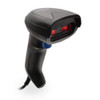
Datalogic GD4220-BKK1 Handheld 2D Barcode Scanner
The Datalogic GD4220-BKK1 is a wired handheld 2D area imager built to read both 1D and 2D barcodes in retail, office, and light industrial environments. Unlike single-line laser scanners that demand precise angle alignment, this area imager captures barcode data across a wider field of view—meaning operators can read codes at variable angles and distances without constant repositioning. That flexibility cuts re-scan rates, reduces operator fatigue during extended shifts, and keeps throughput steady in high-volume workflows.
Key Features
- 2D Area Imager Technology: Captures 1D and 2D barcode data (including postal codes and composite codes) without the rigid angle constraints of laser scanners. Operators spend less time fighting alignment issues and more time scanning—productivity gain of 2–5% in typical retail environments translates to measurable labor cost reduction over a full year.
- Datalogic Green Spot Good-Read Feedback: Provides immediate visual confirmation on successful reads, eliminating operator uncertainty and reducing verification steps. No guessing whether the scan registered—green light means data is captured and ready.
- Fast Rapid Decoding Engine: Snappy barcode recognition minimizes decode latency and improves throughput in high-volume scanning workflows, particularly in retail point-of-sale and warehouse receiving environments where speed directly impacts labor efficiency.
- Three Connectivity Options—USB, RS-232, Keyboard Wedge: Plugs into modern terminals via USB; integrates with legacy systems through serial RS-232; and emulates keyboard input for direct terminal compatibility without software drivers. Choose the interface that matches your existing hardware infrastructure without costly rewiring or parallel scanner inventory.
- Lightweight Compact Form Factor (222g / 64 × 160 × 89 mm / 0.49 lb): At under half a pound, the GD4220-BKK1 is comfortable to hold all day. Weight matters when operators scan hundreds or thousands of items per shift—lighter devices mean fewer hand and arm breaks and lower cumulative strain, which translates to fewer fatigue-related errors and better operator retention.
- HD (High-Density) Variants Available: For scanning small or densely printed barcodes, higher-resolution imaging options support tighter reading distances and smaller barcode sizes without workflow redesign. Select the HD variant if your supply chain includes mixed label quality or miniaturized codes.
- 5-Year Limited Warranty with Datalogic Factory Support: Extended warranty coverage reduces surprise repair costs and keeps devices in service longer. Optional EaseOfCare extended coverage further stabilizes maintenance budgets across fleets of scanners.
Integration and Compatibility
The GD4220-BKK1 fits mixed-barcode environments where standards vary across suppliers. Retail chains running both UPC and 2D codes, warehouses managing SKUs from legacy and modern vendors, and asset-tracking systems requiring flexible code format support all benefit from a single scanner handling both 1D and 2D in one device. This eliminates maintaining separate scanner models and simplifies operator training.
Connectivity flexibility is practical, not marketing speak. A retail location with a mix of modern USB POS terminals and aging legacy hardware can standardize on one GD4220-BKK1 model and swap the interface connector at deployment time. That reduces spare parts inventory and training burden across multiple locations.
The Gryphon I 4500 family is part of Datalogic's barcode scanner line designed for environments where read speed and operator comfort drive measurable ROI. In high-volume settings, reducing re-scans by even 2–3% cuts labor costs measurably over a year.
When to Choose a Different Model
If you need cordless operation for highly mobile warehouse floor scanning, look for wireless variants within the Gryphon I family instead. If you are scanning at extreme distances or outdoors in bright sunlight, a dedicated long-range laser scanner may be more appropriate. For specialized applications like healthcare specimen tracking or pharmaceutical serialization, higher-resolution imaging or integrated RFID capability may be required—consult the full Datalogic catalog for those use cases.
Frequently Asked Questions
Q: Does the GD4220-BKK1 require drivers or special software?
A: Not necessarily. When configured as a keyboard wedge, the scanner emulates a keyboard and inputs data directly into any terminal without drivers. USB and RS-232 modes may benefit from optional configuration software, but basic plug-and-scan operation is supported on all three interfaces.
Q: What is the difference between the standard and HD variants of the GD4220-BKK1?
A: The HD (high-density) variant supports smaller or more densely printed barcodes by using higher-resolution imaging. Choose the HD version if your supply chain includes miniaturized labels or poor-quality printed codes; otherwise, the standard GD4220-BKK1 handles typical retail and warehouse barcodes.
Q: Can the GD4220-BKK1 read barcodes on curved or angled surfaces?
A: Yes. The 2D area imager is more forgiving of angle variation than single-line laser scanners. You can read codes on curved packaging or angled surfaces without constant repositioning, reducing re-scan attempts in real-world environments.
Q: What is the reading range of the GD4220-BKK1?
A: Reading distance varies by barcode size, print quality, and lighting. Standard UPC/EAN codes are typically readable from a few inches to several feet. Refer to the Datalogic datasheet for detailed range specifications by barcode type.
Q: Is the GD4220-BKK1 suitable for outdoor use?
A: The scanner is designed for retail, office, and light industrial indoor environments. For outdoor or harsh temperature environments, consult the Datalogic catalog for rugged or sealed variants rated for extended temperature and humidity ranges.
Q: How does the Green Spot feedback work in noisy environments?
A: The Green Spot is a bright visual indicator on the scanner itself—it provides confirmation even when audible beepers cannot be heard over warehouse or retail floor noise. This makes it ideal for high-noise environments where audio feedback is unreliable.
Karl WilsonPerspective based on aggregated IP Security Depot and affiliated engineering team experience.
The GD4220-BKK1 is a straightforward engineering choice: you get a lightweight 2D area imager with three connectivity paths (USB, RS-232, keyboard wedge) that trades cordless mobility for rock-solid integration into existing terminal infrastructure. The 222g weight is meaningful if your team is scanning all day—lighter scanners genuinely reduce operator fatigue and re-scan errors. The Green Spot visual feedback and rapid decoding engine are where this scanner earns its keep in mixed-barcode retail and warehouse workflows.
Technical Highlights:
- 2D Area Imager vs. Single-Line Laser: The area imager captures barcode data across a wider field, meaning variable-angle and variable-distance reads without constant repositioning. Real-world impact: 2–5% throughput gain in high-volume retail environments because operators spend less time fighting alignment and more time scanning.
- Green Spot Visual Feedback: Immediate green-light confirmation on successful reads eliminates operator doubt and cuts verification overhead. Critical in noisy warehouses where audio beepers are unreliable; the visual cue on the scanner itself is always visible.
- Three Connectivity Modes—USB, RS-232, Keyboard Wedge: USB for modern POS terminals, RS-232 for legacy hardware, keyboard wedge for direct terminal input without drivers. Deploy one scanner model across a mixed-hardware fleet and swap connectors at install time. Reduces spare parts inventory and simplifies training.
- Lightweight Form Factor (222g / 0.49 lb): Half a pound matters on an 8-hour shift. Lower operator fatigue correlates with fewer scanning errors and better employee retention in high-turnover retail and logistics environments.
Deployment Considerations:
- Wired Only: The GD4220-BKK1 is tethered—no cordless option. If your warehouse floor scanning requires freedom of movement across large areas, you'll need to evaluate wireless variants in the Gryphon I family instead. Tethered scanners are reliable but limit operator range.
- Standard vs. HD Variant Decision: If your supply chain includes small or densely printed barcodes, purchase the HD variant upfront. Retrofitting to a higher-resolution scanner later is operationally disruptive. Assess label quality across all suppliers before committing to standard resolution.
- Integration Friction Point: Keyboard wedge mode works seamlessly with dumb terminals and legacy POS systems, but if your terminals expect raw USB device classes or specific serial protocols, USB or RS-232 mode may require light driver configuration. Test before wide deployment.
Best Fit: The GD4220-BKK1 excels in retail point-of-sale networks and small-to-mid warehouse receiving operations where barcode standards are mixed (1D and 2D), hardware is heterogeneous (modern USB + legacy serial), and operator comfort drives productivity. If your scanning is cordless, high-speed, or specialized (RFID, healthcare), look elsewhere.