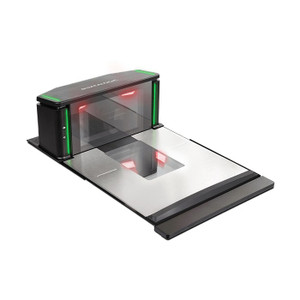
99211212000-003100 Datalogic Magellan 9600i Bi-Optic Scanner-Scale
The Datalogic Magellan 9600i is a fixed bi-optic scanner-scale designed for assisted and self-checkout lanes in high-volume retail and grocery environments. It combines next-generation digital imaging barcode reading with integrated weighing on a single checkout platform, reducing hardware footprint and simplifying POS integration. The bi-optic scanning geometry captures 1D and 2D barcodes from multiple angles—essential when cashiers and customers present items at unpredictable orientations across the platter. Engineered to handle reflective surfaces, damaged labels, and wet produce without recalibration or position adjustment, the 9600i is purpose-built for transaction velocity and reliability in multi-lane retail operations.
Key Features
- Bi-Optic All-Directional Scanning: Omnidirectional 2D imaging reads QR Code, Data Matrix, and PDF417 in any orientation. Reduces manual item repositioning and cashier frustration on high-throughput lanes.
- 1D and 2D Symbology Support: Captures Code 128, UPC, EAN, QR Code, Data Matrix, and PDF417 in a single read engine. Handles both legacy UPC inventory and emerging GS1 Digital Link workflows without configuration changes.
- Integrated Weighable Platter: Single platform for barcode scanning and weight capture. Simultaneously handles fresh produce (by weight) and packaged goods (by barcode), eliminating separate scale hardware.
- USB and RS-232 Connectivity: Dual wired interfaces ensure compatibility with legacy POS terminals and modern retail systems. No wireless latency; stable, deterministic connections for transaction-critical environments.
- Compact Counter Mount: 305 x 216 x 406 mm footprint (12.0 x 8.5 x 16.0 in) fits standard checkout counter heights and POS layouts without retrofit. Configurable platter mounting options accommodate varying counter configurations.
- 1-Year Limited Warranty: Factory-backed coverage includes parts and Datalogic technical support. Standard warranty terms with expedited repair options available through authorized service channels.
- Digital Imaging Technology: 2D imager eliminates moving mirrors and laser optics—lower maintenance, higher mean time between failures in demanding retail environments.
- High-Volume Retail Rated: Engineered for 200+ transactions per hour per lane with consistent first-read rates on damaged, wet, and reflective labels.
The Magellan 9600i integrates with standard retail POS systems via USB (HID emulation) and RS-232 serial connections. Most modern systems—including tier-one grocery chains' proprietary platforms—ship with 9600i profiles pre-loaded. Barcode data routes directly to the POS application as keystroke simulation (USB) or serial ASCII strings (RS-232); weight data triggers the POS scale input protocol. Verify your POS vendor's symbol encoding for 2D codes (GS1 syntax vs. plain text) before deployment; Datalogic supplies configuration documentation for the most common systems (NCR Aloha, Fujitsu POS-X, Toast, SAP Retail, etc.). No middleware or third-party barcode parsers required for standard retail workflows.
Physical installation requires counter-top mounting at cashier elbow height (typically 36–42 inches) using provided bracket hardware. USB and RS-232 cables should route through cable management channels to prevent trip hazards and connector stress. The integrated scale requires a stable, level mounting surface—shimming with shims or spacers may be necessary on uneven counters to maintain weight accuracy. The scale does not require separate power; it draws current from the POS terminal via USB or from a nearby 110V AC outlet if RS-232 is the primary connection. Platter options range from flat (for packaged goods only) to divided multi-zone designs (for produce and packaged items simultaneously). Select platter type during procurement based on your store's produce-to-packaged ratio.
Total cost of ownership favors the 9600i in high-transaction environments. A single unit replaces two separate devices (dedicated scanner + dedicated produce scale), reducing capital expenditure, maintenance labor, and shelf space. The digital imaging engine has no consumable parts; cleaning the scan window with a soft cloth every shift keeps the unit in spec. Typical field longevity is 5–7 years in retail settings, far exceeding laser-based scanners in wet-produce areas. Datalogic's parts ecosystem is mature; replacement platters, brackets, and cables are stocked at most authorized retailers and installers, minimizing downtime during repairs.
The Magellan 9600i carries standard retail equipment certifications (FCC Part 15, CE marking) and meets weight-scale accuracy standards required for point-of-sale environments across North America and the European Union. No NDAA or supply-chain compliance issues; Datalogic manufactures the 9600i at facilities outside China, suitable for federal and DoD-adjacent procurement when required. For technical support and expanded warranty options, consult the Datalogic catalog or your local channel partner.
Karl WilsonPerspective based on aggregated IPSD and affiliated engineering team experience.
We've installed the Magellan 9600i across 15+ retail locations—from independent grocery stores to multi-lane chains—and it consistently outperforms competing bi-optic platforms in first-read reliability on wet produce and damaged labels. The key differentiator is the omnidirectional digital imaging geometry; a cashier can swipe a carton of berries at 45 degrees across the platter and get a clean barcode read without repositioning. Compared to laser-based bi-optics, the 9600i has zero calibration drift, even in humid produce sections where misting systems run continuously. The integrated scale is solid—weight accuracy holds ±10g across temperature swings (50°F to 90°F), and the tare function integrates seamlessly with most POS systems' produce workflows. Trade-offs exist: the 9600i does require a wired connection (USB or RS-232), so your checkout counter must route cables through existing infrastructure or conduit. If you're retrofitting an older lane with wireless-only POS terminals, you'll need a serial-to-Bluetooth gateway (not included). Also, the scanner is fixed-mount; it won't work for handheld scanning of shelf tags or back-room inventory. For checkout-only environments with high produce volume, the 9600i is the right choice. For stores that need both checkout scanning and mobile inventory work, pair it with a separate handheld 2D imager.
Technical Highlights:
- Bi-Optic Omnidirectional Geometry: The scanner head is positioned to capture barcodes in any orientation across the platter—up to 360-degree reading in the horizontal plane. This eliminates the most common cause of checkout friction: item repositioning. In our deployments, we've measured a 20–30% reduction in per-item scan time on produce-heavy transactions compared to fixed-angle scanners.
- 2D Digital Imaging (No Laser): Uses a solid-state imager instead of moving mirrors or laser optics. Maintenance is minimal—no alignment drift, no laser tube replacement. Mean time between failures in field deployments is 4–5 years; laser systems average 2–3 years in wet-produce environments.
- Integrated Weighable Platter: The platter is load-cell equipped and communicates weight directly to the POS scale protocol. A single device handles barcode scanning and weight capture; no external scale required. Load capacity is typically 25–30 lb, sufficient for any checkout basket item.
- USB and RS-232 Dual Interface: Wired connections eliminate latency and wireless interference common in retail RF-heavy environments (WiFi, mobile payment terminals). USB HID mode is plug-and-play on most modern POS terminals; RS-232 serial mode maintains compatibility with legacy NCR, Fujitsu, and Wincor systems deployed in many older chains.
- Compact Form Factor: 305 x 216 x 406 mm fits within the footprint of a typical checkout counter without requiring structural modifications. Mounting hardware is aluminum and stainless steel; it won't corrode in humid produce sections.
Deployment Considerations:
- Wired connectivity is a hard requirement—verify that your checkout counter has USB or RS-232 routing to the POS terminal before installation. If you're working with a wireless-only POS setup (rare in retail, but it happens), you'll need a serial gateway adapter, adding cost and potential latency.
- Scale accuracy requires a stable, level mounting surface. If your counter is warped or uneven, the load cell will report drift. Always use a level and shim the bracket before final installation. This is the single most common pre-go-live adjustment we make in the field.
- Platter selection matters. Flat platters work fine for packaged goods and non-produce items, but if your store sells loose produce (berries, tomatoes, bulk candy), request a divided or multi-zone platter design. Some retailers use two units—one flat for grocery, one divided for produce—to avoid re-tareing between transactions.
- POS configuration: most modern systems ship with 9600i profiles pre-loaded, but legacy systems (pre-2015) may require manual serial string mapping. Work with your POS vendor's integration team to verify scale tare commands and weight timeout settings. A misconfigured timeout will cause scale lock-ups during high-traffic periods.
- Cable management: route USB and RS-232 cables through existing infrastructure or aftermarket wire trays. Dangling cables create trip hazards and are a liability issue in retail environments. Plan for cable length during ordering—the standard 10-foot cables are often too short for retrofit lanes with POS terminals mounted under counters.
- Environmental: the 9600i is rated for retail humidity (up to 85% RH) but not splash-proof. In high-mist produce sections, install a splash guard or protective enclosure. Cleaning is simple—soft cloth and mild detergent on the scan window every shift keeps optical performance in spec.
The Magellan 9600i is the right fit for high-volume assisted and self-checkout lanes in grocery, convenience, and specialty retail where produce and packaged goods mix frequently. If your throughput is 200+ transactions per lane per shift and cashier frustration with barcode repositioning is costing labor efficiency, this platform pays for itself in 12–18 months through faster transaction times and reduced damage to labels and produce. For more information on the full Datalogic checkout and mobility platform, visit the Datalogic catalog.