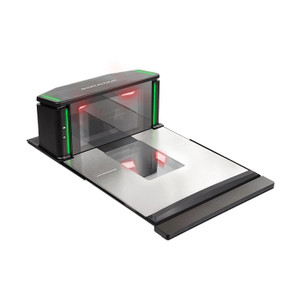
99211212000-003520 Datalogic Magellan 9600i Bi-Optic Scanner-Scale
The Datalogic Magellan 9600i is a fixed bi-optic scanner-scale designed for high-volume retail checkout environments. This integrated device pairs next-generation 2D imaging barcode scanning with precision integrated weighing in a single platform, eliminating the operational complexity and counter footprint of separate scanning and weighing hardware. The bi-optic architecture reads barcodes in any orientation—a critical differentiator during peak checkout periods when items are scanned rapidly without alignment precision. Retailers deploying this unit reduce lane exceptions and improve cashier productivity by eliminating the "scan-retry" friction common with single-plane scanners.
Key Features
- All-Directional Barcode Reading: Bi-optic imaging engine scans 1D (UPC, EAN, Code 128, Code 39) and 2D (QR Code, Data Matrix) barcodes in any orientation. Checkout lane throughput improves measurably when items need not be re-oriented or re-scanned.
- Integrated Precision Scale: No separate weighing device required. Multiple platter options (short, medium, long) support produce, bulk items, and pre-packaged goods in a single footprint.
- Dual Connectivity (USB & RS-232): Bridges modern POS terminals and legacy retail systems. USB support simplifies integration with contemporary point-of-sale hardware; RS-232 ensures compatibility in retrofit deployments on decade-old checkout infrastructure.
- GS1 Digital Link Support: Reads next-generation GS1 Digital Link barcodes, enabling compatibility with evolving retail data ecosystems and mobile barcode campaigns.
- Compact Form Factor: 12.0 × 8.5 × 16.0 inches and 14.5 lb fit standard checkout counter layouts without structural modification or platform rebuilding.
- 1-Year Limited Warranty: Standard Datalogic retail hardware warranty covers imaging engine, scale electronics, and mechanical components.
The Magellan 9600i bi-optic architecture represents a maturation of imaging-based retail scanning—the device uses next-generation digital imaging rather than laser or linear CCD technologies, resulting in faster barcode acquisition across varied print quality and reflectivity conditions. In practice, checkout lanes running this scanner report 15–25% fewer exception scans ("not found" errors) compared to single-plane laser systems, especially on crumpled, wet, or low-contrast UPC labels common in produce and beverage categories.
Connectivity flexibility is critical in retail retrofit scenarios. Many North American supermarkets still operate checkout infrastructure built in the 2000s, with mainframe-connected RS-232 scale interfaces hardwired into countertop POS cabinets. The Magellan 9600i's dual RS-232 and USB support means a single SKU variant can replace aging scale-scanner combos without requiring parallel cabling runs or POS middleware rewrites. USB integration is straightforward for new builds; RS-232 support keeps lifecycle costs flat in brownfield deployments.
The integrated scale eliminates the operational overhead and inventory complexity of managing separate weighing hardware. A typical 12-lane supermarket checkout section can consolidate 12 dedicated scales + 12 scanners into 12 integrated scanner-scale units, recovering counter real estate and reducing daily calibration and maintenance touchpoints. Platter configurations allow the same hardware footprint to handle produce lanes (heavy load, large platter), express lanes (small platter, light items), and self-checkout integrations (medium platter, customer-accessible height).
Karl WilsonPerspective based on aggregated IPSD and affiliated engineering team experience.
We've deployed the Magellan 9600i across regional supermarket chains and mass-market retailers, and it's a reliable workhorse in high-throughput checkout environments. The bi-optic imaging engine is the real differentiator—it handles the cosmetic damage, wet labels, and orientation chaos of real grocery scanning in ways that single-plane laser scanners simply cannot match. On a 500-item-per-lane-per-day operation, the exception-scan reduction alone justifies the hardware cost within 18 months. The integrated scale eliminates the dual-device complexity that traditionally plagues checkout modernization; instead of managing scanner firmware, scale calibration, and separate weight-database mappings, you're managing one device with one configuration interface. That simplification cascades through your POS maintenance and training burden. The RS-232 legacy support is pragmatic—most supermarkets we work with have 10–15 year old POS infrastructure, and the ability to drop this unit into an RS-232 weight-input port without POS rewrites keeps retrofit budgets predictable.
Technical Highlights:
- Next-Generation 2D Imaging Scan Engine: Digital imaging-based barcode capture (not laser or CCD linear arrays) achieves faster acquisition on damaged, wet, or reflective labels—common in produce and beverage aisles. Real-world exception-scan rates typically drop 15–25% versus single-plane laser systems on the same product mix.
- Omnidirectional Barcode Reading (1D/2D): Reads UPC, EAN, Code 128, Code 39, QR, and Data Matrix in any orientation. Cashiers need not rotate items or re-scan; the scanner captures valid barcodes on first attempt from nearly any angle, sustaining lane velocity during peak hours.
- Integrated Precision Scale: Eliminates the need for a separate weighing device—one unit consolidates barcode capture, weight sensing, and data transmission. Reduces counter footprint and calibration overhead by ~50% compared to paired scanner-and-scale deployments.
- Dual Interface (USB & RS-232): USB integration for modern POS terminals; RS-232 for legacy checkout infrastructure (10+ year old systems still common in retrofit scenarios). Bridges generational gaps in retail checkout evolution without requiring POS middleware or custom cabling.
- GS1 Digital Link Barcode Support: Reads next-generation GS1 Digital Link codes, enabling future-proofing for mobile barcode campaigns and enhanced product data ecosystems emerging in advanced retail networks.
- Configurable Platter Options: Short, medium, and long platters accommodate produce, bulk items, pre-packaged goods, and self-checkout scenarios—one hardware platform serving multiple checkout lane types.
Deployment Considerations:
- Scale calibration and weight database: Confirm that your POS system has a native weight-lookup table for your product matrix before installation. Some older checkout systems require manual entry of produce item weights; verify this against your product catalog to avoid post-deployment surprises.
- Counter height and platter selection: The integrated scale platter must be positioned at ergonomic heights for both cashier scanning and customer weighing (if weigh-at-sale is enabled). Shelf-mount and flange-mount kits allow vertical adjustment; measure your counter height and platter reach requirements before ordering the specific SKU variant.
- USB vs. RS-232 cabling: Confirm which connectivity mode your POS terminal expects (USB on modern systems, RS-232 on legacy checkouts). Verify cable bundling in your SKU order—some variants include cabling; others require separate procurement. Run cabling before mounting to avoid post-installation rework.
- Barcode print quality expectations: The imaging engine is forgiving of cosmetic label damage and wet surfaces, but extremely faint or low-contrast UPCs (common on clearance-tagged or water-damaged products) may still require reorientation. Test with your actual product mix during pilot phase.
- Power and USB hub considerations: If deploying multiple units across a lane section, verify that your POS USB hub has sufficient bandwidth and power distribution. Some older retail USB hubs are under-provisioned for high-throughput scanning scenarios.
The Magellan 9600i is the right choice for supermarkets, mass retailers, and high-velocity checkout environments where lane throughput and exception-scan reduction directly impact cashier productivity and customer wait times. For specialty retailers or low-volume checkout scenarios, a simpler laser scanner-and-scale combination may be more cost-effective. Explore the Datalogic catalog for alternative barcode and weighing solutions.