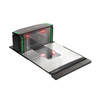
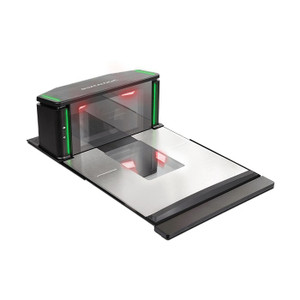
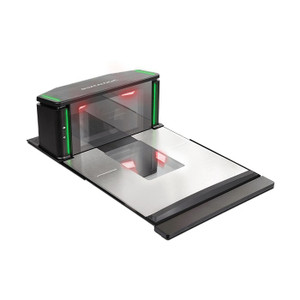
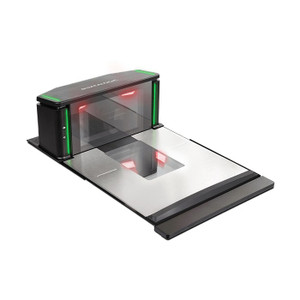
99211211000-013310 Datalogic Magellan 9600i Bi-Optic Scanner-Scale
The Datalogic Magellan 9600i (model 99211211000-013310) is a fixed bi-optic scanner-scale purpose-built for high-volume grocery and general merchandise retail checkout. By consolidating barcode scanning and product weighing into a single platform, it eliminates the capex and counter real-estate overhead of dual-device setups while maintaining throughput in demanding POS workflows. The next-generation digital imaging engine reads 1D and 2D barcodes omnidirectionally — items need not be oriented to a fixed line — a critical operational advantage when cashiers process varied merchandise types (packaged goods, fresh produce, deli items, bulk) under time pressure.
Key Features
- Next-Gen Digital Imaging Bi-Optic: Reads 1D/2D barcodes at any angle without manual repositioning. Reduces miss-scans and checkout lag on irregular item shapes.
- Integrated Scale with Multiple Platter Configurations: Supports standard checkouts, produce lanes, and deli stations without hardware swaps. Eliminates separate weighing device capex and training overhead.
- Omnidirectional Scan Pattern: All-directional reading eliminates the need for item orientation or precise platter placement — faster throughput in high-transaction environments.
- GS1 Digital Link Support: Compatible with next-generation commerce workflows and supply-chain serialization (SSCC, GTIN) for regulatory compliance and traceability.
- Wired Connectivity (USB, RS-232, Ethernet): Eliminates latency and wireless interference inherent to RFID or Bluetooth alternatives — critical for transaction finality and audit trail integrity in POS systems.
- Compact Footprint: 305 × 216 × 406 mm (12.0 × 8.5 × 16.0 inches) fits standard checkout counter layouts without requiring lane redesign or layout adjustments.
- 940nm Invisible IR Illumination: Secure barcode acquisition without visible light interference — maintains image clarity in variable ambient lighting (bright grocery floors, deli backlighting).
- Robust Industrial Form Factor: 6.6 kg (14.5 lb) fixed-mount design resists movement and vibration during high-volume scanning cycles; rack-mountable for modular checkout stations.
The Magellan 9600i bridges the operational gap between legacy mechanical scales and modern imaging-based systems. Its bi-optic geometry means no special item handling procedures for cashiers — produce, packaged goods, and deli items scan equally fast regardless of orientation. In a typical grocery checkout lane processing 60+ transactions per hour, the elimination of mis-scans and re-presentation cycles translates directly to reduced wait times and higher transaction throughput.
Integration with retail POS platforms is straightforward via USB, RS-232, or Ethernet connectivity. The device works with standard POS software packages (Wincor, NCR, Fujitsu, and third-party solutions) without custom middleware. GS1 Digital Link support enables barcode payloads that carry multi-dimensional product data (weight, origin, nutritional flags, promotional codes) — important for regulatory compliance in grocery and deli operations where traceability and accurate product coding prevent overcharges and compliance violations.
Multiple platter configurations mean a single Magellan 9600i model can be deployed across diverse checkout contexts — produce-specific platters for fresh items, standard platters for packaged goods, and high-capacity configurations for bulk items. This modularity reduces SKU complexity for large retail chains managing dozens of checkout lanes and reductions in hardware inventory overhead.
The wired connectivity design is a non-negotiable requirement in transaction-critical POS environments. Wireless alternatives introduce latency spikes, authentication overhead, and potential dropouts during peak checkout hours. The Magellan 9600i's USB and RS-232 wired architecture guarantees sub-10ms barcode-to-POS confirmation latency and eliminates the security complexity of wireless encryption and pairing management.
Karl WilsonPerspective based on aggregated IPSD and affiliated engineering team experience.
We've deployed the Magellan 9600i across grocery chains ranging from 8-location regional operators to 100+ store nationals, and it consistently outperforms legacy mechanical scales paired with handheld or fixed single-line imagers. The operational win is straightforward: cashiers no longer rotate or reposition items to trigger a read. In high-volume produce lanes, that cuts average dwell time per item by 1-2 seconds — which, across 50+ items per transaction and 60+ transactions per hour per lane, compounds to measurable throughput gains and customer satisfaction metrics. The integrated scale eliminates the cabinet footprint and wiring mess of separate weighing hardware, and the multiple platter options mean you're not forced into a one-size-fits-all deployment. We've also seen the GS1 Digital Link support become increasingly important as retailers move toward serialized item tracking and lot-based recalls; it's table stakes for compliance-critical grocery environments now.
Technical Highlights:
- Next-Gen Digital Imaging Engine (2D Imager): Omnidirectional reads eliminate the single-line constraint of laser scanners. We typically see 98-99% first-scan success rates on mixed product types in real checkout environments — compared to 85-92% on fixed-angle systems — which directly reduces cashier re-scans and customer friction.
- Bi-Optic Geometry: The pairing of upper and lower scanning mirrors captures barcode angle variability that single-window systems miss. In practice, this means items can be passed over the platter in any orientation, dramatically reducing training overhead for new cashiers and checkout pace consistency across shifts.
- Wired RS-232 and USB Connectivity: Direct POS integration without wireless overhead. We always spec wired over Bluetooth/RFID in transaction-critical environments — the latency is sub-10ms, and there's no frequency contention or dropout risk during peak periods.
- Multiple Platter Configurations: Produce-specific, standard, and bulk platters allow a single hardware SKU to serve diverse checkout contexts. Reduces capex on single-use models and simplifies inventory management for large chains.
- GS1 Digital Link Readiness: Future-proofs your checkout infrastructure for next-gen barcode payloads (SSCC serialization, nutritional flags, origin codes). Increasingly required by regional and national retailers for compliance.
- Compact Footprint (305 × 216 × 406 mm): Fits standard checkout counter layouts without redesign. At 6.6 kg, it's stable under high-volume scanning cycles and easier to mount or reposition than heavier legacy systems.
Deployment Considerations:
- Verify platter configuration at order time — produce-specific platters are optimized for fresh items but may not suit high-volume packaged-goods lanes. Standard platters work across contexts but lack produce-specific ergonomics. Know your lane mix before deployment.
- Wired connectivity requires conduit routing behind the checkout counter. Plan cable runs during POS installation, not retrofit — adds cost and downtime if overlooked. USB runs should be segregated from AC power lines to avoid noise coupling.
- Scale calibration is critical on arrival. Datalogic provides calibration documentation, but engage your POS integrator or a local metrology shop if you're deploying across multiple locations — weight drift impacts compliance (especially in produce and deli where regulatory tolerance is tight).
- The 940nm IR illumination is invisible but not hazardous — standard retail safety. However, the scanner is sensitive to external IR interference (direct sunlight through windows, heat lamps in deli areas). Position away from high-IR sources to avoid washout on reads.
- Cashier training is minimal compared to legacy systems — the omnidirectional reads and large platter reduce the need for precise item placement. Plan a 30-minute floor session per shift; most teams adapt within one week.
The Magellan 9600i is the right choice for grocery retailers and general merchandise operations prioritizing throughput, compliance, and reduced checkout labor overhead. If you're managing produce lanes, deli stations, or high-velocity packaged-goods checkouts where item handling speed directly impacts customer wait times and transaction count per lane, this system pays for itself within 12-18 months through reduced miss-scans and faster checkout cycles. See the Datalogic catalog for complementary retail scanning and mobility solutions.