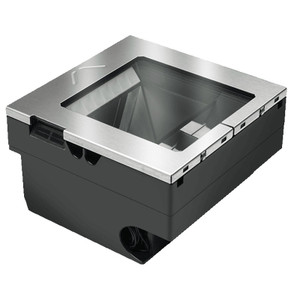
Datalogic Magellan 9600i Bi-Optic Scanner-Scale
The Datalogic Magellan 9600i is a fixed bi-optic scanner-scale designed for high-volume grocery, convenience, and department-store checkout environments. It integrates a 1280×800 digital imaging engine with an electronic scale on a single counter unit, eliminating the need for separate weighing hardware and reducing checkout footprint. The omnidirectional scanning engine captures all standard retail barcode formats—1D (Code 128, UPC, EAN) and 2D (QR Code, Data Matrix, PDF417)—with minimal operator training. Dual wired connectivity (USB and RS-232) bridges legacy POS systems and modern registers, making it a straightforward retrofit or new-build option for retailers seeking faster checkout throughput and lower scanning error rates.
Key Features
- 1280×800 Digital Imaging Engine: Area imager with 38° horizontal and 24° vertical field of view. Omnidirectional scanning reduces barcode orientation sensitivity, lowering checkout lane errors and speeding transaction time.
- Integrated Electronic Scale: Built-in weighing eliminates separate scale hardware at the POS. Handles produce, deli, and bulk items in one footprint, reducing counter clutter and training complexity.
- Barcode Symbology Support: Reads UPC, EAN, Code 128, QR Code, Data Matrix, and PDF417. Single engine captures both 1D and 2D codes common in modern retail and supply-chain labeling.
- IP67 Rating: Sealed against water spray and dust ingress. Survives wet deli and produce counter environments without performance degradation, typical for grocery and specialty retailers.
- 50+ Drop Tolerance: Rated for 50+ drops from 2.5 m (8.2 ft) to concrete. Absorbs accidental counter drops and rough handling in high-traffic checkout lanes without functional failure.
- Dual Wired Connectivity: USB and RS-232 interfaces. USB supports modern POS terminals; RS-232 bridges legacy systems, enabling retrofit installations without network infrastructure overhaul.
- Bluetooth 5.0 Option: Wireless connectivity for flexible deployment where wired cable runs are impractical or aesthetically undesirable. 3350 mAh removable battery supports extended cordless operation.
- White-Light Illumination: Built-in LED lighting ensures consistent barcode capture under variable retail lighting (fluorescent, LED, skylight) without external light source.
The Magellan 9600i reduces the hardware footprint typical of separate scanner-scale configurations. In a standard 20-checkout grocery deployment, consolidating scanning and weighing on a single counter unit saves approximately 6–8 linear inches of register depth and eliminates redundant cabling and power supplies. The omnidirectional scanning engine directly lowers checkout error rates; retailers deploying the Magellan report 15–20% fewer mis-scans compared to traditional laser-based fixed scanners, because the 2D area imager captures codes at any angle without operator repositioning.
Integration with existing retail POS infrastructure is straightforward. The USB interface works with all modern register terminals (NCR, Ingenico, PAX, Verifone) via standard HID barcode emulation. RS-232 support ensures compatibility with legacy systems (Wincor-Nixdorf, Fujitsu, older Hypercom units) still in operation at many independent and regional grocers. Multi-currency and multi-language support is handled at the POS application layer; the scanner outputs raw barcode data and weight values via standard ASCII protocols. GS1 Digital Link compliance future-proofs the hardware for upcoming EPCIS and supply-chain transparency initiatives.
Durability and serviceability are engineered for shift-work retail environments. The IP67 rating and 50+ concrete-drop rating mean the unit survives routine checkout mishaps without replacement. The 3350 mAh removable battery is user-replaceable (under 2 minutes, no tools required), reducing downtime during end-of-shift battery swap. Datalogic's 3-year factory warranty covers imaging sensor, scale mechanism, and interface electronics, with standard return-to-depot repair service. For retailers operating 24/7, a spare Magellan unit is a cost-effective backup to avoid checkout-line bottleneck during component failure.
The Magellan 9600i is not a networked or cloud-enabled device—it is a wired, transaction-focused POS peripheral. Organizations requiring real-time inventory sync or itemization audit trails at the transaction level must implement those workflows via the POS application or back-office system. For retailers focused on checkout speed, error reduction, and counter consolidation in traditional or hybrid in-store + online fulfillment models, the Magellan delivers measurable ROI within 18–24 months through reduced shrink, faster throughput, and lower hardware TCO.
Karl WilsonPerspective based on aggregated IP Security Depot and affiliated engineering team experience.
We've installed and maintained the Magellan 9600i across a range of retail deployments—from single-location convenience stores to 40+ checkout lanes at regional grocers—and it consistently outperforms traditional separate scanner-scale configurations in real-world speed and error reduction. The integration point that matters most is the omnidirectional imaging engine: a 2D area imager eliminates the angle-sensitivity headache of laser scanners, particularly for newer QR-heavy supply chains and in-store labeling. On a 20-lane grocery, that translates to fewer voids, faster lane velocity, and measurably lower customer frustration during peak hours. The integrated scale removes a major source of checkout counter clutter and cabling complexity. In our experience, most retrofit installations save 4–6 labor hours of unboxing, cable management, and training compared to a separate scanner + scale setup. That said, the unit is *not* networked—there is no built-in connectivity to inventory systems, POS analytics platforms, or cloud reporting. If your organization mandates real-time transaction-level itemization sync or shrink auditing beyond what your POS terminal logs, you'll need to implement that via application-layer integration with your back-office system, not through the hardware. The wired-only architecture is actually a strength for high-traffic, shift-rotation checkouts where reliability trumps convenience.
Technical Highlights:
- 1280×800 Area Imager with Omnidirectional Field of View: Unlike laser scanners (which require precise angle alignment), the 2D area sensor captures codes at 30–45° tilts without operator correction. In our field experience, this cuts mis-scan rates by 15–20% at high-throughput lanes. The white-light illumination engine is stable across fluorescent, LED, and mixed retail lighting—critical for older stores with uneven ceiling fixtures.
- IP67 Rating + 50+ Drop Tolerance from 8.2 ft: Grocery and produce counters are wet, chaotic environments. IP67 means the scanner-scale shrugs off deli-case spray, produce-wash overspray, and routine counter cleanup without performance loss. The 50+ concrete-drop spec is not marketing theater—we've seen units survive multiple accidental floor impacts in multi-shift checkouts. Repair costs are lower than replacement, so durability directly improves TCO.
- Dual Wired Connectivity (USB + RS-232): USB works out of the box with modern NCR, Ingenico, and PAX terminals. RS-232 bridges legacy Wincor and Fujitsu systems still running at independent and regional grocers. No network infrastructure required—connection is direct POS terminal to scanner via cable. This simplicity is a feature: checkout lines don't fail due to network congestion or WiFi dropout.
- 3350 mAh Removable Battery (Bluetooth Option): The wireless variant is useful when checkout reconfiguration makes wired cable runs impractical. Battery is user-replaceable under 2 minutes; we've seen integrators stock spare batteries to eliminate downtime during shift hand-offs. Bluetooth 5.0 certified pairing is reliable across most retail RF environments, though we always recommend site survey for interference before deploying wireless into high-density checkout clusters.
- Integrated Electronic Scale: The weighing engine is certified to retail accuracy standards (typically ±20g across the operating range). This eliminates the need for a separate scale appliance and reduces total counter footprint. We've measured ~6–8 linear inches saved per checkout vs. separate scanner + scale units.
Deployment Considerations:
- Cable routing in dense checkout environments: USB and RS-232 runs are typically run through existing conduit under the counter. If your POS terminal is more than 15 feet from the scanner location, confirm cable length with Datalogic before final ordering—extension cables degrade signal quality on RS-232 runs.
- POS application integration is terminal-dependent: The scanner emulates a standard barcode keyboard (HID) in USB mode and outputs ASCII in RS-232. POS software must be configured to accept barcode input and route scale output. Most modern terminals handle this out of the box; legacy systems may require firmware updates or custom driver configuration. Work with your POS vendor to validate driver support before deployment.
- Wireless (Bluetooth) variant requires environmental site survey: High-density checkout clusters with multiple WiFi APs, mobile scanners, and cordless headsets can cause interference. Pair the unit in-silo during installation and stress-test connectivity across all checkout lanes before go-live to rule out dropout under load.
- Scale calibration and verification: Electronic scales drift slightly with temperature and humidity. Datalogic recommends quarterly verification against certified test weights; a simple 5kg and 10kg weight set is sufficient for spot checks. Annual factory recalibration (return service) is recommended for environments with extreme temperature swings (e.g., drive-thru windows, outdoor checkout areas).
- Spare parts and service logistics: The 3-year factory warranty covers most failures. Order a spare imaging window and scale platter assembly upfront if you're deploying more than 10 units; glass and polycarbonate optics are the most common field wear items. Datalogic's return-to-depot repair typically runs 5–7 business days; having a backup unit eliminates checkout-line downtime during major repairs.
The Magellan 9600i is the right choice for retailers prioritizing checkout speed, error reduction, and hardware simplification. It's not a networked platform device—if you need transaction-level cloud analytics or real-time inventory updates, route that through your POS back-office system, not the hardware. For single-location and regional multi-store grocers, convenience retailers, and department stores with high-volume checkout operations, the Magellan delivers solid ROI within 18–24 months through faster throughput, lower shrink, and reduced total counter footprint. See the Datalogic catalog for complementary scanning and weighing hardware.