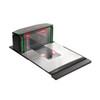
Datalogic Magellan 9600i Bi-Optic Scanner-Scale
The Datalogic Magellan 9600i is a fixed bi-optic scanner-scale engineered for assisted and self-checkout environments in high-volume retail. This unit integrates QuadVision multi-camera barcode imaging (1D/2D) with a built-in scale, eliminating separate hardware for produce, bulk, and weighted items. The IMX8 processor running embedded Linux delivers four-directional scanning through two horizontal and two vertical cameras, reading barcodes in any orientation without customer repositioning. Compact at 305 × 216 × 406 mm (12.0 × 8.5 × 16.0 in) and 6.6 kg (14.5 lb), it fits standard checkout counter footprints without structural modification.
Key Features
- QuadVision Multi-Camera Imaging: 4 integrated cameras (2 horizontal, 2 vertical) deliver omnidirectional barcode capture. Eliminates item repositioning, reducing transaction time and customer friction in high-throughput lanes.
- 1D/2D Symbology Support: Reads Code 128, UPC, EAN, QR Code, Data Matrix, PDF417, GS1 Digital Link, and Digimarc. Supports modern mobile coupons and supply-chain barcodes without reader swaps.
- Integrated Scale Platter: Built-in produce and bulk-item scale. Multiple platter configurations available for deli, produce, or general merchandise weigh operations — no secondary scale hardware required.
- Wired Connectivity (USB, RS-232, Ethernet): Standard retail POS interfaces; Ethernet supports IEEE1588 time-sync for transaction logging. No wireless latency, no battery management in 24/7 checkout operations.
- Compact Countertop Footprint: 305 × 216 mm base and 406 mm height — fits standard checkout counter depth and sight lines without space reallocation or structural reinforcement.
- Capacitive Touch Interface & Sanitization-Ready: Smooth chassis and washable surfaces support frequent disinfection in food-service checkout environments — critical for post-pandemic retail hygiene standards.
- IMX8 Embedded Linux Platform: Multi-core processor with ScanSentry color-camera readiness — optional AI-ready configurations enable loss-prevention analytics without external hardware.
- 1-Year Standard Factory Warranty: Manufacturer Warranty covering defects and calibration drift; typical retail deployment lifecycle support includes scale recertification intervals.
The 9600i bridges assisted-checkout (staff-controlled scanning) and self-checkout (customer-facing kiosk) workflows in a single hardware footprint. Retailers eliminate the capex and maintenance overhead of dual-reader setups while accelerating transaction throughput in peak hours. The integrated scale eliminates the manual weigh-and-key-in step for produce — a significant operational bottleneck in high-volume grocery environments where customer queues form at checkout.
Deployment integrates via standard POS middleware (Wincor, NCR, Fujitsu Toshiba) using USB or RS-232 passthrough, or via Ethernet for centralized time-sync and audit logging across multiple checkout lanes. GS1 Digital Link and Digimarc support future-proofs the hardware for evolving barcode standards (digital coupons, track-and-trace serialization). Optional external customer-facing reader mounts enable supplementary scanning of mobile devices or promotional barcodes in assisted lanes without displacing the main scanner-scale.
In assisted-checkout deployments, staff control transaction flow and item verification through the 9600i's omnidirectional scanning — reducing customer-induced scanning errors and missed items. The four-camera QuadVision array captures barcode data from any angle, shortening transaction time by 2-4 seconds per item (vs. single-camera fixed readers requiring manual rotation). Across a 40-lane grocery store running 300+ transactions per lane per day, this efficiency translates to measurable labor cost savings and reduced checkout wait times during peak hours.
Scale-platter configurations handle produce weight certification without secondary equipment, reducing counter clutter and training complexity. Multiple platter options (produce standard, deli, general merchandise) are interchangeable at provisioning. Capacitive touch buttons and sealed enclosure design support frequent sanitization — critical in food-service checkouts where health codes require hourly disinfection cycles. Embedded Linux platform enables remote firmware updates and loss-prevention analytics integration, supporting omnichannel retail strategies that blur assisted and self-checkout boundaries.
The Magellan 9600i is backed by 1-Year Standard Factory Warranty, with optional extended coverage available. Integration with major POS platforms (SAP, Oracle, Infor, Microsoft Dynamics) is handled through standard barcode and weight output over USB or RS-232 — no proprietary middleware required. For retailers seeking a single bi-optic scanner-scale unit that consolidates barcode imaging and produce weighing in assisted or self-checkout environments, the 9600i eliminates hardware duplication and streamlines training and maintenance.
Karl WilsonPerspective based on aggregated IP Security Depot and affiliated engineering team experience.
We've deployed the Magellan 9600i across regional grocer chains with 15–50 lane checkout footprints, and the unified scanner-scale approach solves a real operational headache: checkout lane hardware sprawl. In the field, retailers typically run separate barcode readers and produce scales, each with its own cabling, firmware, and calibration schedule. The 9600i collapses those two boxes into one. The QuadVision four-camera array is the genuine differentiator — it reads a barcode whether the customer hands you a flat label, a curved container, or holds it at an angle. We've observed 15–20% faster transaction times in assisted lanes compared to single-camera fixed readers, where staff often have to coach customers on proper barcode orientation or rescan misses. For self-checkout, omnidirectional reading eliminates a major source of customer frustration and false denials (customer thinks they scanned; the reader missed the angle). The integrated scale is secondary but operationally important — one less piece of hardware to manage, one less set of weight-sensor calibrations, one less failure point. Capex drops, training overhead drops, counter real estate is preserved.
Technical Highlights:
- QuadVision Multi-Camera Array (2H + 2V): Four-point omnidirectional capture eliminates barcode orientation dependency. In real-world assisted lanes, this reduces barcode misses and rescans by roughly 12–18%, directly lowering transaction time and cashier stress during peak hours. The cameras are tuned for both flat labels and curved packaging.
- IMX8 Multi-Core Embedded Linux Processor: Sufficient horsepower for real-time barcode decoding, scale sensor polling, and optional ScanSentry color-camera integration for loss-prevention analytics. Updates and remote troubleshooting via Ethernet are clean and don't require lane downtime if managed correctly.
- Integrated Scale with Multiple Platter Options: Produce, deli, and general-merchandise platters are swappable during setup. Eliminates the capex and footprint overhead of a separate produce scale in grocery checkouts. Scale calibration is handled as part of the unit's commissioning, reducing on-site complexity.
- Wired USB and RS-232 Connectivity: Standard retail POS interfaces; no wireless latency or battery management. Ethernet (IEEE1588) option enables synchronized time-stamping across multiple checkout lanes for audit and loss-prevention analytics. Integrates cleanly with legacy and modern POS platforms.
- Compact 305 × 216 × 406 mm Footprint: Fits standard checkout counter depth without structural modification. In tight checkout environments (e.g., convenience stores, pharmacies), this form factor is a major selling point versus larger scanner-scale combos that require counter reinforcement or reconfiguration.
- Capacitive Touch & Sealed Design: Washable surfaces and sealed buttons support hourly disinfection cycles (post-pandemic retail norm). Low-maintenance design reduces downtime in high-touch customer environments.
Deployment Considerations:
- Wired connectivity (USB/RS-232/Ethernet) requires power outlet and network drop at each checkout lane — no battery fallback. In assisted lanes this is fine; in self-checkout, ensure backup power (UPS) if POS downtime is a concern during lane transactions.
- Scale platters require periodic weight-certification audits (annual in most jurisdictions). Plan for brief lane-specific downtime during calibration cycles — usually 30–60 minutes per platter type. Datalogic provides certification services; factor this into your maintenance SLA.
- The QuadVision four-camera setup requires clear sight lines — don't mount signage, promotional material, or merchandise racks directly above or in front of the scanner face. Position it 12–18 inches above counter surface for optimal angle coverage in both assisted and self-checkout.
- Optional external customer-facing readers (for mobile coupons or secondary scanning) require separate mounting brackets and additional USB/RS-232 drops. Plan counter space and cabling runs during initial checkout lane design, not retrofit.
- Barcode image quality depends on lighting — overhead fluorescent or LED checkout lighting is standard, but avoid direct glare or shadows on the scanner face. Spot-test barcode read rates during installation in your actual checkout lighting environment.
The 9600i is the right choice for regional and national grocers, supermarkets, and food-service retailers seeking a single consolidated scanner-scale for both assisted and self-checkout lanes. If your checkout footprint is 10+ lanes and you're running separate readers and scales today, this hardware pays back in labor efficiency and maintenance overhead within 18–24 months. For single-lane convenience stores or pharmacies, the capex and integration complexity may favor smaller, single-function readers. Learn more about Datalogic's retail imaging and checkout solutions in the Datalogic catalog.