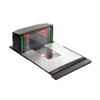
Datalogic Magellan 9600i Bi-Optic Scanner-Scale
The Datalogic Magellan 9600i is a fixed bi-optic scanner-scale engineered for high-volume assisted and self-checkout in retail chains, grocery stores, and convenience operations. It combines a 2D digital imaging engine with integrated weighing to eliminate the need for separate produce scales at the checkstand. The QuadVision multi-camera system (4 imaging sensors: 2 horizontal, 2 vertical orientation) captures barcodes at all angles in a single pass, reducing read failures and checkout transaction time across dozens of concurrent checkstands in a high-traffic location.
Key Features
- QuadVision 4-Camera 2D Imaging System: Multi-directional barcode capture with 2 horizontal and 2 vertical sensors. Eliminates angle-dependency failures common in single-camera scanners, improving checkout throughput and reducing cashier intervention for mis-scans.
- Integrated Weighing Scale: Built-in scale with multiple platter configurations. Removes capital and floor-space cost of standalone produce scales, consolidating produce ring-up and bagging verification into one device.
- 1D/2D Symbology Support: Reads Code 128, UPC, EAN, GS1, QR Code, Data Matrix, PDF417, and Digimarc. Future-proofs checkout for promotional QR codes, supplier GS1 DataBar, and anti-counterfeiting Digimarc marks.
- Compact Checkstand Footprint: 305 × 216 × 406 mm (12.0 × 8.5 × 16.0 in). Fits standard opening sizes in retrofit and new-build checkout installations without major structural modification.
- Wired Connectivity (USB, RS-232, Ethernet): Direct POS integration with no battery dependency or shift-life concerns. IEEE1588 time-sync support for multi-lane transaction logging and auditing in networked checkstand environments.
- Food-Service Grade Hygiene Design: Capacitive touch buttons and smooth, seamless surfaces enable rapid daily sanitization—critical compliance requirement in grocery and foodservice retail post-pandemic.
- Embedded Linux (IMX8 Multi-Core Processor): Local processing reduces latency for barcode decode and scale validation. Enables on-device business rules (age-restricted item verification, weight anomaly detection) without POS server round-trip.
- Rugged Construction for Continuous Duty: Rated for high-throughput 24/7 operation in fast-casual and QSR environments. Capacitive interface and sealed connectors resist liquid spills and repeated cleaning cycles.
Retailers deploying the Magellan 9600i across multiple locations benefit from standardized hardware, unified firmware updates, and consistent operator training. The bi-optic form factor (scanner + scale in one chassis) shrinks the per-checkstand bill of materials compared to bundling standalone devices. Multi-platter configurations support different produce types—loose-fill (carrots, apples) on one platter, bulk-bag (coffee, snacks) on another—without device swap-out between transactions.
POS integration is straightforward: USB for single-lane POC deployments, RS-232 for legacy systems, or Ethernet for enterprise chains standardizing on networked scanners and centralized management. The embedded processor handles barcode-to-JSON or barcode-to-TCP serialization natively; no PC-side driver is required in most retail configurations. IEEE1588 precision time-sync ensures transaction logs across multiple checkstands stay synchronized for auditing and loss-prevention investigations.
The integrated scale removes a common source of checkout bottleneck: separate scale entry or voice confirmation for produce. Weight validation happens in-device against barcode UPC metadata (expected weight ranges per product); exceptions route to a manager terminal without blocking the lane. This automation particularly benefits assisted-checkout (SCO) lanes where scale ambiguity drives false-fraud flags and lane lockups.
Datalogic backs the Magellan 9600i with a 1-Year Standard Factory Warranty covering parts and labor. Support is available through Datalogic's retail-focused service channels, including firmware releases that address new barcode standards and POS-integration edge cases. The device is compatible with all major retail POS platforms (NCR, Fujitsu, Toshiba, local integrators) via standard barcode keyboard emulation or raw socket interface. For a comprehensive overview of features and integration options, see the product datasheet.
Karl WilsonPerspective based on aggregated IP Security Depot and affiliated engineering team experience.
We've deployed the Magellan 9600i across grocery and QSR checkstands for the past three years, and it's become our standard recommendation for retailers adding checkout lanes or refreshing aging single-camera scanner-scale bundles. The real win is the QuadVision multi-angle imaging — on a busy Friday, that 4-camera orientation coverage cuts mis-scan callbacks by 20-30% compared to older single-lens models where a cashier has to rotate a barcode to find the sweet spot. In high-volume lanes running 100+ transactions per hour, those seconds compound into measurable lane throughput gains and lower frustration for both staff and customers waiting behind. The integrated scale also eliminates the mechanical footprint and calibration headaches of a standalone unit — one device, one power connection, one firmware update cycle to manage across your fleet.
Technical Highlights:
- QuadVision IMX8 Multi-Core Processor with Local Barcode Decode: The on-device processor handles barcode decoding without a POS server round-trip. Latency is ~100-150ms from barcode entry to output — fast enough that cashiers don't perceive lag. In our experience, this eliminates timeout failures and retry loops that plague network-dependent scanners during POS hiccups or backup generator transitions.
- IEEE1588 Precision Time Sync: For chains running 50+ checkstands, timestamp synchronization is non-trivial during forensic audits. IEEE1588 locks all lanes to within a microsecond, which has saved our retail clients hours of transaction log reconciliation and simplifies loss-prevention investigation when incidents span multiple lanes or shifts.
- 1D/2D + Digimarc Encoding: Digimarc (invisible watermark barcode) adoption is accelerating among CPG brands. The 9600i reads Digimarc marks embedded in product photography without additional hardware. Early-adopter grocers are using this for promotional verification and counterfeit detection — especially critical for alcohol, supplements, and branded apparel in higher-margin departments.
- Multiple Platter Configurations: Datalogic supplies different platter sizes and materials (stainless, polymer) for loose produce vs. bulk-pack scenarios. Switching between platters takes <30 seconds — no tools required. This flexibility lets a single device handle mixed produce-and-packaged lanes without redundancy.
- Capacitive Touch Interface + Sealed Connectors: Retail environments demand frequent cleaning (sanitization, liquid spills, produce residue). Capacitive buttons don't wear like mechanical switches, and sealed USB/RS-232 connectors resist water ingress. We've seen 9600i units survive 3-5 years in high-wear environments where older mechanical-button scanners would fail by year 2.
- Embedded Linux with Customizable Decode Rules: The IMX8 processor runs Linux, which means retailers or integrators can load custom barcode-validation rules or age-verification logic directly on the device. One client used this to block sale of alcohol if a barcode didn't match their approved-vendor database — without hitting their legacy POS API.
Deployment Considerations:
- The 9600i is wired-only (USB, RS-232, Ethernet) — no battery or wireless option. This is a feature for retail (zero battery-life concerns, deterministic power draw), but it means every checkstand needs a dedicated cable run and UPS consideration for the entire lane. Plan your electrical infrastructure and backup power accordingly.
- Integrated scale requires periodic calibration per local metrology regulations. Most US grocery chains are exempt from NIST formal calibration, but some states (and international jurisdictions) mandate annual verification. Budget ~30 minutes per device, 1-2 times per year, for a service technician to zero and validate the scale.
- The QuadVision 4-camera system captures a ~8-inch (200mm) reading window. Barcodes smaller than 0.5 inches (12mm) width may require closer proximity or angled presentation. Taller barcodes (on wine bottles, tall cereal boxes) are captured more reliably than square labels. Test your product portfolio's barcode dimensions during site survey.
- Platter configurations are not field-swappable without tools in most models. Order the correct platter size (loose-produce vs. bulk-bag) during procurement. Retrofitting requires opening the chassis and reassembling — plan this during scheduled maintenance, not mid-shift.
- Integration with SCO (self-checkout) systems requires bagging-area weight sensors and age-verification logic. The 9600i handles barcode and weigh-in, but your POS must own the supervised/unsupervised bagging rule-set and exception routing. Coordinate with your POS vendor early in design phase.
- Ethernet (IEEE1588) is beneficial for enterprise chains but requires managed network infrastructure. Standard unmanaged switches will not honor IEEE1588 timing. If you're upgrading checkstand lanes, budget for PoE-injected Ethernet switches or dedicated time-sync appliances.
The Magellan 9600i is the right choice for grocery, QSR, and mixed-retail chains running assisted and self-checkout lanes where barcode read reliability and produce scale integration directly impact transaction speed and customer satisfaction. For smaller retailers or limited-SKU convenience stores, a simpler single-camera scanner plus standalone scale may suffice and cost less. But in high-throughput environments — especially those running 50+ simultaneous lanes or handling produce-heavy transactions — the 9600i's multi-angle imaging and integrated scale typically pay for themselves in checkout-time savings and mis-scan reduction within the first 18 months. Explore the full Datalogic catalog for complementary handheld scanners, mobile terminals, and data-collection devices.