
Ubiquiti UA-HUB-DOOR-MINI vs Geovision AS1620: Specification Comparison
Both the Ubiquiti UA-HUB-DOOR-MINI and the Geovision GV-AS1620 are single-door access control panels powered over Ethernet, targeting installers who want to avoid auxiliary power supplies at the door side. The comparison spans PoE power tier and budget, physical form factor, certifications and compliance posture, and warranty coverage — the four axes that most directly influence procurement decisions in enterprise and SMB access control deployments.
In This Guide
- Which unit delivers more usable power at the door, and what does that mean for lock and reader selection?
- How do physical size, mounting, and environmental ratings affect installation in typical IDF or door-frame locations?
- Which unit better satisfies enterprise compliance requirements and integrates into broader security ecosystems?
- Which should you choose: the UA-HUB-DOOR-MINI or the AS1620?
- Side-by-Side Specs
- FAQ
Which unit delivers more usable power at the door, and what does that mean for lock and reader selection?
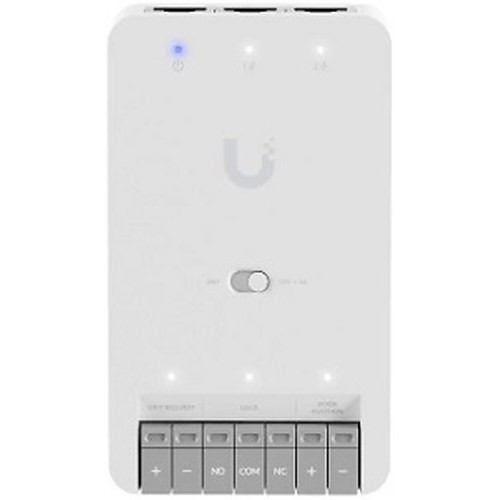
The UA-HUB-DOOR-MINI is powered by PoE++ (802.3bt), drawing 19 W without any PoE output load. PoE++ budgets up to 90 W at the switch port, leaving substantial headroom to downstream-power readers, REX sensors, or small magnetic locks directly from the hub — though the spec sheet does not state a maximum PoE-out wattage for this unit.
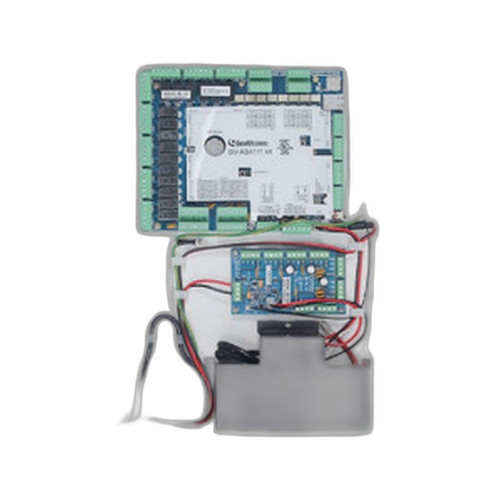
The GV-AS1620 runs on PoE 802.3af, which is capped at 15.4 W at the port (12.95 W minimum guaranteed at the device). 802.3af is sufficient for most Wiegand readers and small strike locks, but cannot power high-current mag-locks or dual-technology readers without a supplemental power supply. Buyers specifying high-draw locking hardware should note this ceiling.
The power-tier gap is real and affects hardware selection downstream. If a door requires only a standard reader and low-current lock, the GV-AS1620's 802.3af is adequate. Where higher-draw hardware or future expansion is anticipated, the UA-HUB-DOOR-MINI's 802.3bt tier provides a larger operating envelope.
How do physical size, mounting, and environmental ratings affect installation in typical IDF or door-frame locations?
The UA-HUB-DOOR-MINI measures 113 × 66 × 27.6 mm and weighs 190 g (6.7 oz). It ships with a DIN-rail mount included and is rated for indoor use at 0–40 °C. The compact footprint targets IDF closets or wall-mounted cable trays where panel space is constrained.
The GV-AS1620 measures 12.00 × 8.00 × 4.00 in (approximately 305 × 203 × 102 mm) and weighs 4 lb (approximately 1.8 kg). It is described as a compact/discrete installation form factor, but its physical dimensions are substantially larger than the Ubiquiti unit. The housing is white. No operating temperature range or environment rating (indoor/outdoor) is listed in the provided specifications.
For installations where panel real estate is scarce — shared telecom closets, shallow wall boxes — the UA-HUB-DOOR-MINI's DIN-rail form at roughly one-quarter the footprint of the GV-AS1620 is a meaningful differentiator. The GV-AS1620's larger enclosure may be advantageous where field-wiring terminations and relay outputs need physical space, but no relay output count is quantified in the provided specs.
Which unit better satisfies enterprise compliance requirements and integrates into broader security ecosystems?
The UA-HUB-DOOR-MINI carries CE, FCC, IC, UL 294, and CAN/ULC-60839-11-1 certifications. UL 294 is the access control unit standard specifically required by many enterprise and government procurement policies. NDAA compliance (Section 889) is explicitly confirmed, which is a hard gate for U.S. federal and state contracts. It operates within the UniFi Access ecosystem.
The GV-AS1620 lists a 3-year warranty, which is the longest stated warranty of the two units. It is described as integrating with IP-based access control systems and providing relay outputs for electromagnetic locks. No UL 294 listing, NDAA compliance status, or specific software platform is stated in the provided specifications.
For buyers whose procurement requires UL 294 listing or NDAA compliance documentation, the UA-HUB-DOOR-MINI satisfies both from stated specs; the GV-AS1620 does not address either in the provided data. Conversely, the GV-AS1620's 3-year warranty exceeds the UA-HUB-DOOR-MINI, for which only 'Manufacturer Warranty' is stated without a term.
Which should you choose: the UA-HUB-DOOR-MINI or the AS1620?
Our take: The UA-HUB-DOOR-MINI is the stronger choice when UL 294 listing, NDAA compliance, or a higher PoE power budget are non-negotiable procurement criteria. Its PoE++ (802.3bt) power tier versus the GV-AS1620's 802.3af means roughly 4–6× the available wattage headroom for downstream locking hardware and readers. Its DIN-rail footprint of 113 × 66 × 27.6 mm is dramatically smaller than the GV-AS1620's 305 × 203 × 102 mm enclosure, a decisive factor in constrained IDF installations. The GV-AS1620 counters with an explicitly stated 3-year warranty — the UA-HUB-DOOR-MINI lists only 'Manufacturer Warranty' with no stated term — and may suit integrators already standardized on Geovision's IP access platform. Neither unit should be selected without confirming software platform compatibility with the broader site design.
Side-by-Side Comparison
Spec-for-spec, from manufacturer data.
| Specification | Ubiquiti UA-HUB-DOOR-MINI | Geovision AS1620 |
|---|---|---|
| Door Capacity | 1 | 1 |
| PoE Standard | PoE++ (802.3bt) | PoE (802.3af) |
| Power Consumption | 19 W (without PoE output) | — |
| Dimensions | 113 × 66 × 27.6 mm | 305 × 203 × 102 mm (12 × 8 × 4 in) |
| Weight | 190 g (6.7 oz) | 4 lb (~1.8 kg) |
| Mount Type | DIN Rail (included) | — |
| Enclosure Material | Polycarbonate, metal | — |
| Housing Color | — | White |
| Operating Temperature | 0 to 40 °C | — |
| Environment Rating | Indoor | — |
| UL 294 Listed | Yes | — |
| NDAA Compliant | Yes | — |
| Certifications | CE, FCC, IC, UL 294, CAN/ULC-60839-11-1 | — |
| Ecosystem / Platform | UniFi Access | Geovision IP access control |
| Network Ports | (3) GbE RJ45 | — |
| Warranty | Manufacturer Warranty (term not stated) | 3-Year Warranty |
Frequently Asked Questions
Which should you choose: the UA-HUB-DOOR-MINI or the AS1620?
The UA-HUB-DOOR-MINI is the stronger choice when UL 294 listing, NDAA compliance, or a higher PoE power budget are non-negotiable procurement criteria. Its PoE++ (802.3bt) power tier versus the GV-AS1620's 802.3af means roughly 4–6× the available wattage headroom for downstream locking hardware and readers. Its DIN-rail footprint of 113 × 66 × 27.6 mm is dramatically smaller than the GV-AS1620's 305 × 203 × 102 mm enclosure, a decisive factor in constrained IDF installations. The GV-AS1620 counters with an explicitly stated 3-year warranty — the UA-HUB-DOOR-MINI lists only 'Manufacturer Warranty' with no stated term — and may suit integrators already standardized on Geovision's IP access platform. Neither unit should be selected without confirming software platform compatibility with the broader site design.
Is the UA-HUB-DOOR-MINI or GV-AS1620 required for U.S. government or federal facility installations?
Based on provided specs, only the UA-HUB-DOOR-MINI explicitly confirms NDAA compliance (Section 889) and holds a UL 294 listing, both of which are commonly required for U.S. federal and many state/local government access control procurement. The GV-AS1620 specs do not address NDAA compliance or UL 294 listing; buyers should verify directly with Geovision before specifying it on a government project.
Can either unit power a magnetic lock directly without a separate power supply?
The UA-HUB-DOOR-MINI is powered by PoE++ (802.3bt) at 19 W draw, which provides more headroom for downstream devices, though its maximum PoE-out wattage is not stated in the provided specs. The GV-AS1620 runs on PoE 802.3af (maximum 15.4 W at the port), which may be insufficient for high-current electromagnetic locks. Neither spec sheet explicitly lists a lock power output rating; consult the full datasheets and match to your specific lock's inrush and holding current requirements.
Which unit has the longer warranty, and does that affect long-term deployment risk?
The GV-AS1620 lists an explicit 3-year warranty. The UA-HUB-DOOR-MINI lists only 'Manufacturer Warranty' with no stated term in the provided specifications. Buyers prioritizing a documented multi-year warranty for long-term service contracts should confirm the Ubiquiti warranty term directly before procurement, as the GV-AS1620 has the only quantified warranty period in the data provided.
More Access Controller Comparisons
- Ubiquiti UA-G3-SK-PRO vs Speco Technologies A1
- Ubiquiti UA-G3-SK-PRO vs Geovision AS1620
- Ubiquiti UA-G3-SK-PRO vs Ubiquiti UA-HUB-DOOR-MINI
- Ubiquiti UA-HUB-DOOR-MINI vs Speco Technologies A1
- Speco Technologies A1 vs Geovision AS1620
Access Controller Buying Guides
Get a Second Opinion on Your Camera Choice
Share your site layout, coverage goals, and budget. Our team will validate the camera selection, flag anything we would change, and recommend products that match the use case.