
Ubiquiti U6-MESH-US vs Ubiquiti U6-IW: Specification Comparison
The U6-MESH-US and U6-IW are both Ubiquiti WiFi 6 (802.11ax) dual-band access points managed under the UniFi ecosystem, making them genuine cross-shop candidates for enterprise and prosumer deployments. The comparison centers on deployment environment and physical integration: one is an outdoor-rated mesh node designed for pole or wall mounting in exposed locations, while the other is an in-wall unit with a built-in gigabit switch aimed at high-density indoor spaces. Buyers selecting between them must weigh throughput, physical environment, and switching integration.

In This Guide
- Which AP delivers higher throughput and can it handle your client density?
- Where can each unit be physically installed, and what does it require for power?
- Does either unit reduce infrastructure by integrating switching or PoE output?
- Which should you choose: the U6-MESH-US or the U6-IW?
- Side-by-Side Specs
- FAQ
Which AP delivers higher throughput and can it handle your client density?
The U6-MESH-US is specified at 5.3 Gbps aggregate throughput across both bands combined, with a 5 dBi antenna gain on the 5 GHz radio. No per-band breakdown is provided in the supplied specs.
The U6-IW specifies 4.8 Gbps on the 5 GHz band alone, with the 2.4 GHz radio rated at 573.5 Mbps. The spec sheet lists support for 250+ concurrent clients. No concurrent-client figure is provided for the U6-MESH-US.
On raw aggregate numbers the U6-MESH-US leads (5.3 Gbps vs. a combined ~5.37 Gbps implied for the U6-IW, though cross-band comparisons should be treated cautiously as the U6-MESH-US figure is aggregate-only). The U6-IW provides an explicit client-capacity figure of 250+; the U6-MESH-US does not. Both support HE 20/40/80/160 MHz channel widths and full 802.11ax feature sets. VLAN support via dynamic RADIUS assignment is confirmed only for the U6-IW; the U6-MESH-US spec does not address VLAN capabilities.
Where can each unit be physically installed, and what does it require for power?
The U6-MESH-US is explicitly outdoor-rated with an IPX5 ingress protection rating, a polycarbonate and aluminum enclosure, and an operating range of -30 to 60°C. It mounts on a wall or pole using included hardware and covers up to 140 m² (1,500 ft²) per node. Its cylindrical form factor measures Ø48.5 × 159.5 mm and weighs 2.1 lb.
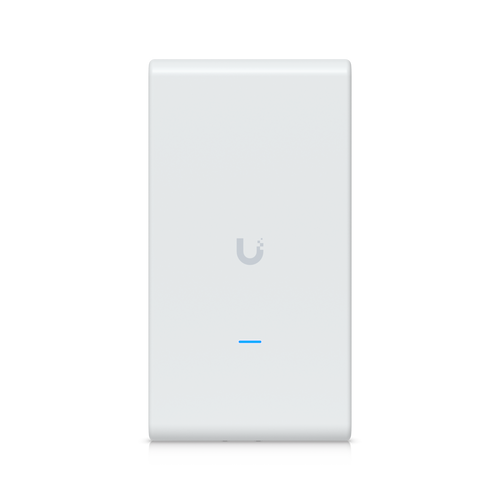
The U6-IW is an in-wall unit designed to fit a standard wall-cavity mount. Its flat rectangular form factor (139.7 × 96 × 31.2 mm) and 460 g weight reflect the flush-mount use case. No IP or outdoor rating is stated in the supplied specs. Operating temperature is -30 to 60°C, identical to the U6-MESH-US.
Power requirements differ. The U6-MESH-US lists PoE 802.3af at 13W consumption and a voltage range of 44–57V DC. The U6-IW requires PoE+ (802.3at) at 13W excluding its own PoE output, meaning the upstream switch must supply 802.3at. The U6-IW also outputs PoE to downstream devices, a capability not present on the U6-MESH-US.
Does either unit reduce infrastructure by integrating switching or PoE output?
The U6-IW includes an integrated 4-port gigabit Ethernet switch with one PoE output port and a 13W PoE power budget (excluding its own consumption). This allows a single cable run to the wall plate to serve the AP plus up to three wired downstream devices, one of which can be PoE-powered. The spec notes a 13W PoE output budget; actual powered-device wattage is constrained by that figure.
The U6-MESH-US provides a single GbE RJ45 port with no integrated switching and no downstream PoE output. It is a single-uplink device intended for mesh or point-to-point outdoor coverage, not for consolidating wired edge connections.
Management for both units falls under the UniFi ecosystem. The U6-MESH-US spec cites the UniFi Network web application and mobile app explicitly. The U6-IW spec notes UniFi Cloud or On-Premises Controller. Both carry identical certifications (CE, FCC, IC, SRRC, Anatel) and are confirmed NDAA-compliant.
Which should you choose: the U6-MESH-US or the U6-IW?
Our take: The U6-MESH-US is the stronger choice when the deployment site is outdoors or requires weatherproof coverage, pole or wall mounting in exposed environments, and a higher aggregate throughput ceiling of 5.3 Gbps. Its IPX5 rating and -30 to 60°C operating range make it suited for parking structures, building exteriors, and campus mesh links where the U6-IW has no stated outdoor rating. The U6-IW is the stronger choice for dense indoor environments: its integrated 4-port GbE switch with PoE output eliminates a separate edge switch per room, it serves 250+ confirmed concurrent clients, and its flush in-wall form factor suits hotels, offices, and classrooms. Power input differs materially — the U6-MESH-US accepts 802.3af, while the U6-IW requires 802.3at from the upstream switch. Both operate under the UniFi controller platform and are NDAA-compliant, so the decision reduces to deployment environment and whether consolidated switching per drop is a priority.
Side-by-Side Comparison
Spec-for-spec, from manufacturer data.
| Specification | Ubiquiti U6-MESH-US | Ubiquiti U6-IW |
|---|---|---|
| WiFi Standard | WiFi 6 (802.11ax) | WiFi 6 (802.11ax) |
| Aggregate Throughput | 5.3 Gbps | 4.8 Gbps (5 GHz) + 573.5 Mbps (2.4 GHz) |
| Concurrent Clients | — | 250+ |
| Form Factor | External Outdoor Cylindrical | In-Wall Flush Mount |
| Environment Rating | IPX5 Outdoor-Rated | Not specified |
| Operating Temperature | -30 to 60°C | -30 to 60°C |
| Power Input | PoE 802.3af (44–57V DC) | PoE+ 802.3at |
| Power Consumption | 13W | 13W (excluding PoE output) |
| PoE Output | None | Yes (1 port, 13W budget) |
| Integrated Switch Ports | 1x GbE RJ45 (uplink only) | 4x GbE (1x PoE out) |
| VLAN Support | — | Dynamic RADIUS-assigned VLAN |
| Antenna Gain (5 GHz) | 5 dBi | — |
| Coverage Area | 140 m² (1,500 ft²) | — |
| Mount Type | Wall; Pole (mounts included) | Wall Mount (mount included) |
| Dimensions | Ø48.5 × 159.5 mm | 139.7 × 96 × 31.2 mm |
| Weight | 2.1 lb (952 g) | 1 lb (460 g) |
| NDAA Compliant | Yes | Yes |
| Certifications | CE, FCC, IC, Anatel, SRRC | CE, FCC, IC, SRRC, Anatel |
Frequently Asked Questions
Which should you choose: the U6-MESH-US or the U6-IW?
The U6-MESH-US is the stronger choice when the deployment site is outdoors or requires weatherproof coverage, pole or wall mounting in exposed environments, and a higher aggregate throughput ceiling of 5.3 Gbps. Its IPX5 rating and -30 to 60°C operating range make it suited for parking structures, building exteriors, and campus mesh links where the U6-IW has no stated outdoor rating. The U6-IW is the stronger choice for dense indoor environments: its integrated 4-port GbE switch with PoE output eliminates a separate edge switch per room, it serves 250+ confirmed concurrent clients, and its flush in-wall form factor suits hotels, offices, and classrooms. Power input differs materially — the U6-MESH-US accepts 802.3af, while the U6-IW requires 802.3at from the upstream switch. Both operate under the UniFi controller platform and are NDAA-compliant, so the decision reduces to deployment environment and whether consolidated switching per drop is a priority.
Can I use the U6-MESH-US indoors if I need more throughput?
The U6-MESH-US is specified with an outdoor-rated IPX5 enclosure and pole or wall mount hardware, and its 5.3 Gbps aggregate throughput figure is higher than the U6-IW's stated aggregate. Nothing in the supplied specs prohibits indoor use, but its cylindrical external form factor and included mounts are designed for outdoor or semi-exposed installations. The U6-IW's in-wall design is purpose-built for indoor spaces where aesthetics and switch integration matter.
Will my existing 802.3af switch power the U6-IW?
No. The U6-IW requires PoE+ (IEEE 802.3at) input. The U6-MESH-US accepts 802.3af (44–57V DC, 13W), making it compatible with a wider range of existing PoE switches. If your infrastructure is 802.3af-only, the U6-MESH-US is the compatible choice without a switch upgrade or injector.
Does the U6-IW replace a wall switch, or do I still need one?
The U6-IW includes an integrated 4-port gigabit Ethernet switch with one PoE output port and a 13W PoE power budget (excluding its own consumption). For locations needing only a few wired drops and one PoE device at the wall plate, it can replace a separate edge switch. The U6-MESH-US has a single uplink port and no integrated switching, so it does not offer this consolidation.
More Wireless Access Point Comparisons
Get a Second Opinion on Your Camera Choice
Share your site layout, coverage goals, and budget. Our team will validate the camera selection, flag anything we would change, and recommend products that match the use case.