
Ubiquiti U6-MESH-PRO vs Ubiquiti U6-MESH-US: Specification Comparison
Both the Ubiquiti U6-MESH-PRO and U6-MESH-US are outdoor-rated, PoE-powered WiFi 6 (802.11ax) dual-band mesh access points designed for perimeter and yard deployments. They share the same operating temperature range, wall/pole mounting options, NDAA compliance, and UniFi ecosystem. This comparison examines where their throughput ceilings, physical footprint, port count, power draw, IP weatherproofing, and coverage area diverge—factors that directly determine which unit fits a given outdoor wireless infrastructure project.

In This Guide
- Which unit delivers higher throughput and how do their radio specifications compare?
- How do the two units differ in physical design, weatherproofing, coverage area, and operating environment?
- How do power requirements and port configurations differ between the two models?
- Which should you choose: the U6-MESH-PRO or the U6-MESH-US?
- Side-by-Side Specs
- FAQ
Which unit delivers higher throughput and how do their radio specifications compare?
The U6-MESH-US is specified at 5.3 Gbps aggregate throughput across its 2.4 GHz and 5 GHz bands. The U6-MESH-PRO lists 2.4 Gbps on the 5 GHz band and 573.5 Mbps on the 2.4 GHz band as individual band maximums; an explicit aggregate figure is not provided in the supplied specs. Both units are 802.11ax (WiFi 6) dual-band and support channel bandwidths of HT 20/40, VHT 20/40/80/160, and HE modes, making them radio-protocol peers.
The U6-MESH-US carries a 5 GHz antenna gain figure of 5 dBi; the U6-MESH-PRO does not list an antenna gain value in the provided specifications. The U6-MESH-PRO explicitly states support for 250+ concurrent clients; the U6-MESH-US does not specify a concurrent client figure. The U6-MESH-PRO spec sheet notes 2x2 MU-MIMO per band; the U6-MESH-US does not state a MIMO stream count in the provided data.
How do the two units differ in physical design, weatherproofing, coverage area, and operating environment?
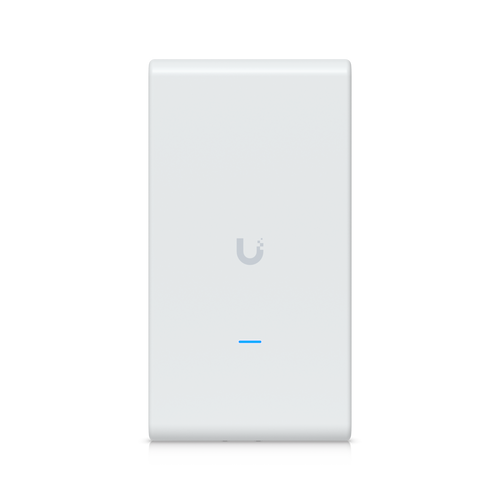
The U6-MESH-PRO is a substantially larger unit at 343.2 × 181.2 × 60.2 mm and 819 g (1.8 lb), with a UV-stabilized polycarbonate enclosure and aluminum alloy plus steel mount hardware. It carries an IPX6 rating, meaning it is protected against powerful water jets from any direction. The U6-MESH-US is a compact cylindrical form factor at Ø48.5 × 159.5 mm and 2.1 lb, with a polycarbonate and aluminum enclosure. Its IP rating is IPX5, providing protection against water jets but to a lower pressure threshold than IPX6.
Coverage area differs: the U6-MESH-PRO is rated at 185 m² (2,000 ft²) per AP, while the U6-MESH-US is rated at 140 m² (1,500 ft²) per node. Both units share an operating temperature range of -30 to 60 °C (-22 to 140 °F). Pole mount compatibility is explicitly specified for the U6-MESH-PRO (1–2.5 inch, 25–63.5 mm diameter); the U6-MESH-US lists wall and pole mounting but does not specify a pole diameter range in the provided data.
How do power requirements and port configurations differ between the two models?
The U6-MESH-PRO draws a maximum of 9 W over a voltage range of 42.5–57 V DC, compatible with 802.3af PoE switches. The U6-MESH-US draws 13 W over 44–57 V DC; its datasheet notes PoE 802.3at or higher is required, though the product field also lists 802.3af—buyers should verify switch port wattage headroom against the 13 W draw. The 4 W difference per port is material when budgeting PoE switch capacity across a multi-node mesh.
Port count is a meaningful differentiator: the U6-MESH-PRO provides two GbE RJ45 ports, enabling a daisy-chain or dual-uplink wiring topology without an additional switch. The U6-MESH-US provides a single GbE RJ45 port, limiting it to a single uplink connection per node. Both support Gigabit Ethernet connectivity. The U6-MESH-PRO lists management via Ethernet; the U6-MESH-US explicitly names the UniFi Network web application and mobile app as its management interface.
Which should you choose: the U6-MESH-PRO or the U6-MESH-US?
Our take: The U6-MESH-PRO is the stronger choice when port flexibility, lower power draw, and higher weatherproofing are the primary requirements. It delivers two GbE ports versus the U6-MESH-US's single port—enabling daisy-chain cabling without an additional switch—while drawing only 9 W compared to the U6-MESH-US's 13 W, reducing PoE budget per port by roughly 30%. Its IPX6 rating also exceeds the U6-MESH-US's IPX5, offering greater resistance to high-pressure water. The U6-MESH-US counters with a specified 5.3 Gbps aggregate throughput and a more compact cylindrical form factor suited to pole-top or discreet installations. Choose the U6-MESH-PRO for multi-drop outdoor runs on af-class switches with tight power budgets; choose the U6-MESH-US where aggregate throughput headroom is the priority and a single uplink port suffices. Both require an active UniFi controller deployment.
Side-by-Side Comparison
Spec-for-spec, from manufacturer data.
| Specification | Ubiquiti U6-MESH-PRO | Ubiquiti U6-MESH-US |
|---|---|---|
| WiFi Standard | 802.11ax (WiFi 6) dual-band | 802.11ax (WiFi 6) dual-band |
| Aggregate Throughput | — | 5.3 Gbps |
| 5 GHz Max Data Rate | 2.4 Gbps | — |
| 2.4 GHz Max Data Rate | 573.5 Mbps | — |
| Concurrent Clients | 250+ | — |
| IP Rating | IPX6 | IPX5 |
| Coverage Area | 185 m² (2,000 ft²) | 140 m² (1,500 ft²) |
| Power Consumption (max) | 9 W | 13 W |
| Voltage Range | 42.5–57 V DC | 44–57 V DC |
| PoE Standard (datasheet) | 802.3af | 802.3at or higher |
| GbE Ports | 2x GbE RJ45 | 1x GbE RJ45 |
| Dimensions | 343.2 x 181.2 x 60.2 mm | Ø48.5 x 159.5 mm |
| Weight | 819 g (1.8 lb) | 2.1 lb |
| Antenna Gain (5 GHz) | — | 5 dBi |
| Operating Temperature | -30 to 60 °C | -30 to 60 °C |
| NDAA Compliant | Yes | Yes |
Frequently Asked Questions
Which should you choose: the U6-MESH-PRO or the U6-MESH-US?
The U6-MESH-PRO is the stronger choice when port flexibility, lower power draw, and higher weatherproofing are the primary requirements. It delivers two GbE ports versus the U6-MESH-US's single port—enabling daisy-chain cabling without an additional switch—while drawing only 9 W compared to the U6-MESH-US's 13 W, reducing PoE budget per port by roughly 30%. Its IPX6 rating also exceeds the U6-MESH-US's IPX5, offering greater resistance to high-pressure water. The U6-MESH-US counters with a specified 5.3 Gbps aggregate throughput and a more compact cylindrical form factor suited to pole-top or discreet installations. Choose the U6-MESH-PRO for multi-drop outdoor runs on af-class switches with tight power budgets; choose the U6-MESH-US where aggregate throughput headroom is the priority and a single uplink port suffices. Both require an active UniFi controller deployment.
Can I power both the U6-MESH-PRO and U6-MESH-US from a standard 802.3af PoE switch?
The U6-MESH-PRO draws 9 W within a 42.5–57 V DC range, which falls within 802.3af's 15.4 W budget. The U6-MESH-US draws 13 W; its datasheet specifies 802.3at or higher, which budgets up to 30 W. Although one product field lists 802.3af for the U6-MESH-US, the 13 W draw and the 802.3at notation in the datasheet spec suggest confirming switch port wattage before deploying on af-only hardware.
Which model is better suited for installations exposed to rain and hose-down conditions?
The U6-MESH-PRO carries an IPX6 rating, protecting against powerful water jets from any direction. The U6-MESH-US is rated IPX5, which covers lower-pressure water jets. For installations near car washes, loading docks, or areas subject to high-pressure cleaning, the U6-MESH-PRO's IPX6 rating provides a higher margin of protection per the IEC 60529 standard.
Is the U6-MESH-PRO or U6-MESH-US better for larger outdoor deployments with many nodes?
The U6-MESH-PRO covers 185 m² (2,000 ft²) per AP versus 140 m² (1,500 ft²) for the U6-MESH-US, meaning fewer U6-MESH-PRO nodes may be needed for equivalent area coverage. Its dual GbE ports also simplify cabling topology in multi-node runs. The U6-MESH-US offers a higher specified aggregate throughput of 5.3 Gbps, which may be advantageous in high-density client scenarios where bandwidth ceiling—not coverage radius—is the constraint. Neither unit's specification data was sufficient to declare one definitively superior for all large deployments.
More Wireless Access Point Comparisons
Get a Second Opinion on Your Camera Choice
Share your site layout, coverage goals, and budget. Our team will validate the camera selection, flag anything we would change, and recommend products that match the use case.