
i-PRO S4576LA vs Pelco SRXF3-12360-ES: Specification Comparison
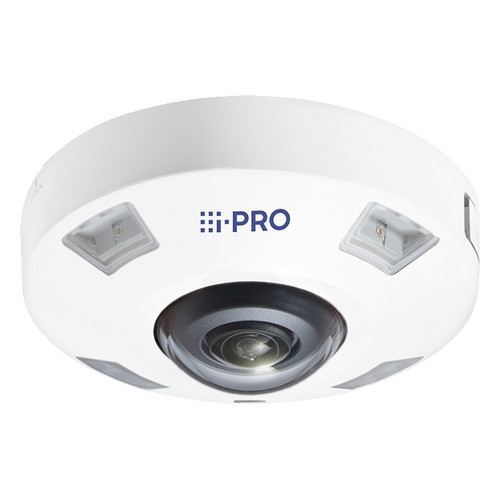
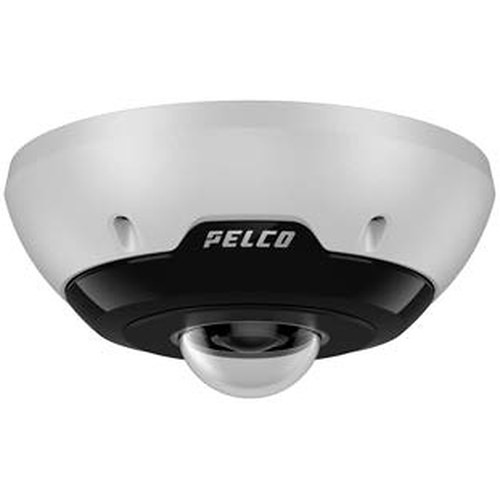
Both the i-PRO WV-S4576LA and the Pelco SRXF3-12360-ES are 12MP outdoor fisheye IP cameras designed for wide-area, single-unit 360-degree surveillance coverage. They occupy the same resolution class and share the fixed fisheye form factor, making them genuine cross-shop candidates for installers specifying perimeter, lobby, or large open-space coverage. This comparison examines how their imaging capabilities, physical installation requirements, and VMS/analytics integration profiles differ across the specifications provided.
In This Guide
How do the imaging specs compare?
The i-PRO WV-S4576LA uses an approximately 1/2-type 12MP CMOS sensor with a 1.4 mm fixed fisheye lens delivering a 183° horizontal and 183° vertical field of view. Minimum illumination is rated at 0.3 lx in color and 0.04 lx in black-and-white, with IR LEDs rated to 14 m (45 ft). Dynamic range reaches a specified maximum of 84 dB with WDR on at level 31. Frame rate is 25 fps. The Pelco SRXF3-12360-ES specifies a 2.7 mm f/2.5 lens with a 180°/360° field of view and a maximum resolution of 3840 × 2160. Frame rate at full resolution is 12.5 fps — half that of the i-PRO. Minimum illumination is stated at 0.10 lux (no color/B&W breakdown provided in the supplied specs). The Pelco spec sheet lists WDR up to 83 dB; no IR illuminator is specified for the Pelco, while the i-PRO carries active built-in IR.
The i-PRO's aperture is rated at F1.9, versus F2.0/f2.5 noted for the Pelco (the supplied Pelco spec contains both figures; the datasheet-sourced lens value is f/2.5). A wider aperture admits more light, which, combined with the lower rated minimum illumination of 0.04 lx B&W and active IR on the i-PRO, gives it a meaningful low-light advantage on paper. The Pelco spec notes 4 GB RAM and 4 GB Flash on-camera, whereas the i-PRO runs on an Ambarella CV22 SoC; neither manufacturer provides full sensor-size data for the Pelco in the supplied specs. The i-PRO supports H.265 and H.264 with smart-coding GOP control; the Pelco spec lists H.264 as the primary compression standard (the supplied field also shows H.265, but the sourced datasheet spec lists H.264 only — buyers should verify Pelco's current firmware).
What about installation and environment?
Both cameras carry IP66 and IK10 ratings for outdoor dust/water ingress and vandal resistance. The Pelco adds an IP67 rating, offering a higher level of momentary water immersion protection not claimed by the i-PRO. Both are rated for an operating temperature range of -40°C to +60°C, making them equivalent for cold-climate or high-heat deployments. The i-PRO also specifies NEMA 4X and Type 4X (UL50) compliance, wind resistance up to 40 m/s (~89 mph), a 50 J shock rating per IEC 60068-2-75, and EN50155-TX railway application certification — environmental credentials not present in the Pelco spec sheet. The i-PRO also incorporates a Rosahl anti-condensation element.
Power requirements differ: the i-PRO WV-S4576LA runs on PoE IEEE 802.3af (Class 0) or DC 12V at 1.1A, while the Pelco SRXF3-12360-ES requires PoE+ (IEEE 802.3at, Class 3), which demands a PoE+ capable switch or injector and draws a higher power budget. This is a meaningful infrastructure consideration for retrofits. The Pelco spec lists mounting options including wall, ceiling, pole, pendant, and corner. The i-PRO spec lists wall, ceiling, and rack. Physical dimensions are provided for the Pelco (6" × 6" × 2.81"); the i-PRO spec provides mass (880 g with plate / 1.3 kg with bracket) but not outer dimensions. The Pelco weight with wall mount is listed at approximately 1.001 kg (2.21 lb).
Which fits your VMS and analytics better?
The i-PRO WV-S4576LA supports ONVIF Profiles G, M, S, and T — a broader profile set than the Pelco SRXF3-12360-ES, which is specified for ONVIF Profile S and Profile T only. Profile G (edge recording/retrieval) and Profile M (analytics metadata) support on the i-PRO are absent from the Pelco's listed compliance. For edge analytics, the i-PRO provides AI-VMD, AI People Counting optimized for 360° fisheye, AI Privacy Guard, AI Scene Change Detection, and AI Sound Classification (gunshot, yell, vehicle horn, glass break) via its Ambarella CV22 SoC. The Pelco offers Pelco Smart Analytics with 8 behavior detection modes; the specific behaviors are not enumerated in the supplied spec. Buyers integrating with proprietary Pelco VMS (e.g., Pelco VideoXpert) should confirm native driver support as a separate step.
Audio: the i-PRO specifies a mic/line input, audio output via a 3.5 mm stereo jack (600Ω, -20dBV), G.726/G.711 compression, and audio detection plus AI sound classification. The Pelco spec notes microphone support but does not detail compression formats, output, or audio analytics in the supplied data. Both cameras list microSD as on-board storage. The i-PRO also specifies alarm I/O (3× alarm input, 1× alarm output, 1× AUX out) and a composite monitor output for local setup; corresponding I/O details are not present in the Pelco spec. The i-PRO supports up to 14 concurrent users. Maximum concurrent access is not specified for the Pelco in the supplied data.
Which should you choose: the S4576LA or the SRXF3-12360-ES?
Our take: The S4576LA is the stronger choice when low-light performance, AI-edge analytics depth, and broad ONVIF compatibility are the primary requirements; the SRXF3-12360-ES is competitive where behavior-based analytics within the Pelco ecosystem and IP67-rated immersion tolerance are priorities. On concrete spec deltas: the i-PRO delivers 25 fps versus the Pelco's 12.5 fps at full resolution, a 0.04 lx (B&W) minimum illumination versus the Pelco's 0.10 lux, and active 14 m IR illumination that the Pelco lacks entirely. The i-PRO also adds ONVIF Profiles G and M not listed for the Pelco, plus a richer AI analytics suite including sound classification. The trade-off is power: the i-PRO runs on standard 802.3af PoE, easing switch compatibility, while the Pelco requires PoE+ (802.3at). Platform qualifier: installations already standardized on Pelco VideoXpert VMS should verify native driver depth before specifying the i-PRO.
Side-by-Side Comparison
Spec-for-spec, from manufacturer data.
| Specification | i-PRO S4576LA | Pelco SRXF3-12360-ES |
|---|---|---|
| Resolution | 12MP | 12MP (3840 × 2160) |
| Image Sensor | Approx. 1/2-type 12MP CMOS | Not specified in supplied specs |
| Lens / Focal Length | 1.4 mm fixed fisheye | 2.7 mm f/2.5 |
| Maximum Aperture | F1.9 | F2.0 / f2.5 (per supplied specs) |
| Field of View | 183° H × 183° V | 180° / 360° |
| Min. Illumination | 0.3 lx (Color) / 0.04 lx (B&W) | 0.10 lux (no color/B&W breakdown) |
| IR Illumination | Built-in IR LED, 14 m (45 ft) | — |
| WDR | On/Off; max 84 dB (level 31) | WDR; up to 83 dB |
| Max Frame Rate | 25 fps | 12.5 fps (full resolution) |
| Video Compression | H.265 / H.264 (CBR/VBR) | H.264 (H.265 unconfirmed in datasheet) |
| IP Rating | IP66 / NEMA 4X | IP66 / IP67 |
| Impact Rating | IK10 (IEC 62262) | IK10 |
| Operating Temperature | -40°C to +50°C (IR on) / -40°C to +60°C (IR off) | -40°C to +60°C |
| Power Input / PoE Class | PoE 802.3af (Class 0) or DC 12V 1.1A | PoE+ 802.3at (Class 3) |
| ONVIF Profiles | G / M / S / T | S / T |
| Edge Storage | microSD | microSD |
| Audio | Mic/Line input, 3.5 mm output; G.726/G.711; AI sound classification | Microphone supported; compression format not specified |
| Alarm I/O | 3× Alarm IN, 1× Alarm OUT, 1× AUX OUT | Not specified in supplied specs |
| Dimensions | Not specified (mass: 880 g plate / 1.3 kg with bracket) | 6" × 6" × 2.81" / 1.001 kg (with wall mount) |
| Warranty | 5-year | 5-year |
Frequently Asked Questions
Which should you choose: the S4576LA or the SRXF3-12360-ES?
The S4576LA is the stronger choice when low-light performance, AI-edge analytics depth, and broad ONVIF compatibility are the primary requirements; the SRXF3-12360-ES is competitive where behavior-based analytics within the Pelco ecosystem and IP67-rated immersion tolerance are priorities. On concrete spec deltas: the i-PRO delivers 25 fps versus the Pelco's 12.5 fps at full resolution, a 0.04 lx (B&W) minimum illumination versus the Pelco's 0.10 lux, and active 14 m IR illumination that the Pelco lacks entirely. The i-PRO also adds ONVIF Profiles G and M not listed for the Pelco, plus a richer AI analytics suite including sound classification. The trade-off is power: the i-PRO runs on standard 802.3af PoE, easing switch compatibility, while the Pelco requires PoE+ (802.3at). Platform qualifier: installations already standardized on Pelco VideoXpert VMS should verify native driver depth before specifying the i-PRO.
Is the i-PRO WV-S4576LA or the Pelco SRXF3-12360-ES better for low-light performance?
Based on the supplied specifications, the i-PRO WV-S4576LA has the advantage in low light. It is rated at 0.04 lx minimum illumination in black-and-white mode and includes built-in IR LEDs with a 14 m range. The Pelco SRXF3-12360-ES is rated at 0.10 lux minimum illumination and does not specify any IR illuminator in the provided specs, meaning it relies entirely on ambient light at night.
Do both cameras require a PoE+ switch, or will a standard PoE switch work?
The i-PRO WV-S4576LA operates on standard PoE (IEEE 802.3af, Class 0), so it works with any compliant 802.3af switch or injector. The Pelco SRXF3-12360-ES is specified as PoE+ (IEEE 802.3at, Class 3), which requires a PoE+-capable switch or injector. If your existing infrastructure is 802.3af-only, the i-PRO avoids the need for hardware upgrades.
Which camera offers better VMS integration flexibility?
The i-PRO WV-S4576LA supports ONVIF Profiles G, M, S, and T, which covers edge recording retrieval (G) and analytics metadata (M) in addition to the standard streaming profiles. The Pelco SRXF3-12360-ES is listed as compliant with ONVIF Profile S and Profile T only. For VMS platforms that leverage ONVIF Profile G or M, the i-PRO provides broader out-of-the-box compatibility. Sites already invested in Pelco's own VMS ecosystem should evaluate native Pelco driver support separately.
Get a Second Opinion on Your Camera Choice
Share your site layout, coverage goals, and budget. Our team will validate the camera selection, flag anything we would change, and recommend products that match the use case.