
Hanwha XNV-9083R vs i-PRO S85402-V2L1: Specification Comparison
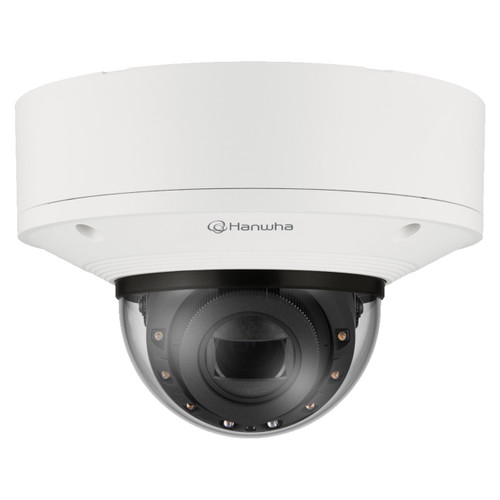
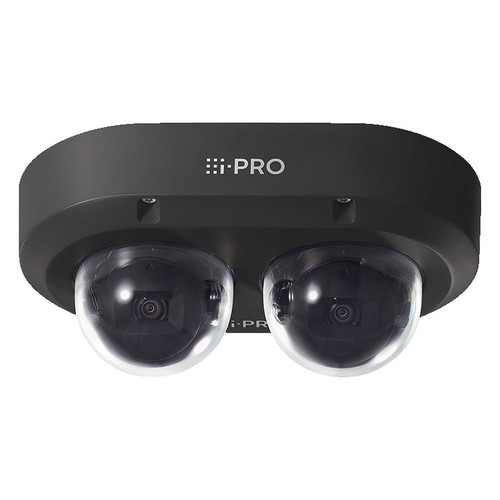
Both the Hanwha XNV-9083R and the i-PRO WV-S85402-V2L1 are 8MP outdoor vandal-resistant fixed dome cameras aimed at enterprise-grade perimeter and area surveillance. The Hanwha delivers its 8MP from a single 1/1.8-inch sensor at 3840×2160, while the i-PRO achieves its 8MP through two independent 4MP (2688×1520) sensors in a dual-dome housing. This comparison covers imaging performance, environmental and installation suitability, and VMS/analytics integration for integrators choosing between these two platforms.
In This Guide
How do the imaging specs compare?
The Hanwha XNV-9083R uses a single 1/1.8-inch progressive scan CMOS sensor producing a native 3840×2160 (8MP) output at 30fps, with a motorized varifocal lens spanning 4.4–9.3mm (2.1x zoom) and a maximum aperture of F1.3 at the wide end. Minimum illumination is 0.04 Lux in color mode and 0 Lux with IR active, with WiseIR reaching 50m (164ft). Its extremeWDR is rated at 120dB. The i-PRO WV-S85402-V2L1 uses two independent 1/2.7-inch CMOS sensors, each producing 2688×1520 (4MP) at 30fps, with a 2.9–7.3mm motorized varifocal lens (2.5x zoom) and a maximum aperture of F2.0 at wide. Minimum illumination is specified at 0.12 Lux (BW, 50IRE, F2.0, 1/30s), and IR range is 40m (high setting). The i-PRO's Super Dynamic WDR reaches 108dB at maximum level.
On pixel-level detection geometry (DORI), the Hanwha reaches 50.8m detect / 20.3m observe / 10.2m recognize / 5.1m identify in wide, and 176.6m / 70.7m / 35.3m / 17.7m in tele. The i-PRO reaches 45.1m / 18.0m / 9.0m / 4.5m wide and 136.5m / 54.6m / 27.3m / 13.6m tele. The Hanwha's larger sensor, wider aperture (F1.3 vs F2.0), lower minimum illumination (0.04 Lux vs 0.12 Lux), longer IR throw (50m vs 40m), and higher WDR rating (120dB vs 108dB) give it a measurable advantage in low-light and high-contrast scenes. The i-PRO's dual-sensor architecture, however, enables two independent coverage zones from a single mounting point, a capability the single-sensor Hanwha cannot replicate.
What about installation and environment?
Both cameras carry IP66, IP67, NEMA 4X, and IK10 impact ratings and are PoE+ (IEEE 802.3at, Class 4) powered. Maximum power draw is 22.5W for the Hanwha and 22.2W for the i-PRO — effectively identical for switch-port budgeting. The Hanwha is rated for –50°C to +55°C operating; the i-PRO extends to –40°C to +60°C. The Hanwha is heavier and larger (ø180×125mm, 1,900g) versus the i-PRO (250×150×105mm, approx. 1,800g). The Hanwha also carries an IP6K9K high-pressure wash rating and IK10+ (exceeding standard IK10), while the i-PRO meets standard IK10 and additionally specifies wind resistance up to 40 m/s (~89 mph) and an anti-condensation Temish element — the Hanwha does not list either of these in its provided specs. The i-PRO also lists NEMA TS 2 compliance (traffic-signal cabinet standard), which the Hanwha does not. The Hanwha supports 12VDC as an alternative input; the i-PRO specs do not list a DC voltage alternative. The Hanwha includes a built-in gyro sensor for digital image stabilization; the i-PRO does not list this feature.
Which fits your VMS and analytics better?
Both cameras are ONVIF Profile S/G/T/M compliant and support H.265, H.264, and MJPEG compression with CBR/VBR bitrate control. The Hanwha supports up to 10 streaming profiles and 3 virtual channels with unicast to 20 simultaneous users; the i-PRO supports 24 simultaneous users. Both support MQTT. The Hanwha's protocol stack includes SRTP and a broader listed set including SUNAPI and Wisenet SDK integration. The i-PRO runs on an Ambarella CV2 SoC and supports AI Video Analytics (6 types) including AI sound classification (gunshot, yell, vehicle horn, glass break) — a differentiating capability not listed for the Hanwha. The Hanwha's AI analytics include object detection (person/face/vehicle/license plate with vehicle sub-type), virtual line/area crossing, people counting, queue management, and heatmap; these are more extensive in the provided spec set than the i-PRO's six listed AI types.
For on-board storage, the Hanwha provides dual microSD/SDHC/SDXC slots supporting up to 1TB (2×512GB). The i-PRO provides a single microSD/SDHC/SDXC slot supporting up to 512GB. Audio-wise, the Hanwha has one mic/line input and one line output; the i-PRO provides three 3.5mm stereo audio inputs and one audio output, plus 3 alarm I/O terminals vs the Hanwha's 2 configurable I/O ports. The Hanwha's security posture includes TPM 2.0 at FIPS 140-2 Level 2; the i-PRO specifies FIPS 140-2 Level 3 — a higher cryptographic assurance level relevant to government and regulated installations. Both support IEEE 802.1X and HTTPS.
Which should you choose: the XNV-9083R or the S85402-V2L1?
Our take: The XNV-9083R is the stronger choice when single-field-of-view low-light performance and richer onboard AI analytics are the primary requirements. Its 1/1.8-inch sensor with F1.3 aperture achieves 0.04 Lux color minimum illumination versus the i-PRO's 0.12 Lux, its WiseIR extends 50m versus 40m, and its WDR is rated 120dB versus 108dB — all meaningful gaps for night-time or high-contrast scenes. It also adds dual SD card slots (1TB total) versus the i-PRO's single slot (512GB), and a broader published analytics suite including license plate attributes, people counting, and heatmap. Choose the i-PRO WV-S85402-V2L1 when the installation demands two independent coverage zones from one mounting point (dual-sensor architecture), a higher FIPS 140-2 Level 3 security posture for regulated environments, AI sound classification, traffic-cabinet NEMA TS 2 compliance, or a wider operating temperature ceiling (+60°C vs +55°C).
Side-by-Side Comparison
Spec-for-spec, from manufacturer data.
| Specification | Hanwha XNV-9083R | i-PRO S85402-V2L1 |
|---|---|---|
| Resolution | 3840×2160 (8MP, single sensor) | 2×2688×1520 (2×4MP dual sensor) |
| Image Sensor | 1/1.8" progressive scan CMOS | 2× 1/2.7" CMOS |
| Lens / Focal Length | 4.4–9.3mm motorized varifocal (2.1x) | 2.9–7.3mm motorized varifocal (2.5x) |
| Max Aperture | F1.3 (wide) / F2.15 (tele) | F2.0 (wide) / F3.0 (tele) |
| Min. Illumination | 0.04 Lux color / 0 Lux IR | 0.12 Lux (BW, 50IRE, F2.0, 1/30s) |
| IR Range | 50m (164ft) WiseIR | 40m (high) / 30m (50IRE) |
| Wide Dynamic Range | 120dB extremeWDR | 108dB max (Super Dynamic, Level 31) |
| Max Frame Rate | 30fps @ 8MP | 30fps @ 4MP per sensor |
| Video Compression | H.265, H.264 (Main/Baseline/High), MJPEG | H.265, H.264 (CBR/VBR), MJPEG |
| IP Rating | IP66 / IP67 / IP6K9K / NEMA 4X | IP66 / IP67 / NEMA 4X |
| IK / Impact Rating | IK10+ | IK10 |
| Operating Temperature | −50°C to +55°C | −40°C to +60°C |
| Power Input / PoE Class | PoE+ (802.3at) Class 4 / 12VDC; 22.5W max | PoE+ (802.3at) Class 4; 22.2W max |
| Edge Storage | 2× microSD/SDHC/SDXC, max 1TB (2×512GB) | 1× microSDXC/SDHC/SD, max 512GB |
| Audio I/O | 1× mic/line in; 1× line out | 3× 3.5mm stereo in; 1× 3.5mm stereo out |
| Alarm I/O | 2 configurable I/O ports | 3 alarm terminals (IN/OUT/AUX) |
| ONVIF Profiles | S / G / T / M | G / M / S / T |
| Cybersecurity Certification | TPM 2.0, FIPS 140-2 Level 2 | FIPS 140-2 Level 3 |
| Dimensions | ø180×125mm (ø7.09×4.92") | 250×150×105mm (9.84×5.91×4.13") |
| Weight | 1,900g (4.19 lb) | Approx. 1,800g |
| Warranty | 3-year | 3-year |
Frequently Asked Questions
Which should you choose: the XNV-9083R or the S85402-V2L1?
The XNV-9083R is the stronger choice when single-field-of-view low-light performance and richer onboard AI analytics are the primary requirements. Its 1/1.8-inch sensor with F1.3 aperture achieves 0.04 Lux color minimum illumination versus the i-PRO's 0.12 Lux, its WiseIR extends 50m versus 40m, and its WDR is rated 120dB versus 108dB — all meaningful gaps for night-time or high-contrast scenes. It also adds dual SD card slots (1TB total) versus the i-PRO's single slot (512GB), and a broader published analytics suite including license plate attributes, people counting, and heatmap. Choose the i-PRO WV-S85402-V2L1 when the installation demands two independent coverage zones from one mounting point (dual-sensor architecture), a higher FIPS 140-2 Level 3 security posture for regulated environments, AI sound classification, traffic-cabinet NEMA TS 2 compliance, or a wider operating temperature ceiling (+60°C vs +55°C).
Is the XNV-9083R or the WV-S85402-V2L1 better for low-light performance?
Based on published specs, the XNV-9083R has a measurable low-light advantage: its minimum color illumination is 0.04 Lux versus 0.12 Lux for the i-PRO, its IR throw is 50m versus 40m, and its maximum wide-end aperture is F1.3 versus F2.0. The Hanwha also claims 0 Lux operation with IR active; the i-PRO's spec sheet does not publish a 0-Lux IR figure in the provided data.
Can either camera cover two different areas at once without a second mounting point?
Yes — but only the i-PRO WV-S85402-V2L1. It houses two independent 4MP sensors, each individually adjustable (pan –50° to +230°, tilt +10° to +105°, yaw ±90°), enabling two discrete coverage zones from a single junction box. The Hanwha XNV-9083R is a single-sensor camera and covers one field of view per installation.
Which camera meets higher cybersecurity standards?
The i-PRO WV-S85402-V2L1 specifies FIPS 140-2 Level 3 cryptographic compliance, which is one level above the Hanwha XNV-9083R's listed TPM 2.0 at FIPS 140-2 Level 2. Both support HTTPS, IEEE 802.1X authentication, and SNMPv3. For U.S. federal or regulated-sector deployments that mandate Level 3, the i-PRO meets that bar; the Hanwha does not based on provided specifications.
Get a Second Opinion on Your Camera Choice
Share your site layout, coverage goals, and budget. Our team will validate the camera selection, flag anything we would change, and recommend products that match the use case.