
Hanwha XNV-9082R vs i-PRO U85402-V2L: Specification Comparison
Both the Hanwha XNV-9082R and the i-PRO WV-U85402-V2L are 8MP-class outdoor fixed vandal domes targeting perimeter and critical-infrastructure applications. The XNV-9082R delivers its 8MP output from a single 4K sensor, while the U85402-V2L achieves an equivalent pixel budget across two independent 4MP sensors covering separate fields of view. Both carry IP67 and IK10 ratings, 40m IR illuminators, motorized varifocal lenses, ONVIF Profile S/G/T compliance, and three-year warranties, making them direct cross-shop candidates for integrators specifying high-resolution outdoor fixed domes.
In This Guide
How do the imaging specs compare?
The XNV-9082R uses a single 1/2.8-inch progressive CMOS sensor capturing 3840×2160 at 30 fps with a 2.8–8.4mm (3x) motorized varifocal lens and a maximum wide-end aperture of F1.2, versus F2.0 wide on the U85402-V2L's dual 1/2.7-inch sensors at 2688×1520 per channel (2.9–7.3mm, 2.5x optical zoom). The Hanwha's F1.2 maximum aperture combined with a 0.05 Lux color / 0 Lux IR minimum illumination specification gives it a measurable low-light advantage over the i-PRO's 0.12 Lux (BW, F2.0, 1/30s) figure. The Hanwha also posts a wider horizontal field of view at its widest setting — 114° versus 100° — and a longer tele detect range of 211.0m versus 136.5m at the 25ppm/8ppf threshold.
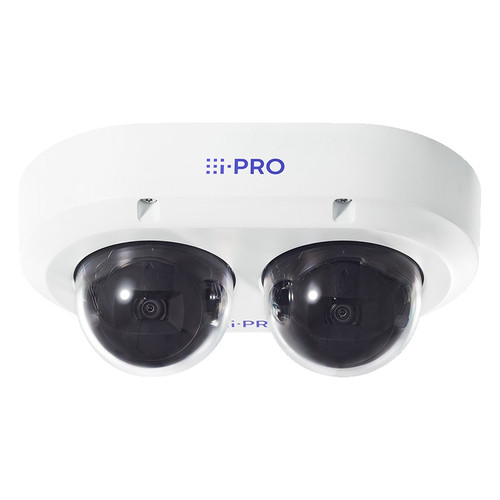
For dynamic range, the XNV-9082R is rated at 120dB extremeWDR versus the U85402-V2L's 108dB Super Dynamic (level 31). Both cameras deliver 40m IR range; the i-PRO specifies dual intensity thresholds (40m at 30IRE, 30m at 50IRE), while the Hanwha lists 40m WiseIR at 0 Lux. The XNV-9082R includes a built-in gyro sensor for digital image stabilization, a specification not listed for the U85402-V2L. The i-PRO's dual-sensor architecture is its distinguishing imaging feature: two independently adjustable heads (pan ±50°–230°, tilt +10°–105°, yaw ±90°) allow simultaneous coverage of two discrete scene areas from a single mounting point, which is a fundamentally different deployment model from the single-sensor Hanwha.
What about installation and environment?
Both cameras share IP66/IP67, NEMA 4X, and IK10 environmental ratings, making them equivalent for washdown, rain, and vandal-resistance requirements. The XNV-9082R adds IP6K9K certification (high-pressure/high-temperature washdown per ISO 20653) and notes an IK10+ rating — specs not listed for the U85402-V2L. The i-PRO specifies wind resistance up to 40m/s (~89mph) and includes a Temish anti-condensation element, neither of which appears in the Hanwha's published specifications. The i-PRO also cites NEMA TS 2 (2.2.7–2.2.9) traffic-cabinet compliance, which is not listed for the XNV-9082R.
Power and thermal ranges diverge. The XNV-9082R draws up to 12.95W and accepts PoE IEEE 802.3af (Class 3), 12VDC, or 24VAC, operating from -50°C to +60°C. The U85402-V2L requires PoE+ (802.3at, 18.9W) or DC 54V — a higher infrastructure requirement — and operates from -40°C to +60°C (power-on limited to -20°C). The Hanwha's -50°C cold-start capability and lower PoE class (standard 802.3af switches) are meaningful advantages in cold-climate or budget-constrained switch deployments. The XNV-9082R weighs 1900g versus approximately 1800g for the U85402-V2L; the i-PRO's footprint is larger (250×150×105mm declared with attachment plate) compared to the Hanwha's ø180×125mm dome profile.
Which fits your VMS and analytics better?
Both cameras support ONVIF Profile S/G/T, H.265/H.264/MJPEG compression, SNMPv1/v2c/v3, 802.1X authentication, HTTPS, and MQTT. The XNV-9082R supports up to 20 unicast users and 10 stream profiles with 3 virtual channels; the U85402-V2L supports 24 simultaneous users. Edge storage is comparable — both support microSD up to 512GB — though the Hanwha provides two microSD slots (2×512GB = up to 1TB total) versus a single slot on the i-PRO. The Hanwha also publishes 4GB RAM / 512MB Flash onboard compute specs; the i-PRO lists an Ambarella CV22 SoC but does not publish RAM/Flash figures in the provided specifications.
Analytics depth differs significantly. The XNV-9082R lists a broad on-camera analytics suite including directional detection, appear/disappear, enter/exit, loitering, tampering, fog detection, virtual line, audio detection, sound classification, shock detection, face/upper body detection, people counting, queue management, and heatmap. The U85402-V2L's provided specifications list VMD (4 areas), scene change detection, audio detection, and fog compensation, with AI Analytics and AI Sound Classification fields marked as '—' (not specified). The i-PRO camera includes 3 alarm I/O terminals versus 2 configurable I/O ports on the Hanwha, and its dual-head architecture with independent pan/tilt/yaw adjustment per sensor head is a hardware differentiator for covering two separate scene angles without a second camera installation.
Which should you choose: the XNV-9082R or the U85402-V2L?
Our take: The XNV-9082R is the stronger choice when a single wide-angle or tele-range scene requires maximum pixel density, deeper analytics, and compatibility with standard PoE switches. Its single 4K sensor resolves 3840×2160 versus 2688×1520 per channel on the i-PRO, its 120dB extremeWDR outpaces the i-PRO's 108dB Super Dynamic, its F1.2 aperture and 0.05 Lux color sensitivity undercut the i-PRO's 0.12 Lux BW figure, and its tele detect range of 211.0m at 25ppm exceeds the U85402-V2L's 136.5m. It also runs on 802.3af Class 3 switches, saving infrastructure cost. The U85402-V2L is the better fit where a single mounting point must cover two discrete fields of view simultaneously — its dual independently adjustable sensor heads and Ambarella CV22 AI SoC address that use case in ways a single-sensor dome cannot, and its wind-resistance and anti-condensation specs may matter in exposed traffic or coastal installations.
Side-by-Side Comparison
Spec-for-spec, from manufacturer data.
| Specification | Hanwha XNV-9082R | i-PRO U85402-V2L |
|---|---|---|
| Resolution | 3840×2160 (8MP, single sensor) | 2688×1520 per sensor × 2 (dual 4MP) |
| Image Sensor | 1/2.8" progressive CMOS | 2× 1/2.7" CMOS |
| Lens / Focal Length | 2.8–8.4mm, 3x motorized varifocal | 2.9–7.3mm, 2.5x motorized zoom |
| Max Aperture (Wide) | F1.2 | F2.0 |
| Min. Illumination | 0.05 Lux color / 0 Lux IR | 0.12 Lux BW (F2.0, 1/30s) |
| IR Range | 40m WiseIR (0 Lux) | 40m (30IRE) / 30m (50IRE) |
| Wide Dynamic Range | 120dB extremeWDR | 108dB Super Dynamic (level 31) |
| Max Frame Rate | 30fps @ 8MP | 30fps |
| Video Compression | H.265, H.264, MJPEG | H.265, H.264, MJPEG |
| IP Rating | IP66 / IP67 / IP6K9K / NEMA 4X | IP66 / IP67 / NEMA 4X |
| Impact Rating | IK10+ | IK10 |
| Operating Temperature | -50°C to +60°C | -40°C to +60°C (power-on: -20°C to +60°C) |
| Power Input / PoE Class | PoE 802.3af Class 3 (12.95W max); 12VDC; 24VAC | PoE+ 802.3at (18.9W); DC 54V |
| Edge Storage | 2× microSD/SDHC/SDXC, up to 1TB (512GB×2) | 1× microSD/SDHC/SDXC, up to 512GB |
| Alarm I/O | 2 configurable I/O ports | 3 alarm I/O terminals |
| On-Camera Analytics | Directional, enter/exit, loitering, virtual line, face/upper body, people counting, queue, heatmap, +more | VMD (4 areas), SCD (1 area), audio detection; AI Analytics not specified |
| ONVIF | Profile S / G / T | Profile G / S / T |
| Weight | 1900g (4.19 lb) | Approx. 1800g |
| Warranty | 3 years | 3 years |
Frequently Asked Questions
Which should you choose: the XNV-9082R or the U85402-V2L?
The XNV-9082R is the stronger choice when a single wide-angle or tele-range scene requires maximum pixel density, deeper analytics, and compatibility with standard PoE switches. Its single 4K sensor resolves 3840×2160 versus 2688×1520 per channel on the i-PRO, its 120dB extremeWDR outpaces the i-PRO's 108dB Super Dynamic, its F1.2 aperture and 0.05 Lux color sensitivity undercut the i-PRO's 0.12 Lux BW figure, and its tele detect range of 211.0m at 25ppm exceeds the U85402-V2L's 136.5m. It also runs on 802.3af Class 3 switches, saving infrastructure cost. The U85402-V2L is the better fit where a single mounting point must cover two discrete fields of view simultaneously — its dual independently adjustable sensor heads and Ambarella CV22 AI SoC address that use case in ways a single-sensor dome cannot, and its wind-resistance and anti-condensation specs may matter in exposed traffic or coastal installations.
Is the XNV-9082R or the WV-U85402-V2L better for low-light performance?
Based on published specs, the XNV-9082R has the edge: its minimum illumination is 0.05 Lux color / 0 Lux IR with an F1.2 maximum aperture at wide, compared to the U85402-V2L's 0.12 Lux (BW, F2.0, 1/30s). Both cameras include 40m IR illuminators for no-light operation.
Can either camera work with a standard 802.3af PoE switch, or do I need PoE+?
The XNV-9082R draws up to 12.95W and is rated for PoE IEEE 802.3af (Class 3), so it works with standard PoE switches. The U85402-V2L requires PoE+ (802.3at) at 18.9W or DC 54V, meaning your switch infrastructure must support 802.3at to power it — a meaningful budget and planning consideration.
Which camera offers more on-camera analytics without a separate server license?
The XNV-9082R's published specification lists a substantially broader on-camera analytics suite — including directional detection, enter/exit, loitering, virtual line, face/upper body detection, people counting, queue management, and heatmap — all listed as built-in. The U85402-V2L's provided specifications mark its AI Analytics and AI Sound Classification fields as not specified ('—'), listing VMD (4 areas), scene change detection, and audio detection as confirmed on-camera capabilities.
Get a Second Opinion on Your Camera Choice
Share your site layout, coverage goals, and budget. Our team will validate the camera selection, flag anything we would change, and recommend products that match the use case.