
Hanwha XNP-8300RW vs i-PRO X66600-Z3LS: Specification Comparison
Both the Hanwha XNP-8300RW and the i-PRO WV-X66600-Z3LS are outdoor 6MP PTZ network cameras with 30x optical zoom, IR illumination, AI analytics, IK10 vandal resistance, and IP66 weatherproofing — products a security integrator or IT buyer would directly cross-shop for perimeter surveillance, traffic monitoring, or large-area coverage applications. The comparison below is drawn strictly from the supplied specifications for each model.
In This Guide
How do the imaging specs compare?
Both cameras share a 1/2.8-inch CMOS sensor and 6MP (3328×1872) resolution, but diverge on frame rate: the XNP-8300RW delivers 30 fps, while the X66600-Z3LS is rated at 60 fps — a meaningful advantage for tracking fast-moving subjects. The Hanwha lens runs 5–150mm (F1.6 wide / F4.56 tele), while the i-PRO runs 4.5–135mm (F1.8 wide / F4.7 tele); the Hanwha's wider aperture at the wide end (F1.6 vs F1.8) offers a marginal light-gathering benefit. Both reach 30x optical zoom; the i-PRO adds an extended zoom mode up to 78x at 1280×720 resolution, which the Hanwha does not specify. Minimum illumination is 0.1 Lux color / 0 Lux IR for the Hanwha versus 0.1 Lux BW for the i-PRO — the Hanwha spec explicitly covers color low-light performance; the i-PRO's color minimum illumination is not stated.
On dynamic range, the Hanwha claims Extreme WDR at 120 dB, while the i-PRO's Super Dynamic reaches up to 132 dB at maximum level — a 12 dB advantage for the i-PRO in high-contrast scenes. IR range favors the i-PRO: 280m at 30 IRE (200m at 50 IRE) versus the Hanwha's 200m Wise IR. DORI detection figures reinforce this: at tele, the Hanwha reaches 3,482m detect / 696m recognize, while the i-PRO reaches 3,050m detect / 610m recognize — the Hanwha has a slight edge at maximum tele detection range, but both are within the same order of magnitude. The Hanwha includes a built-in wiper for lens cleaning in adverse conditions; the i-PRO spec does not list a wiper. Both include gyro-based digital image stabilization.
What about installation and environment?
Both cameras carry IP66 and IK10 ratings and are NEMA-TS2 certified. The i-PRO additionally lists NEMA 4X in its product attributes. Operating temperature ranges differ significantly: the Hanwha is rated –40°C to +55°C operational, while the i-PRO's operational range is –30°C to +60°C (power-on); the i-PRO's storage range extends to –50°C to +60°C versus the Hanwha's –50°C to +60°C storage. In extreme cold environments (below –30°C), the Hanwha maintains operation where the i-PRO does not. The i-PRO specifies a wind resistance rating of up to 40 m/s (~89 mph); the Hanwha does not list a wind resistance figure.
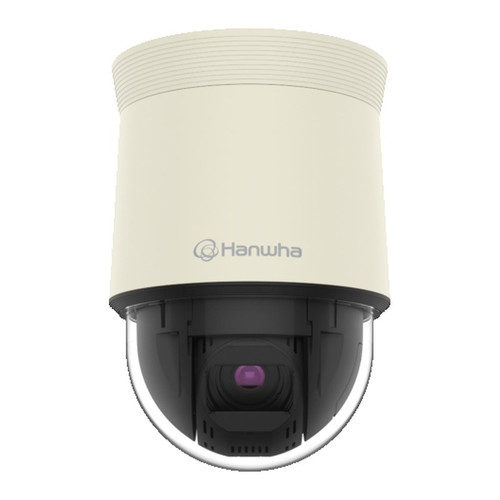
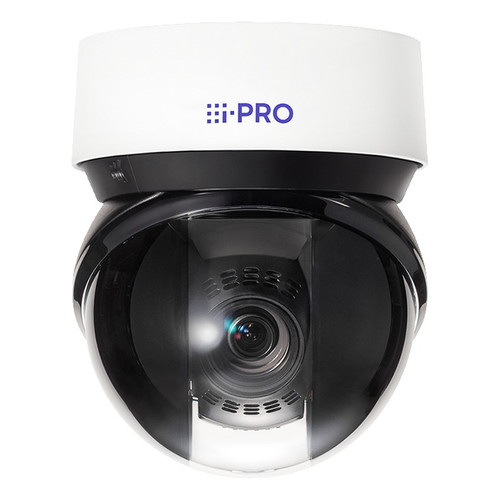
Both cameras are powered via PoE++ (IEEE 802.3bt Class 6). The Hanwha draws a maximum of 42W (typical 20W) and requires an included HPoE injector; the i-PRO is rated at 45.9W. The Hanwha is physically larger and heavier at Ø184.9×318.8mm / 5.4 kg, compared to the i-PRO's Ø167×205mm / approximately 3 kg — a notable difference for pole or pendant mount load calculations. The i-PRO's dome form factor contrasts with the Hanwha's traditional PTZ housing. The i-PRO specifies a tamper-resistant enclosure; the Hanwha does not use that specific language.
Which fits your VMS and analytics better?
The Hanwha supports ONVIF Profile S/G/T plus Hanwha's SUNAPI (HTTP API) and Wisenet open platform — three integration paths including a proprietary SDK. The i-PRO supports ONVIF Profile G/M/S/T, adding Profile M (metadata/analytics streaming) which the Hanwha does not list. The Hanwha streams up to 10 simultaneous profiles to 20 unicast or 128 multicast users; the i-PRO supports up to 14 simultaneous users. The i-PRO additionally lists MQTT and NTCIP protocol support (relevant for traffic management deployments); the Hanwha does not list those protocols.
On analytics, the Hanwha specifies directional detection, fog detection, face detection, appear/disappear, enter/exit, object auto-tracking (person/vehicle), and target lock tracking. The i-PRO lists AI motion, privacy masking, face, people, and vehicle detection, plus AI sound classification (gunshot, yell, vehicle horn, glass break) — the latter being a differentiator not present in the Hanwha spec. The i-PRO provides dedicated alarm inputs (×3) and outputs (×1) plus AUX OUT (×1) on-device; the Hanwha requires an external NW I/O Box for alarm I/O. Both include audio input; the i-PRO specifies both 3.5mm audio input and output jacks. Edge storage: the Hanwha supports dual Micro SD/SDHC/SDXC slots up to 1TB total; the i-PRO supports a single microSD/SDHC card (64GB–512GB SDXC). The i-PRO carries a stated 5-year warranty; the Hanwha warranty is not specified in the provided data.
Which should you choose: the XNP-8300RW or the X66600-Z3LS?
Our take: The XNP-8300RW is the stronger choice when the installation site experiences extreme cold below –30°C, requires a built-in wiper for lens cleaning in rain or debris, or prioritizes dual SD card redundancy. Three concrete spec deltas: the Hanwha operates to –40°C versus the i-PRO's –30°C power-on minimum; the Hanwha includes an integrated wiper (the i-PRO does not list one); and the Hanwha offers dual SD slots versus the i-PRO's single slot. Conversely, the X66600-Z3LS is preferable when 60fps smooth tracking of fast-moving targets is required, when the VMS leverages ONVIF Profile M metadata streaming or NTCIP/MQTT protocols, when on-device AI sound classification (gunshot, glass break) adds investigative value, or when 132 dB WDR in high-contrast scenes and a 280m IR range at 30 IRE are the decisive factors. Platform qualifier: Hanwha-based VMS deployments (Wisenet WAVE/SSM) gain tighter integration via SUNAPI; i-PRO cameras integrate natively with i-PRO's own VMS ecosystem and Genetec/Milestone via ONVIF Profile M.
Side-by-Side Comparison
Spec-for-spec, from manufacturer data.
| Specification | Hanwha XNP-8300RW | i-PRO X66600-Z3LS |
|---|---|---|
| Resolution | 6MP (3328×1872) | 6MP (3328×1872) |
| Image Sensor | 1/2.8" CMOS | Approx. 1/2.8" CMOS |
| Max Frame Rate | 30 fps | 60 fps |
| Lens / Focal Length | 5–150mm, DC auto iris (30x optical) | 4.5–135mm, motorized (30x optical; 78x extended at 720p) |
| Max Aperture (Wide / Tele) | F1.6 (Wide) / F4.56 (Tele) | F1.8 (Wide) / F4.7 (Tele) |
| Min. Illumination | 0.1 Lux color / 0 Lux IR | 0.1 Lux (BW); color min not specified |
| IR Range | 200m (Wise IR) | 280m @ 30 IRE / 200m @ 50 IRE |
| WDR | Extreme WDR 120 dB | Super Dynamic up to 132 dB |
| Pan Speed (Preset) | Max 500°/sec | Preset 700°/sec |
| Tilt Speed (Preset) | Max 350°/sec | Preset 500°/sec |
| IP / Impact Rating | IP66 / IK10 / NEMA 4X / NEMA-TS2 | IP66 / IK10 / NEMA 4X / NEMA-TS2 |
| Operating Temperature | –40°C to +55°C | –30°C to +60°C (power-on) |
| Power Input / PoE Class | HPoE IEEE 802.3bt Class 6, Type 3; max 42W | PoE++ 54V, 45.9W; Class 6 |
| ONVIF Profiles | Profile S / G / T | Profile G / M / S / T |
| Edge Storage | Dual Micro SD/SDHC/SDXC (up to 1TB total) | Single microSDHC/SDXC (4GB–512GB) |
| Audio | Audio input (spec listed); output not specified | 3.5mm audio in + out; AI sound classification |
| Alarm I/O | Requires external NW I/O Box | Alarm IN ×3, Alarm OUT ×1, AUX OUT ×1 (on-device) |
| Dimensions / Weight | Ø184.9×318.8mm / 5.4 kg | Ø167×205mm / approx. 3 kg |
| Built-in Wiper | Yes | Not specified |
| Warranty | Not specified in provided specs | 5 years |
Frequently Asked Questions
Which should you choose: the XNP-8300RW or the X66600-Z3LS?
The XNP-8300RW is the stronger choice when the installation site experiences extreme cold below –30°C, requires a built-in wiper for lens cleaning in rain or debris, or prioritizes dual SD card redundancy. Three concrete spec deltas: the Hanwha operates to –40°C versus the i-PRO's –30°C power-on minimum; the Hanwha includes an integrated wiper (the i-PRO does not list one); and the Hanwha offers dual SD slots versus the i-PRO's single slot. Conversely, the X66600-Z3LS is preferable when 60fps smooth tracking of fast-moving targets is required, when the VMS leverages ONVIF Profile M metadata streaming or NTCIP/MQTT protocols, when on-device AI sound classification (gunshot, glass break) adds investigative value, or when 132 dB WDR in high-contrast scenes and a 280m IR range at 30 IRE are the decisive factors. Platform qualifier: Hanwha-based VMS deployments (Wisenet WAVE/SSM) gain tighter integration via SUNAPI; i-PRO cameras integrate natively with i-PRO's own VMS ecosystem and Genetec/Milestone via ONVIF Profile M.
Is the XNP-8300RW or WV-X66600-Z3LS better for low-light performance?
Both share a 0.1 Lux minimum illumination figure, but the specs differ in how that is expressed: the Hanwha rates 0.1 Lux in color mode (F1.6, 1/30s) and 0 Lux with IR on, while the i-PRO rates 0.1 Lux in BW mode — its color minimum illumination is not stated in the provided specs. The i-PRO has a longer IR illumination range (280m at 30 IRE vs. 200m for the Hanwha), while the Hanwha's wider maximum aperture (F1.6 vs. F1.8) offers a marginal passive light-gathering advantage at the wide end.
Can either camera handle very cold outdoor deployments — say, below –30°C?
Yes, but only the Hanwha XNP-8300RW is rated for operation down to –40°C. The i-PRO WV-X66600-Z3LS specifies a power-on operating minimum of –30°C, so it is not rated for operation below that threshold. Both cameras share the same storage temperature lower limit of –50°C.
Which camera is easier to integrate into a third-party VMS?
Both support ONVIF, but the i-PRO WV-X66600-Z3LS supports ONVIF Profile G/M/S/T — including Profile M for metadata and analytics streaming — while the Hanwha XNP-8300RW supports Profile S/G/T. If your VMS leverages ONVIF Profile M for AI metadata, the i-PRO has the edge. The Hanwha additionally offers SUNAPI (a Hanwha-proprietary HTTP API) and the Wisenet open platform, which provide deeper integration with Wisenet-ecosystem VMS software. The i-PRO also lists MQTT and NTCIP protocols not present on the Hanwha, relevant for traffic-management or smart-city integrations.
Get a Second Opinion on Your Camera Choice
Share your site layout, coverage goals, and budget. Our team will validate the camera selection, flag anything we would change, and recommend products that match the use case.