
Hanwha XND-9082RV vs i-PRO S85402-V2L1: Specification Comparison
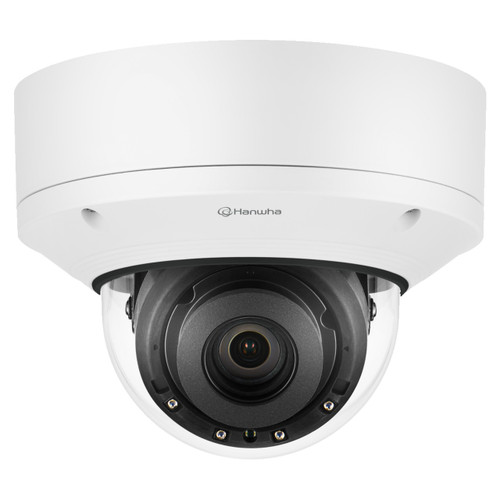
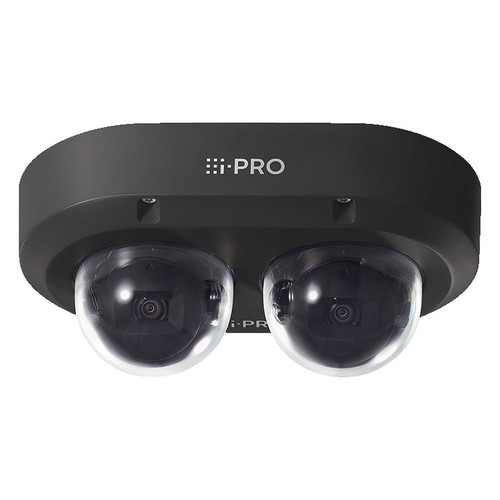
This comparison covers two fixed-dome IP cameras that both deliver 8MP total resolution with motorized varifocal lenses, IR illumination, and ONVIF support. The Hanwha XND-9082RV uses a single 8MP sensor in an indoor-rated dome, while the i-PRO WV-S85402-V2L1 pairs two 4MP sensors in an outdoor-hardened dual-dome housing. Buyers evaluating 8MP fixed domes for surveillance deployments will find meaningful differences in sensor architecture, environmental ratings, AI analytics depth, and power requirements that should drive the final selection.
In This Guide
How do the imaging specs compare?
The XND-9082RV uses a single 1/2.8" progressive CMOS sensor delivering a native 3840×2160 (8MP) frame, with a 2.8–8.4mm (3×) motorized varifocal lens reaching F1.2 at wide — significantly faster than the i-PRO's F2.0 wide aperture. That wider aperture directly supports the XND-9082RV's lower minimum illumination: 0.05 Lux color versus the WV-S85402-V2L1's 0.12 Lux in black-and-white at F2.0. WDR also favors the Hanwha at 120dB (extremeWDR) compared to 108dB (Super Dynamic, Level 31) on the i-PRO. Both cameras reach 0 Lux with IR active and offer a 40m IR range.
The WV-S85402-V2L1 takes a different approach: two independent 1/2.7" CMOS sensors, each resolving 2688×1520 (4MP), combined for 8MP total coverage. Its 2.9–7.3mm lens provides a 2.5× zoom range versus the XND-9082RV's 3×. DORI detection at wide favors the Hanwha (49.9m vs. 45.1m), and tele detection extends significantly further on the XND-9082RV (211.0m vs. 136.5m). The dual-sensor architecture of the i-PRO allows independent angle adjustment per dome head (H: -50° to +230°; V: +10° to +105°; Yaw: ±90°), enabling coverage of two distinct zones from a single mount point — a capability the single-sensor XND-9082RV does not replicate. The i-PRO runs on an Ambarella CV2 SoC; Hanwha does not specify the SoC in the provided specs.
What about installation and environment?
The XND-9082RV is rated IP52 (dust partially protected, water drip resistant) and IK10, limiting it to indoor deployments or well-protected interior spaces. Operating temperature range is -25°C to +60°C. It weighs 1,600g and measures ø160×125mm. Power is PoE IEEE 802.3af Class 3 at 12.95W maximum, or 12VDC — a standard PoE budget that most existing switches support without upgrade. Dual microSD slots accept up to 1TB total onboard storage.
The WV-S85402-V2L1 is built for outdoor use: IP67/IP66, NEMA 4X, IK10, and NEMA TS 2 (2.2.7–2.2.9) compliant for traffic-infrastructure applications. It operates from -40°C to +60°C — a 15°C cold-side advantage over the Hanwha — and includes an anti-condensation Temish element plus wind resistance rated to 40 m/s (approximately 89 mph). It weighs approximately 1,800g in an aluminum body with stainless steel screws. Power requires PoE+ (IEEE 802.3at) at 22.2W, meaning existing 802.3af-only switches will require upgrading or a PoE+ injector. The larger housing (250×150×105mm) and dual-dome geometry require more ceiling or wall real estate than the Hanwha's ø160mm footprint.
Which fits your VMS and analytics better?
Both cameras support ONVIF Profile S, G, and T. The i-PRO additionally supports ONVIF Profile M, which includes metadata streaming for AI analytics events — relevant if your VMS is Profile M-capable. The XND-9082RV exposes SUNAPI (Hanwha's HTTP API) and the Wisenet open platform for deeper integration with Wisenet WAVE or compatible VMSes. The i-PRO lists standard HTTP/HTTPS API access; no proprietary SDK detail is provided in the supplied specifications.
Analytics breadth is substantial on both. The XND-9082RV offers defocus detection, directional detection, motion detection, digital auto tracking, appear/disappear, enter/exit, loitering, tampering, fog detection, virtual line, audio detection, sound classification, shock detection, face and upper body detection, plus business intelligence (people counting, queue management, heatmap). The i-PRO WV-S85402-V2L1 specifies six AI Video Analytics types, VMD across four areas, SCD, audio detection, and AI Sound Classification covering gunshot, yell, vehicle horn, and glass break. Edge storage differs: the Hanwha provides dual microSD slots up to 1TB (512GB×2), while the i-PRO provides a single microSDXC slot up to 512GB. Audio I/O also diverges: the XND-9082RV includes a built-in microphone, selectable mic/line in, and line out; the i-PRO provides three 3.5mm audio inputs and one 3.5mm audio output with no built-in microphone noted. The i-PRO holds a security certification advantage with FIPS 140-2 Level 3 and signed firmware, which is relevant for government or high-compliance deployments.
Which should you choose: the XND-9082RV or the S85402-V2L1?
Our take: The XND-9082RV is the stronger choice when the installation is indoors and maximum single-sensor image quality, broader analytics, or budget-constrained PoE infrastructure is the priority. Its F1.2 wide aperture delivers meaningfully better low-light performance (0.05 Lux color vs. 0.12 Lux BW), its 120dB WDR exceeds the i-PRO's 108dB, and its 3× zoom yields a longer tele DORI detect range (211.0m vs. 136.5m). Dual microSD slots double the onboard storage ceiling (1TB vs. 512GB). However, the WV-S85402-V2L1 is the correct choice for any outdoor or harsh-environment deployment: IP67/IP66 and NEMA 4X versus IP52, -40°C cold-temperature operation versus -25°C, and wind resistance rated to 40 m/s. Its dual-sensor architecture enables independent two-zone coverage from a single mount point. For government or compliance-driven projects, FIPS 140-2 Level 3 certification on the i-PRO may be a mandatory differentiator.
Side-by-Side Comparison
Spec-for-spec, from manufacturer data.
| Specification | Hanwha XND-9082RV | i-PRO S85402-V2L1 |
|---|---|---|
| Resolution | 3840×2160 (8MP, single sensor) | 2688×1520 per sensor × 2 (8MP total, dual sensor) |
| Image Sensor | 1/2.8" progressive CMOS | 2× 1/2.7" CMOS |
| Lens / Focal Length | 2.8–8.4mm, 3× motorized varifocal | 2.9–7.3mm, 2.5× motorized zoom / motorized focus |
| Max Aperture | F1.2 (Wide) / F2.8 (Tele) | F2.0 (Wide) / F3.0 (Tele) |
| Min Illumination | 0.05 Lux color / 0 Lux (IR) | 0.12 Lux BW at F2.0, 1/30s / 0 Lux (IR) |
| IR Range | 40m (WiseIR) | 40m (High) / 30m (50IRE) |
| WDR | 120dB (extremeWDR) | 108dB max (Super Dynamic, Level 31) |
| Max Frame Rate | 30fps @ 8MP | 30fps |
| Video Compression | H.265, H.264, MJPEG, WiseStream II | H.265, H.264 CBR/VBR, JPEG, Smart Coding (GOP control) |
| IP Rating | IP52 | IP67 / IP66 / NEMA 4X |
| IK Rating | IK10 | IK10 |
| Operating Temperature | -25°C to +60°C | -40°C to +60°C |
| Power Input | PoE 802.3af Class 3 / 12VDC | PoE+ 802.3at |
| Max Power Draw | 12.95W | 22.2W |
| Edge Storage | Dual microSD/SDHC/SDXC, up to 1TB (512GB×2) | Single microSDXC, up to 512GB |
| Audio I/O | Built-in mic; selectable mic/line in; line out | 3× 3.5mm audio in; 1× 3.5mm audio out; no built-in mic noted |
| Dimensions | ø160×125mm | 250mm(D)×150mm(W)×105mm(H) |
| Weight | 1,600g (3.53 lb) | Approx. 1,800g |
| Warranty | 3-year | 3-year |
Frequently Asked Questions
Which should you choose: the XND-9082RV or the S85402-V2L1?
The XND-9082RV is the stronger choice when the installation is indoors and maximum single-sensor image quality, broader analytics, or budget-constrained PoE infrastructure is the priority. Its F1.2 wide aperture delivers meaningfully better low-light performance (0.05 Lux color vs. 0.12 Lux BW), its 120dB WDR exceeds the i-PRO's 108dB, and its 3× zoom yields a longer tele DORI detect range (211.0m vs. 136.5m). Dual microSD slots double the onboard storage ceiling (1TB vs. 512GB). However, the WV-S85402-V2L1 is the correct choice for any outdoor or harsh-environment deployment: IP67/IP66 and NEMA 4X versus IP52, -40°C cold-temperature operation versus -25°C, and wind resistance rated to 40 m/s. Its dual-sensor architecture enables independent two-zone coverage from a single mount point. For government or compliance-driven projects, FIPS 140-2 Level 3 certification on the i-PRO may be a mandatory differentiator.
Can the i-PRO WV-S85402-V2L1 be used indoors?
The provided specifications rate it for outdoor use (IP67/IP66, NEMA 4X) and its operating temperature range (-40°C to +60°C) exceeds indoor requirements, so it is technically suitable for indoor use. However, its larger dual-dome housing, PoE+ power requirement (22.2W), and dual-sensor geometry make it overspecified for a typical indoor installation where the Hanwha's IP52 rating is sufficient.
Does my existing 802.3af PoE switch work with both cameras?
The Hanwha XND-9082RV draws a maximum of 12.95W and is rated IEEE 802.3af Class 3, so a standard 802.3af port with at least 15.4W budget per port will power it. The i-PRO WV-S85402-V2L1 requires PoE+ (IEEE 802.3at) at 22.2W, which exceeds the 802.3af 15.4W per-port limit. An 802.3af-only switch cannot power the i-PRO without a separate PoE+ injector or a switch upgrade to 802.3at.
Which camera has stronger cybersecurity features?
Both cameras support HTTPS, IEEE 802.1X, and SNMPv3. The XND-9082RV adds IP filtering, digest authentication, EAP-TLS/LEAP/PEAP options, SRTP, and device certificate management via a pre-installed Hanwha Techwin Root CA. The i-PRO WV-S85402-V2L1 adds FIPS 140-2 Level 3 certification and signed firmware verification — a higher bar for cryptographic module validation. For U.S. federal, defense, or compliance-mandated deployments where FIPS 140-2 Level 3 is required, the i-PRO has a clear advantage. For standard commercial deployments, both cameras offer comparable network security controls.
Get a Second Opinion on Your Camera Choice
Share your site layout, coverage goals, and budget. Our team will validate the camera selection, flag anything we would change, and recommend products that match the use case.