
Hanwha XND-9082RV vs i-PRO S85402-V2L: Specification Comparison
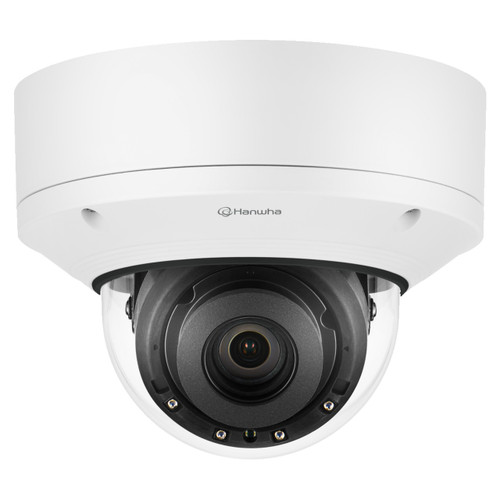
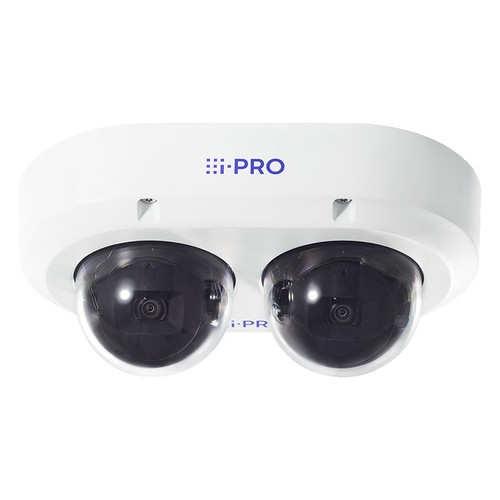
The Hanwha XND-9082RV and i-PRO WV-S85402-V2L are both 8MP varifocal IR dome cameras aimed at indoor and outdoor installations where high-resolution coverage, onboard analytics, and network integration matter. The Hanwha uses a single 3840×2160 sensor while the i-PRO employs a dual-sensor architecture delivering 2×4MP. This comparison examines imaging performance, installation suitability, and systems integration across both models to help integrators and IT buyers determine which camera best fits their specific deployment requirements.
In This Guide
How do the imaging specs compare?
The Hanwha XND-9082RV delivers a native 3840×2160 (8MP) image from a single 1/2.8" progressive CMOS sensor with a 2.8–8.4mm (3× motorized) varifocal lens. Maximum aperture reaches F1.2 at the wide end, providing a meaningful low-light advantage; minimum illumination is rated at 0.05 Lux color and 0 Lux with IR active. WDR is specified at 120dB (extremeWDR). DORI identify range extends to 21.1m at tele. The i-PRO WV-S85402-V2L uses two 1/2.7" CMOS sensors each at 2688×1520 (H.265), totaling 8MP across the dual-sensor array. Its lens covers 2.9–7.3mm (2.5× motorized), with a maximum aperture of F2.0 wide / F3.0 tele — a full stop narrower than the Hanwha at the wide end. Minimum illumination is rated at 0.12 Lux (B/W with IR), and dynamic range reaches 108dB (Super Dynamic, Level 31). DORI identify range at tele is 13.6m, meaningfully shorter than the Hanwha's 21.1m.
Both cameras provide 40m IR range and 30fps operation. The Hanwha includes WiseStream II smart codec and digital image stabilization via a built-in gyro sensor — neither feature is listed in the i-PRO specification. The i-PRO includes an Ambarella CV2 SoC and supports up to 10.5× extra digital zoom (at 640×360), which the Hanwha does not specify. Both support H.265 and H.264 compression with VBR/CBR modes.
What about installation and environment?
The i-PRO WV-S85402-V2L carries IP67/IP66 and NEMA 4X ratings, making it fully waterproof and suitable for outdoor and wash-down environments. The Hanwha XND-9082RV is rated IP52, which provides protection against limited dust ingress and dripping water — appropriate for indoor or sheltered installations but not open outdoor exposure. Both cameras achieve IK10 impact resistance. The i-PRO is also rated to NEMA TS 2 (traffic/transportation standard) and specifies wind resistance up to 40m/s (~89 mph) with an anti-condensation Temish element; neither of these features appears in the Hanwha specification.
Operating temperature for the i-PRO spans -40°C to +60°C (power-on from -20°C), while the Hanwha operates from -25°C to +60°C — a 15°C cold-start advantage for the i-PRO in harsh climates. Power draw differs significantly: the Hanwha runs on standard PoE (IEEE 802.3af, Class 3) at a maximum of 12.95W, while the i-PRO requires PoE+ (IEEE 802.3at) at 22.2W, demanding compatible switches or injectors. The Hanwha also accepts 12VDC as an alternate power source; no DC alternative is listed for the i-PRO. The Hanwha weighs 1,600g with ø160×125mm dimensions; the i-PRO is approximately 1,800g at 250mm(D)×150mm(W)×105mm(H).
Which fits your VMS and analytics better?
Both cameras support ONVIF Profiles S, G, and T. The i-PRO adds ONVIF Profile M, which covers metadata streaming for analytics events — relevant for VMS platforms that consume AI-derived metadata. The Hanwha supports SUNAPI (HTTP API) and the Wisenet open platform in addition to ONVIF, which is advantageous for Wisenet/Hanwha VMS environments. The i-PRO's AI analytics suite is described as six AI video analytics types and four AI sound classification types (gunshot, yell, vehicle horn, glass break); specific AI video analytics type names are not enumerated in the provided specification. The Hanwha lists named analytics explicitly: defocus detection, directional detection, digital auto tracking, appear/disappear, enter/exit, loitering, tampering, fog detection, virtual line, audio detection, sound classification, shock detection, and face/upper-body detection, plus business intelligence functions (people counting, queue management, heatmap).
For audio, the Hanwha provides a built-in microphone, selectable mic/line input, and line output, with G.711 and G.726 compression. The i-PRO offers three 3.5mm stereo audio inputs and one stereo audio output, supporting half- and full-duplex transmission with G.726 and G.711 encoding — a richer audio I/O complement. Edge storage on the Hanwha supports two microSD/SDXC slots up to 512GB each (1TB total), plus NAS recording. The i-PRO specifies a single microSD slot up to 512GB. Network security on the i-PRO includes FIPS 140-2 Level 3 certification and signed firmware, which the Hanwha specification does not list; the Hanwha provides 802.1X with EAP-TLS/LEAP/PEAP and a Hanwha Techwin device certificate. Simultaneous unicast users: Hanwha supports 20; i-PRO supports 24.
Which should you choose: the XND-9082RV or the S85402-V2L?
Our take: The XND-9082RV is the stronger choice when deployment is indoors or in a protected environment, standard PoE infrastructure is in place, and maximum onboard analytics breadth or dual-slot edge storage redundancy is required. Its F1.2 aperture provides a one-stop low-light advantage over the i-PRO's F2.0, its 120dB WDR exceeds the i-PRO's 108dB, and its dual microSD slots allow up to 1TB of on-camera storage versus the i-PRO's single 512GB slot. The WV-S85402-V2L is the stronger choice for outdoor or harsh-environment installations: IP67/NEMA 4X versus the Hanwha's IP52 makes it the only option for exposed mounting, and its -40°C cold-start rating covers climates where the Hanwha's -25°C threshold may be insufficient. The i-PRO's requirement for PoE+ (22.2W versus 12.95W) and ONVIF Profile M support are additional factors for infrastructure planning and AI-metadata-capable VMS platforms.
Side-by-Side Comparison
Spec-for-spec, from manufacturer data.
| Specification | Hanwha XND-9082RV | i-PRO S85402-V2L |
|---|---|---|
| Resolution | 3840×2160 (8MP, single sensor) | 2688×1520 per sensor × 2 (8MP total, dual sensor) |
| Image Sensor | 1/2.8" progressive CMOS | 2× 1/2.7" CMOS (dual sensor) |
| Lens / Focal Length | 2.8–8.4mm, 3× motorized varifocal | 2.9–7.3mm, 2.5× motorized varifocal |
| Max Aperture | F1.2 (Wide) / F2.8 (Tele) | F2.0 (Wide) / F3.0 (Tele) |
| Angular FOV (H) | 114° (Wide) | 43°–100° |
| Min. Illumination | 0.05 Lux color / 0 Lux IR | 0.12 Lux (B/W, IR LED) |
| IR Range | WiseIR 40m (131ft) | 40m (High mode) |
| WDR / Dynamic Range | extremeWDR 120dB | Super Dynamic 108dB (Level 31 max) |
| Max Frame Rate | 30fps @ 8MP | 30fps |
| Video Compression | H.265, H.264 (Main/Base/High), MJPEG; WiseStream II | H.265, H.264 (CBR/VBR), MJPEG; GOP control |
| IP Rating | IP52 | IP67 / IP66; NEMA 4X |
| IK Rating | IK10 | IK10 |
| Operating Temperature | -25°C to +60°C | -40°C to +60°C (Power On: -20°C to +60°C) |
| Power Input / PoE Class | PoE IEEE 802.3af Class 3; 12VDC alt. | PoE+ IEEE 802.3at |
| Max Power Draw | 12.95W | 22.2W |
| Edge Storage | 2× microSD/SDXC up to 512GB each (1TB total); NAS | 1× microSD up to 512GB |
| Audio I/O | Built-in mic; mic/line in; line out; G.711/G.726 | 3× 3.5mm stereo in; 1× 3.5mm stereo out; half/full duplex; G.711/G.726 |
| ONVIF Profiles | S, G, T | S, G, T, M |
| Simultaneous Streams / Users | Unicast 20 users; up to 10 profiles | 24 simultaneous users |
| Dimensions | ø160 × 125mm | 250(D) × 150(W) × 105(H) mm |
| Weight | 1,600g (3.53 lb) | Approx. 1,800g |
| Warranty | 3 years | 3 years |
Frequently Asked Questions
Which should you choose: the XND-9082RV or the S85402-V2L?
The XND-9082RV is the stronger choice when deployment is indoors or in a protected environment, standard PoE infrastructure is in place, and maximum onboard analytics breadth or dual-slot edge storage redundancy is required. Its F1.2 aperture provides a one-stop low-light advantage over the i-PRO's F2.0, its 120dB WDR exceeds the i-PRO's 108dB, and its dual microSD slots allow up to 1TB of on-camera storage versus the i-PRO's single 512GB slot. The WV-S85402-V2L is the stronger choice for outdoor or harsh-environment installations: IP67/NEMA 4X versus the Hanwha's IP52 makes it the only option for exposed mounting, and its -40°C cold-start rating covers climates where the Hanwha's -25°C threshold may be insufficient. The i-PRO's requirement for PoE+ (22.2W versus 12.95W) and ONVIF Profile M support are additional factors for infrastructure planning and AI-metadata-capable VMS platforms.
Can the Hanwha XND-9082RV be used outdoors?
Based on the provided specifications, the XND-9082RV carries an IP52 rating, which protects against limited dust ingress and vertically dripping water. It is not rated for rain exposure, outdoor jet-wash, or full weather immersion. For exposed outdoor mounting, the i-PRO WV-S85402-V2L with its IP67/IP66 and NEMA 4X rating is the appropriate choice between these two models.
Do I need a PoE+ switch for either of these cameras?
The Hanwha XND-9082RV draws a maximum of 12.95W and is powered by standard PoE (IEEE 802.3af, Class 3), so a standard PoE switch or injector is sufficient. It also accepts 12VDC as an alternate source. The i-PRO WV-S85402-V2L requires PoE+ (IEEE 802.3at) at 22.2W; a standard PoE port will not supply adequate power, so a PoE+ capable switch or midspan injector is required.
Which camera supports more edge recording storage?
The Hanwha XND-9082RV supports two microSD/SDXC card slots, each up to 512GB, for a combined on-camera capacity of up to 1TB. It also supports NAS recording. The i-PRO WV-S85402-V2L specification lists a single microSD slot with a maximum capacity of 512GB. If redundant or higher-capacity local recording is a priority, the Hanwha has a clear advantage on this specification.
Get a Second Opinion on Your Camera Choice
Share your site layout, coverage goals, and budget. Our team will validate the camera selection, flag anything we would change, and recommend products that match the use case.