
Hanwha QNP-6320H vs i-PRO S66300-Z4L: Specification Comparison
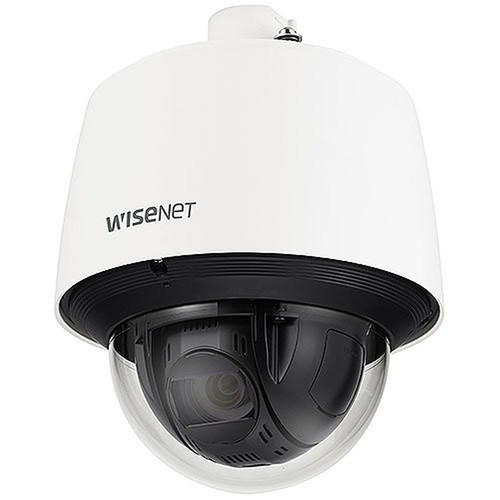
Both the Hanwha QNP-6320H and the i-PRO WV-S66300-Z4L are 2MP outdoor PTZ dome cameras designed for wide-area surveillance, making them direct cross-shop candidates for installers specifying high-speed PTZ units. The Hanwha offers a 32x optical zoom on a compact aluminum/polycarbonate body powered by PoE+, while the i-PRO delivers a 40x optical zoom (extendable to 60x digital), 350m IR range, onboard AI analytics, and native audio I/O on a PoE++ platform. This comparison covers imaging performance, installation and environmental ratings, and VMS/analytics integration to help buyers choose between them.

In This Guide
How do the imaging specs compare?
Both cameras share a 1/2.8-inch CMOS sensor producing 1920×1080 resolution. The Hanwha QNP-6320H provides a 4.44–142.6mm lens at 32x optical zoom (F1.6 wide, F4.4 tele), a minimum illumination of 0.05 lux color / 0.005 lux B/W, and 120dB WDR via its SSDR/WDR processing. The i-PRO WV-S66300-Z4L offers a wider 4.25–170mm lens at 40x optical zoom (extendable to 60x digital at 720p), F1.6 wide / F4.95 tele, a minimum illumination of 0.006 lux B/W, and a maximum 144dB dynamic range with Super Dynamic (level 31). The i-PRO's slightly lower lux floor and higher dynamic range ceiling are the measurable imaging advantages; the Hanwha's F4.4 tele vs. i-PRO's F4.95 tele gives the Hanwha a marginally brighter tele aperture.
On IR performance, the i-PRO specifies 350m detection range at 30IRE with dual IR LEDs; the Hanwha QNP-6320H lists no IR illuminator, IR LED, or IR wavelength in its specifications—IR Night Vision is tagged in the product attributes but no operative IR range figure is provided in the spec sheet. In DORI terms, the i-PRO reaches 2,199.9m detection / 440m recognition in tele, versus the Hanwha's 1,921.3m detection / 384.3m recognition in tele—a roughly 14–15% advantage for the i-PRO at telephoto distances. The Hanwha supports a maximum 60fps frame rate at 1080p; the i-PRO specifies a variable frame rate without a stated 1080p maximum fps figure. Pan speed is identical at 700°/s preset for both; tilt preset speed is 300°/s on the Hanwha versus 500°/s on the i-PRO, a meaningful advantage for fast-moving tracking scenarios.
What about installation and environment?
Both cameras carry IP66 and IK10 ratings and are certified for outdoor vandal-resistant installation. The Hanwha QNP-6320H adds a NEMA 4X rating and operates from −35°C to +55°C with storage down to −50°C. The i-PRO WV-S66300-Z4L operates from −50°C to +60°C—a wider operational band at both ends—and adds a wind resistance specification of up to 40m/s (~89 mph), which the Hanwha does not list. The i-PRO also specifies a tamper-resistant enclosure.
Power requirements differ significantly: the Hanwha QNP-6320H draws PoE+ (IEEE 802.3at, Class 4) at a maximum of 23W / typical 14W. The i-PRO WV-S66300-Z4L requires PoE++ (IEEE 802.3bt) at 45.9W—more than double the Hanwha's draw—which mandates PoE++ switches or midspans and affects infrastructure cost. On form factor, the Hanwha measures ø204.3×265mm and weighs 2,700g; the i-PRO is ø167×205mm and approximately 3,000g, making the i-PRO physically smaller in diameter but slightly heavier. The Hanwha lists a range of compatible mounts (wall, pole, parapet, corner, hanging, ceiling assembly, cabinet). The i-PRO's compatible mounting accessories are not enumerated in the provided specifications.
Which fits your VMS and analytics better?
The Hanwha QNP-6320H supports ONVIF Profile S/G/T, Wisenet SUNAPI (HTTP API), and Wisenet open platform, integrating natively into Wisenet WAVE and third-party ONVIF-compliant VMS platforms. Onboard analytics include directional detection, motion detection, enter/exit, tampering, virtual line, and audio detection (the last requires the optional SPM-4210 I/O box). Privacy masking supports 32 zones (4-point quadrangle, six color options including mosaic). Edge storage is a single microSD/SDHC/SDXC slot up to 256GB. The Hanwha does not list native audio input/output on the camera body; audio requires the optional accessory.
The i-PRO WV-S66300-Z4L supports ONVIF Profile G/M/S/T and provides onboard AI analytics covering motion, face, people, vehicle, mask, and occupancy detection, plus AI sound classification (gunshot, yell, vehicle horn, glass break)—all without an external module. Audio is built in: 4× 3.5mm stereo input jacks and one 3.5mm stereo output, plus 3 alarm I/O terminals, enabling full audio integration without accessories. The i-PRO is also FIPS 140-2 Level 3 certified, relevant for federal or high-security deployments. Edge storage uses microSDXC (capacity not specified in the provided specs). The i-PRO lists a 5-year warranty; no warranty term is stated in the Hanwha specifications provided.
Which should you choose: the QNP-6320H or the S66300-Z4L?
Our take: The i-PRO WV-S66300-Z4L is the stronger choice when maximum IR range, wider dynamic range, built-in AI analytics, and native audio are mission-critical requirements on a future-proof platform. Key spec deltas: the i-PRO delivers 350m IR at 30IRE versus no documented IR range for the Hanwha; its Super Dynamic tops out at 144dB versus the Hanwha's 120dB; and its tele DORI detection reaches 2,199.9m versus the Hanwha's 1,921.3m. However, it demands PoE++ at 45.9W versus the Hanwha's PoE+ at 23W maximum—a real infrastructure cost driver. The Hanwha QNP-6320H is the better fit for Wisenet-centric deployments, budget-constrained PoE+ switch infrastructure, and installations where a 32x optical zoom is sufficient and onboard audio/AI can be deferred or handled at the VMS layer.
Side-by-Side Comparison
Spec-for-spec, from manufacturer data.
| Specification | Hanwha QNP-6320H | i-PRO S66300-Z4L |
|---|---|---|
| Resolution | 1920×1080 (2MP) | 1920×1080 (2MP) |
| Image Sensor | 1/2.8" CMOS | Approx. 1/2.8" type CMOS (5.57×3.13mm scanning area) |
| Optical Zoom / Focal Length | 32x / 4.44–142.6mm | 40x (60x digital at 720p) / 4.25–170mm |
| Max Aperture (Wide / Tele) | F1.6 (Wide) / F4.4 (Tele) | F1.6 (Wide) / F4.95 (Tele) |
| Minimum Illumination | 0.05 lux color / 0.005 lux B/W | 0.006 lux B/W (F1.6, 1/30s) |
| IR Range | Not specified in provided specs | 350m @ 30IRE / 250m @ 50IRE |
| Wide Dynamic Range | 120dB | Max. 144dB (Super Dynamic On, Level 31) |
| Max Frame Rate | 60fps @ 1080p | Variable (no maximum fps figure stated in provided specs) |
| Video Compression | H.265 / H.264 / MJPEG | H.265 / H.264 / MJPEG |
| IP Rating | IP66 | IP66 |
| IK / Impact Rating | IK10 | IK10 (IEC 62262) |
| Operating Temperature | −35°C to +55°C | −50°C to +60°C |
| Power Input / PoE Class | PoE+ IEEE 802.3at, Class 4, max 23W | PoE++ IEEE 802.3bt, 45.9W |
| Audio (Built-in) | — | 4× 3.5mm stereo in / 1× 3.5mm stereo out |
| Edge Storage | microSD/SDHC/SDXC, 1 slot, max 256GB | microSDXC (capacity not stated in provided specs) |
| ONVIF Profile | S / G / T | G / M / S / T |
| AI / Onboard Analytics | Directional, motion, enter/exit, tampering, virtual line; audio via optional I/O box | AI motion, face, people, vehicle, mask, occupancy; AI sound classification (gunshot, yell, vehicle horn, glass break) |
| Dimensions (max) | ø204.3×265mm | ø167×205mm |
| Weight | 2,700g (5.95 lb) | Approx. 3,000g (without attachment) |
| Warranty | Not stated in provided specs | 5 years |
Frequently Asked Questions
Which should you choose: the QNP-6320H or the S66300-Z4L?
The i-PRO WV-S66300-Z4L is the stronger choice when maximum IR range, wider dynamic range, built-in AI analytics, and native audio are mission-critical requirements on a future-proof platform. Key spec deltas: the i-PRO delivers 350m IR at 30IRE versus no documented IR range for the Hanwha; its Super Dynamic tops out at 144dB versus the Hanwha's 120dB; and its tele DORI detection reaches 2,199.9m versus the Hanwha's 1,921.3m. However, it demands PoE++ at 45.9W versus the Hanwha's PoE+ at 23W maximum—a real infrastructure cost driver. The Hanwha QNP-6320H is the better fit for Wisenet-centric deployments, budget-constrained PoE+ switch infrastructure, and installations where a 32x optical zoom is sufficient and onboard audio/AI can be deferred or handled at the VMS layer.
Is the QNP-6320H or WV-S66300-Z4L better for low-light performance?
The i-PRO WV-S66300-Z4L has a documented advantage: its minimum illumination is 0.006 lux B/W (F1.6, 1/30s) and it carries 350m IR illuminators rated to 30IRE. The Hanwha QNP-6320H specifies 0.05 lux color / 0.005 lux B/W—a lower B/W lux floor than the i-PRO—but its IR illuminator specifications are absent from the provided spec sheet, so active IR performance cannot be compared on a documented basis.
Can I power both cameras from a standard PoE+ switch?
No. The Hanwha QNP-6320H is PoE+ (IEEE 802.3at, Class 4, max 23W) and will power from any standard PoE+ port. The i-PRO WV-S66300-Z4L requires PoE++ (IEEE 802.3bt) at 45.9W; standard PoE+ ports deliver only up to 30W and cannot power it. You will need a PoE++ switch or injector for the i-PRO.
Which camera has better built-in analytics without extra hardware?
The i-PRO WV-S66300-Z4L includes AI-based motion, face, people, vehicle, mask, and occupancy detection plus AI sound classification (gunshot, yell, vehicle horn, glass break) natively. The Hanwha QNP-6320H supports directional detection, motion detection, enter/exit, tampering, and virtual line analytics on-camera, but audio detection requires the optional SPM-4210 I/O box. Neither facial recognition nor vehicle classification is listed in the Hanwha's provided specifications.
Get a Second Opinion on Your Camera Choice
Share your site layout, coverage goals, and budget. Our team will validate the camera selection, flag anything we would change, and recommend products that match the use case.