
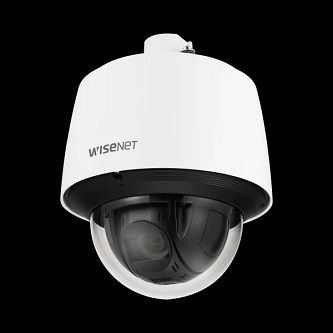
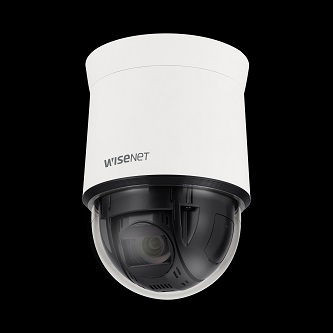
Hanwha QNP-6250H vs Hanwha XNV-6083R: Specification Comparison
Both the Hanwha QNP-6250H and XNV-6083R are 2MP (1920×1080) outdoor PTZ dome cameras sharing the same sensor class, 60fps frame rate, and PoE+ power draw. They target the same surveillance use cases—perimeter monitoring, large-area coverage, and day/night operation—making them genuine cross-shop candidates. The comparison focuses on optical zoom range, environmental ratings, audio capability, alarm I/O, and cold-weather operating range, which are the primary differentiators between these two models.
In This Guide
How do the imaging specs compare?
Both cameras use a 1/2.8" CMOS sensor, deliver 1920×1080 at up to 60fps, and share identical minimum illumination ratings of 0.05 Lux color / 0.005 Lux B/W. Both offer 120dB WDR, SSNR V digital noise reduction, BLC/HLC/SSDR backlight compensation, Auto (ICR) day/night switching, and built-in gyro-based digital image stabilization. At wide angle the DORI performance is identical: Detect 60.7m, Observe 24.3m, Recognize 12.1m, Identify 6.1m.
The key optical difference is zoom ratio. The QNP-6250H uses a 4.44–111mm lens for 25× optical zoom (32× digital, 800× combined), while the XNV-6083R uses a 4.44–142.6mm lens for 32× optical zoom (32× digital, 1024× combined). That 28.4% longer telephoto reach translates directly into tele-end DORI: the XNV-6083R detects targets at 1,921m vs. 1,471m for the QNP-6250H, observes at 768.5m vs. 588.5m, and identifies at 192.1m vs. 147.1m. The QNP-6250H tele aperture is F3.9 vs. the XNV-6083R's F4.4, a marginal difference unlikely to affect real-world low-light performance at telephoto.
What about installation and environment?
The QNP-6250H carries IP66, IK10, and NEMA 4X certifications and is rated for operation from -35°C to +55°C. Its aluminum body (head in polycarbonate) and NEMA 4X rating make it suitable for environments requiring resistance to corrosive washdown or severe weather. It is the larger unit at ø204.3×265mm and 2,700g. The XNV-6083R is rated IP67 and IK10 but does not list NEMA 4X, and its plastic body operates from -10°C to +55°C—a significantly narrower cold-weather window. It is the more compact unit at ø152×218mm and 1,700g.
Both run on PoE+ (IEEE 802.3at, Class 4). The QNP-6250H draws up to 23W typical 14W; the XNV-6083R draws up to 14.5W typical 12W, giving it a lower PoE budget requirement. Both use RJ-45 at 10/100BASE-T, though the QNP-6250H specifies a metal-shielded connector versus the XNV-6083R's unspecified RJ-45. Mounting accessory ecosystems differ: the XNV-6083R lists an in-ceiling mount (SHP-1520FW), box housing (SHP-3701H), and additional ceiling/wall options not catalogued for the QNP-6250H, while the QNP-6250H lists a parapet mount (SBP-156LMW) not listed for the XNV-6083R.
Which fits your VMS and analytics better?
Both cameras support ONVIF Profile S/G/T, SUNAPI (HTTP API), Wisenet open platform, H.265/H.264 (Main/High)/MJPEG, WiseStream II smart codec, CBR/VBR bitrate control, up to 10 streaming profiles, unicast (20 users)/multicast, 802.1X network authentication, HTTPS/SRTP/WSS secure communication, firmware encryption, Digest Authentication with brute-force protection, IP filtering, and NTCIP1205. Both provide micro SD/SDHC/SDXC edge storage up to 256GB and 1GB RAM / 256MB Flash. Analytics on both include motion detection, directional detection, virtual line crossing, and tampering. The QNP-6250H additionally lists Enter/Exit analytics; both note auto-tracking support.
Audio and alarm I/O is a clear differentiator. The XNV-6083R provides a selectable mic/line audio input (2.5VDC, 2K Ohm impedance) with G.711/G.726 compression, a line-level audio output (max 1Vrms), and 4 alarm inputs / 2 alarm outputs on-board. The QNP-6250H specifies no audio input, no audio output, and its alarm output and audio clip play are noted as dependent on the optional SPM-4210 I/O box. The QNP-6250H also lists AES+ZIP data encryption; the QNP-6250H lists Authentication & ZIP encryption. Both include a Hanwha Techwin Root CA device certificate. Neither lists a Vandal Rating discrepancy—both are IK10.
Which should you choose: the QNP-6250H or the XNV-6083R?
Our take: The XNV-6083R is the stronger choice when maximum telephoto reach, built-in audio I/O, and native alarm connectivity are priorities. Its 32× optical zoom (vs. 25×) extends tele-end detection range by 450m (1,921m vs. 1,471m) and identification range by 45m (192.1m vs. 147.1m)—meaningful for large perimeter or open-area deployments. It also includes on-board audio in/out (G.711/G.726) and 4 alarm inputs / 2 alarm outputs natively, whereas the QNP-6250H requires an external SPM-4210 I/O box for those functions. Conversely, the QNP-6250H is the correct selection for installations below -10°C (rated to -35°C), sites requiring NEMA 4X corrosion resistance, or applications demanding a metal-shielded Ethernet connection. Buyers on constrained PoE budgets may also appreciate the XNV-6083R's lower typical draw (12W vs. 14W). Both carry the same 3-year warranty and ONVIF Profile S/G/T compatibility.
Side-by-Side Comparison
Spec-for-spec, from manufacturer data.
| Specification | Hanwha QNP-6250H | Hanwha XNV-6083R |
|---|---|---|
| Resolution | 1920×1080 (2MP) | 1920×1080 (2MP) |
| Image Sensor | 1/2.8" CMOS | 1/2.8" CMOS |
| Focal Length / Optical Zoom | 4.44–111mm (25×) | 4.44–142.6mm (32×) |
| Total Zoom (optical × digital) | 800× (25× opt / 32× dig) | 1024× (32× opt / 32× dig) |
| Min. Illumination | 0.05 Lux color / 0.005 Lux B/W | 0.05 Lux color / 0.005 Lux B/W |
| Wide Dynamic Range | 120dB | 120dB |
| Max. Frame Rate | 60fps | 60fps |
| Tele-end Detect / Identify (DORI) | 1,471.3m detect / 147.1m identify | 1,921.3m detect / 192.1m identify |
| IP Rating | IP66 | IP67 |
| IK / Impact Rating | IK10 | IK10 |
| NEMA Rating | NEMA 4X | — |
| Operating Temperature | -35°C to +55°C | -10°C to +55°C |
| Power Input / PoE Class | PoE+ 802.3at, Class 4 (max 23W) | PoE+ 802.3at, Class 4 (max 14.5W) |
| Audio In / Out | — | Mic/line in; line out (1Vrms) |
| Alarm I/O | Via optional SPM-4210 I/O box | 4 inputs / 2 outputs (on-board) |
| Video Compression | H.265/H.264 (Main/High), MJPEG | H.265/H.264 (Main/High), MJPEG |
| Edge Storage | microSD/SDHC/SDXC, 1 slot, max 256GB | microSD/SDHC/SDXC, 1 slot, max 256GB |
| Body Material | Aluminum (body) / Polycarbonate (head) | Plastic |
| Dimensions | ø204.3×265mm (ø8.04×10.43") | ø152×218mm (ø5.98×8.58") |
| Weight | 2,700g (5.95 lb) | 1,700g (3.75 lb) |
| Warranty | 3-year | 3-year |
Frequently Asked Questions
Which should you choose: the QNP-6250H or the XNV-6083R?
The XNV-6083R is the stronger choice when maximum telephoto reach, built-in audio I/O, and native alarm connectivity are priorities. Its 32× optical zoom (vs. 25×) extends tele-end detection range by 450m (1,921m vs. 1,471m) and identification range by 45m (192.1m vs. 147.1m)—meaningful for large perimeter or open-area deployments. It also includes on-board audio in/out (G.711/G.726) and 4 alarm inputs / 2 alarm outputs natively, whereas the QNP-6250H requires an external SPM-4210 I/O box for those functions. Conversely, the QNP-6250H is the correct selection for installations below -10°C (rated to -35°C), sites requiring NEMA 4X corrosion resistance, or applications demanding a metal-shielded Ethernet connection. Buyers on constrained PoE budgets may also appreciate the XNV-6083R's lower typical draw (12W vs. 14W). Both carry the same 3-year warranty and ONVIF Profile S/G/T compatibility.
Is the QNP-6250H or XNV-6083R better for long-distance identification?
Based on the provided specs, the XNV-6083R identifies targets at 192.1m (630.3ft) at tele end versus 147.1m (482.7ft) for the QNP-6250H—a 45m advantage driven by its 32× optical zoom (4.44–142.6mm) compared to the QNP-6250H's 25× (4.44–111mm).
Which camera works better in extreme cold?
The QNP-6250H is rated for operation down to -35°C, while the XNV-6083R is rated only to -10°C. For installations in cold climates or unheated enclosures, the QNP-6250H is the appropriate choice based on the specified operating temperature ranges.
Does either camera have built-in audio and alarm I/O?
Yes—the XNV-6083R includes a selectable mic/line audio input, a line-level audio output, 4 alarm inputs, and 2 alarm outputs on-board. The QNP-6250H's specs list no native audio input or output and note that alarm output and audio clip play require the optional SPM-4210 I/O box.
Get a Second Opinion on Your Camera Choice
Share your site layout, coverage goals, and budget. Our team will validate the camera selection, flag anything we would change, and recommend products that match the use case.