
Hanwha QND-8080R vs Hanwha XNV-8081Z: Specification Comparison
Both the Hanwha QND-8080R and XNV-8081Z are 5MP motorized-varifocal PTZ dome cameras operating at 30fps with 120dB WDR and ONVIF Profile S/G/T support—making them legitimate cross-shop candidates for installers choosing between an indoor-rated cost-optimized unit and a ruggedized outdoor-hardened model. The comparison covers imaging performance, environmental ratings and power, and VMS/analytics integration to help systems integrators match each camera to the right deployment scenario.
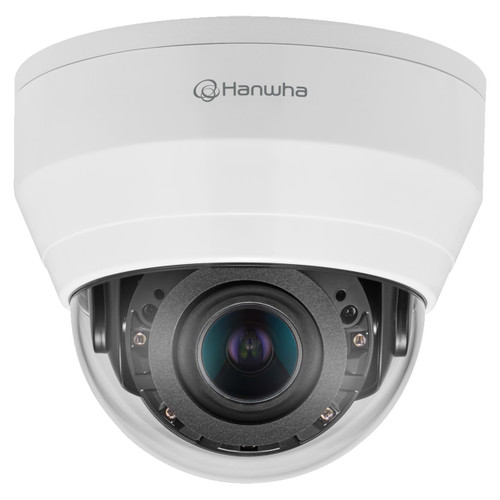
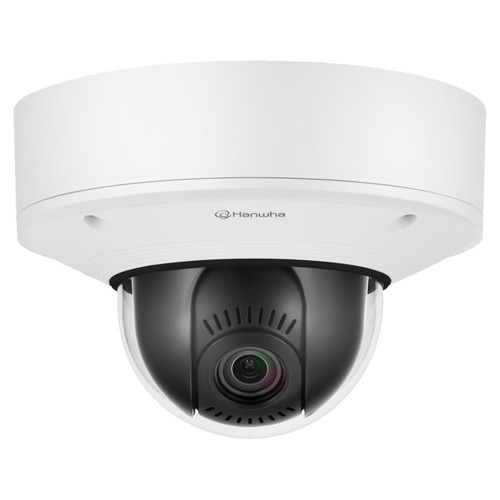
In This Guide
How do the imaging specs compare?
The QND-8080R uses a 1/2.8" 5MP CMOS sensor resolving 2592×1944 at 30fps with a minimum illumination of 0.15 Lux color and 0 Lux with IR active (850nm IR LEDs rated to 20m/65.6ft). Its 3.2–10mm motorized varifocal lens delivers a 3.1x zoom ratio with apertures of F1.6 (wide) to F2.9 (tele) and a horizontal field of view of 101°. The XNV-8081Z employs a larger 1/1.8" 6MP CMOS sensor resolving 2560×1920 at 30fps—the larger sensor yielding a significantly better minimum illumination of 0.07 Lux color and 0.007 Lux B/W. Its 3.6–9.4mm lens provides a 2.6x zoom ratio with apertures of F1.2 (wide) to F2.4 (tele) and a slightly wider horizontal field of view of 102.5°.
Both cameras deliver 120dB WDR and include BLC, SSDR, and Day/Night Auto(ICR). The XNV-8081Z adds HLC (Highlight Compensation), Digital Image Stabilization, and a Defog function not listed for the QND-8080R. The QND-8080R specifies IR illumination range at 20m; the XNV-8081Z spec sheet does not state an IR throw distance—only a minimum object distance of 0.5m. Noise reduction is SSNR on the QND-8080R versus SSNRV (generation V) on the XNV-8081Z. Pan/tilt ranges also differ: the QND-8080R offers 0°–350° pan and 0°–67° tilt, while the XNV-8081Z is specified at ±175° pan (350° total) and 0°–85° tilt, giving it a deeper tilt angle for elevated mounting positions.
What about installation and environment?
The QND-8080R is rated IP42 and carries no IK impact rating, positioning it as an indoor-only camera. It is constructed of plastic and aluminum, weighs 430g (0.95 lb), and measures ø120.3×102.0mm. Operating temperature range is –10°C to +55°C (+14°F to +131°F) with 0–90% non-condensing RH. Power is PoE only (IEEE 802.3af, Class 3) with a maximum draw of 8.90W and typical draw of 6.60W. A CVBS video output (1.0Vp-p / 75Ω) is provided for installation alignment.
The XNV-8081Z is rated IP67/IP66/IP6K9K and IK10+, with NEMA 4X certification, making it suitable for demanding outdoor and vandal-prone environments. It is constructed of aluminum, weighs 1.75kg (3.86 lb), and measures ø180×125mm. Its operating temperature range extends from –50°C to +60°C (–58°F to +140°F)—a far wider thermal envelope than the QND-8080R. Power options include PoE (IEEE 802.3af, Class 3), 12VDC, or 24VAC (optional), offering flexibility where PoE infrastructure is absent. A Micro USB output (1280×720) is provided for installation alignment in place of CVBS.
Which fits your VMS and analytics better?
Both cameras support ONVIF Profile S/G/T, SUNAPI (HTTP API), and the Wisenet open platform, and both encode H.265/H.264 (Main/High) and MJPEG with CBR/VBR bitrate control and WiseStream II smart codec. The QND-8080R supports up to 3 simultaneous streaming profiles and up to 6 unicast users. The XNV-8081Z supports up to 10 simultaneous streaming profiles and up to 20 unicast users—a meaningful difference for multi-VMS or high-viewer-count deployments. Edge storage on the QND-8080R is a single Micro SD/SDHC/SDXC slot supporting up to 128GB; the XNV-8081Z has two slots supporting up to 512GB total. RAM is 512MB on the QND-8080R versus 1024MB on the XNV-8081Z.
Analytics differ substantially. The QND-8080R provides motion detection (4 polygonal zones), tampering, defocus detection, and virtual area/line crossing analytics. The XNV-8081Z extends this with face detection, digital auto tracking, appear/disappear, loitering, fog detection, audio detection, sound classification, shock detection, and Business Intelligence functions (people counting, queue management, heatmap)—analytics not listed for the QND-8080R. Privacy masking is 6 rectangular zones on the QND-8080R versus 32 four-point quadrangle zones with color/mosaic options on the XNV-8081Z. The XNV-8081Z also includes two-way audio (line-in/mic-in selectable with 2.5VDC bias supply, and line-out at 1Vrms), with G.711/G.726 audio compression; the QND-8080R lists no audio input or output in its specifications.
Which should you choose: the QND-8080R or the XNV-8081Z?
Our take: The QND-8080R is the stronger choice when budget is a primary constraint and the deployment is strictly indoor with controlled ambient conditions. For outdoor or vandal-risk installations, the XNV-8081Z is the only technically viable option: it carries IP67/IP6K9K/NEMA 4X weatherproofing and IK10+ impact resistance versus the QND-8080R's IP42 indoor-only rating, and its operating temperature floor of –50°C versus –10°C covers cold-climate exteriors the QND-8080R cannot handle. Image quality also favors the XNV-8081Z—its 1/1.8" sensor achieves 0.07 Lux color versus 0.15 Lux, and its F1.2 wide aperture outperforms the QND-8080R's F1.6 in low-light conditions. The XNV-8081Z also supports dual SD slots (512GB) versus a single 128GB slot, 20 unicast streams versus 6, and a significantly broader analytics suite including people counting, heatmap, and audio analytics. Both carry a 3-year warranty and identical ONVIF Profile S/G/T compatibility.
Side-by-Side Comparison
Spec-for-spec, from manufacturer data.
| Specification | Hanwha QND-8080R | Hanwha XNV-8081Z |
|---|---|---|
| Resolution | 2592×1944 (5MP) | 2560×1920 (5MP) |
| Image Sensor | 1/2.8" CMOS | 1/1.8" 6MP CMOS |
| Lens / Focal Length | 3.2–10mm, 3.1x motorized varifocal | 3.6–9.4mm, 2.6x motorized varifocal |
| Max Aperture (Wide) | F1.6 | F1.2 |
| Min. Illumination | 0.15 Lux color / 0 Lux IR | 0.07 Lux color / 0.007 Lux B/W |
| IR Range | 20m (65.6ft) | Not specified |
| Wide Dynamic Range | 120dB | 120dB |
| Max Frame Rate | 30fps @ 5MP | 30fps |
| Pan / Tilt / Rotate | 0°–350° / 0°–67° / 0°–355° | ±175° / 0°–85° / ±175° |
| Video Compression | H.265 / H.264 / MJPEG | H.265 / H.264 / MJPEG |
| Simultaneous Streams / Unicast Users | 3 profiles / 6 users | 10 profiles / 20 users |
| IP Rating | IP42 | IP67 / IP66 / IP6K9K / NEMA 4X |
| IK / Impact Rating | — | IK10+ |
| Operating Temperature | –10°C to +55°C | –50°C to +60°C |
| Power Input | PoE IEEE 802.3af Class 3 (max 8.90W / typical 6.60W) | PoE IEEE 802.3af Class 3 / 12VDC / 24VAC (max 5.40W) |
| Edge Storage | 1x Micro SD/SDHC/SDXC, up to 128GB | 2x Micro SD/SDHC/SDXC, up to 512GB |
| RAM | 512MB RAM / 256MB Flash | 1024MB RAM / 256MB Flash |
| Audio | — | Line/Mic in (selectable, 2.5VDC bias); Line out 1Vrms; G.711/G.726 |
| Weight | 430g (0.95 lb) | 1.75kg (3.86 lb) |
| Dimensions | ø120.3×102.0mm (ø4.74×4.02") | ø180×125mm (ø7.1×4.9") |
| Environment Rating | Indoor | Outdoor |
| Warranty | 3 years | 3 years |
Frequently Asked Questions
Which should you choose: the QND-8080R or the XNV-8081Z?
The QND-8080R is the stronger choice when budget is a primary constraint and the deployment is strictly indoor with controlled ambient conditions. For outdoor or vandal-risk installations, the XNV-8081Z is the only technically viable option: it carries IP67/IP6K9K/NEMA 4X weatherproofing and IK10+ impact resistance versus the QND-8080R's IP42 indoor-only rating, and its operating temperature floor of –50°C versus –10°C covers cold-climate exteriors the QND-8080R cannot handle. Image quality also favors the XNV-8081Z—its 1/1.8" sensor achieves 0.07 Lux color versus 0.15 Lux, and its F1.2 wide aperture outperforms the QND-8080R's F1.6 in low-light conditions. The XNV-8081Z also supports dual SD slots (512GB) versus a single 128GB slot, 20 unicast streams versus 6, and a significantly broader analytics suite including people counting, heatmap, and audio analytics. Both carry a 3-year warranty and identical ONVIF Profile S/G/T compatibility.
Is the QND-8080R or XNV-8081Z better for low-light performance?
Based on the provided specifications, the XNV-8081Z has the advantage in low light. It achieves 0.07 Lux color and 0.007 Lux B/W minimum illumination, compared to 0.15 Lux color on the QND-8080R. The XNV-8081Z also uses a larger 1/1.8" sensor and a faster F1.2 wide aperture versus the QND-8080R's 1/2.8" sensor and F1.6 aperture. Note that the QND-8080R specifies an IR range of 20m; the XNV-8081Z spec does not list an IR throw distance.
Can I use either of these cameras outdoors?
Only the XNV-8081Z is rated for outdoor use. It carries IP67/IP66/IP6K9K weatherproofing, NEMA 4X certification, IK10+ impact resistance, and an operating temperature range of –50°C to +60°C. The QND-8080R is rated IP42 with no IK rating and an operating temperature range of –10°C to +55°C, making it suitable for indoor environments only.
Which camera supports more advanced video analytics?
The XNV-8081Z has a broader analytics suite per its specifications, including face detection, digital auto tracking, loitering, appear/disappear, fog detection, audio detection, sound classification, shock detection, and Business Intelligence functions (people counting, queue management, heatmap). The QND-8080R is specified with motion detection (4 polygonal zones), tampering, defocus detection, and virtual area/line crossing analytics. Both share ONVIF Profile S/G/T compatibility.
Get a Second Opinion on Your Camera Choice
Share your site layout, coverage goals, and budget. Our team will validate the camera selection, flag anything we would change, and recommend products that match the use case.