
Hanwha PNM-9085RQZ1 vs Hanwha XNV-8081Z: Specification Comparison
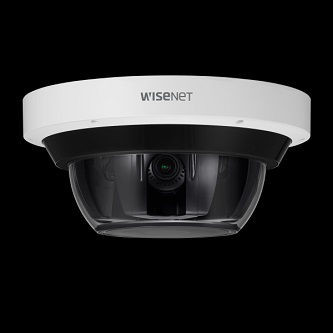
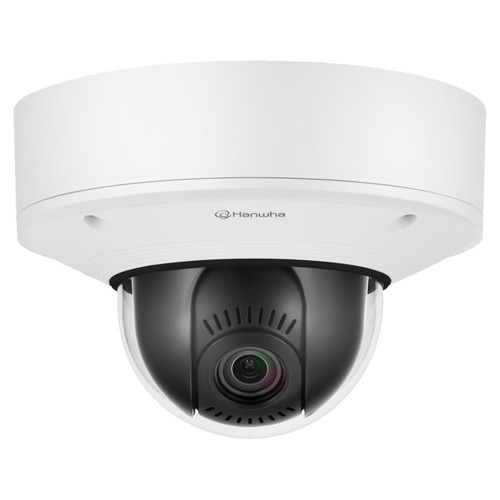
Both the Hanwha PNM-9085RQZ1 and XNV-8081Z are 5MP outdoor vandal-resistant dome cameras sharing the same 2560×1920 resolution, 30fps frame rate, 120dB WDR, and H.265 compression. However, they differ substantially in architecture: the PNM-9085RQZ1 is a multi-sensor quad-channel PTZ platform drawing up to 45W over PoE++, while the XNV-8081Z is a single-sensor motorized varifocal dome drawing 5.4W over standard PoE. Installers choosing between them are weighing aggregate coverage area against simplicity, power infrastructure, and per-unit cost.
In This Guide
How do the imaging specs compare?
The PNM-9085RQZ1 houses four independent 1/1.8" 5MP CMOS sensors (4×2560×1920), each with a 4.13–9.4mm motorized varifocal lens at 2.3x zoom and a maximum aperture of F1.92 (Wide) / F2.67 (Tele). Minimum illumination is 0.11 Lux color / 0 Lux IR, with built-in IR reaching 30m (98ft). The XNV-8081Z uses a single 1/1.8" 6MP CMOS sensor with a 3.6–9.4mm motorized varifocal lens at 2.6x zoom and a wider aperture of F1.2 (Wide) / F2.4 (Tele). Its minimum illumination is 0.07 Lux color / 0.007 Lux B/W — meaningfully more sensitive in low light than the PNM-9085RQZ1, though the XNV-8081Z's IR range is not stated in the provided specs.
Both cameras deliver 120dB WDR, SSNR V digital noise reduction, digital image stabilization, defog, and Auto ICR day/night switching. The PNM-9085RQZ1's wider horizontal field of view across four sensors (each up to H:87.58°/V:64.58°) offers broad simultaneous coverage, while the XNV-8081Z provides a slightly wider single-channel field of view (H:102.5°/V:74.2°) with more optical reach per dollar of IR sensitivity. The XNV-8081Z also supports Hallway view (90°/270° rotation) not listed for the PNM-9085RQZ1.
What about installation and environment?
The PNM-9085RQZ1 is rated IP66/IK10/NEMA4X and operates from -40°C to +55°C (-40°F to +131°F). It requires HPoE (IEEE 802.3bt Class 6/Type 3) or 12VDC, drawing up to 45W — a dedicated PoE++ switch port or injector is mandatory. The unit is large (Ø315×145.9mm) and heavy (5.2kg / 11.5lb), with aluminum housing. It includes a 4-slot Micro SD edge storage bay (up to 256GB per channel) and supports a 3/4" conduit entry with compatible hanging mount SBP-317HMW.
The XNV-8081Z carries a higher ingress rating — IP67/IP6K9K/NEMA4X — and a stronger impact rating of IK10+ (versus IK10 on the PNM-9085RQZ1). Its operating range extends to -50°C to +60°C, broader on both ends than the PNM-9085RQZ1. It runs on standard PoE (IEEE 802.3af Class 3) at only 5.4W, compatible with nearly any existing switch infrastructure. The unit is significantly smaller (Ø180×125mm) and lighter (1.75kg / 3.86lb). Its Ethernet port is 10/100BASE-T only, while the PNM-9085RQZ1 supports 10/100/1000BASE-T with a metal-shielded RJ-45. The XNV-8081Z also accepts 24VAC (optional), adding installation flexibility.
Which fits your VMS and analytics better?
Both cameras support ONVIF Profile S and T, SUNAPI (HTTP API), and Wisenet open platform. The XNV-8081Z additionally supports ONVIF Profile G (on-device recording/retrieval), which the PNM-9085RQZ1 does not list. The XNV-8081Z also lists SRTP in its protocol stack; the PNM-9085RQZ1 does not. Analytics coverage is broader on the XNV-8081Z: it adds Digital auto tracking, Sound classification, Shock detection, and Business Intelligence functions (People Counting, Queue Management, Heatmap) not listed for the PNM-9085RQZ1, which covers Defocus, Directional, Fog, Face, Motion, Appear/Disappear, Enter/Exit, Loitering, Tampering, Virtual line, and Audio detection.
Edge storage differs meaningfully: the PNM-9085RQZ1 provides four Micro SD slots (up to 256GB each), while the XNV-8081Z provides two Micro SD slots (up to 512GB total). Both support audio in/out with identical electrical specs (2.5VDC mic supply, 2K Ohm input impedance, 1Vrms line out). The XNV-8081Z's alarm events include NAS recording and Audio clip playback, which are not listed for the PNM-9085RQZ1. The PNM-9085RQZ1 has 5GB RAM / 1280MB Flash versus the XNV-8081Z's 1024MB RAM / 256MB Flash, reflecting its quad-sensor processing demands.
Which should you choose: the PNM-9085RQZ1 or the XNV-8081Z?
Our take: The PNM-9085RQZ1 is the stronger choice when a single mounting point must simultaneously cover multiple zones at 5MP resolution per channel, justifying its PoE++ power requirement and larger footprint — its four independent 5MP sensors deliver 20MP aggregate coverage at up to 30fps each, with 30m IR per sensor, from a single conduit drop. By contrast, the XNV-8081Z outperforms on three concrete metrics relevant to dense single-sensor deployments: lower minimum illumination (0.07 Lux color vs. 0.11 Lux), higher impact resistance (IK10+ vs. IK10), and a broader operating temperature range (-50°C to +60°C vs. -40°C to +55°C). It also draws only 5.4W on standard PoE 802.3af — roughly one-eighth the power of the PNM-9085RQZ1 — making it far simpler to deploy across existing switch infrastructure. Choose the PNM-9085RQZ1 for wide-area multi-zone surveillance from a single pole or ceiling mount; choose the XNV-8081Z for single-zone coverage in extreme environments or where PoE++ infrastructure is unavailable.
Side-by-Side Comparison
Spec-for-spec, from manufacturer data.
| Specification | Hanwha PNM-9085RQZ1 | Hanwha XNV-8081Z |
|---|---|---|
| Resolution | 2560×1920 per channel (×4 channels) | 2560×1920 |
| Image Sensor | 1/1.8" 5MP CMOS ×4 | 1/1.8" 6MP CMOS ×1 |
| Lens / Focal Length | 4.13–9.4mm (2.3x) motorized varifocal | 3.6–9.4mm (2.6x) motorized varifocal |
| Max Aperture | F1.92 (Wide) / F2.67 (Tele) | F1.2 (Wide) / F2.4 (Tele) |
| Min Illumination | 0.11 Lux color / 0 Lux IR | 0.07 Lux color / 0.007 Lux B/W |
| IR Range | 30m (98ft) | Not specified in provided specs |
| Wide Dynamic Range | 120dB | 120dB |
| Max Frame Rate | 30fps | 30fps |
| Video Compression | H.265 / H.264 / MJPEG | H.265 / H.264 / MJPEG |
| IP Rating | IP66 / NEMA4X | IP67 / IP6K9K / NEMA4X |
| IK / Impact Rating | IK10 | IK10+ |
| Operating Temperature | -40°C to +55°C | -50°C to +60°C |
| Power Input / PoE Class | HPoE IEEE 802.3bt Class 6 / Type 3 or 12VDC | PoE IEEE 802.3af Class 3 or 12VDC or 24VAC |
| Power Max | 45W | 5.40W |
| Edge Storage | Micro SD/SDHC/SDXC — 4 slots, up to 256GB each | Micro SD/SDHC/SDXC — 2 slots, up to 512GB total |
| ONVIF Profiles | S, T | S, G, T |
| Analytics | Motion, Face, Loitering, Enter/Exit, Appear/Disappear, Virtual Line, Fog, Defocus, Directional, Tampering, Audio detection | Motion, Face, Loitering, Enter/Exit, Appear/Disappear, Virtual Line, Fog, Defocus, Directional, Tampering, Audio detection, Digital auto tracking, Sound classification, Shock detection, People Counting, Queue Management, Heatmap |
| Audio | In (mic/line selectable) / Line out | In (mic/line selectable) / Line out |
| Ethernet | 10/100/1000BASE-T metal-shielded RJ-45 | 10/100BASE-T RJ-45 |
| Dimensions | Ø315×145.9mm (12.40"×5.74") | Ø180×125mm (Ø7.1"×4.9") |
| Weight | 5.2kg (11.5lb) | 1.75kg (3.86lb) |
| Warranty | 3 years | 3 years |
Frequently Asked Questions
Which should you choose: the PNM-9085RQZ1 or the XNV-8081Z?
The PNM-9085RQZ1 is the stronger choice when a single mounting point must simultaneously cover multiple zones at 5MP resolution per channel, justifying its PoE++ power requirement and larger footprint — its four independent 5MP sensors deliver 20MP aggregate coverage at up to 30fps each, with 30m IR per sensor, from a single conduit drop. By contrast, the XNV-8081Z outperforms on three concrete metrics relevant to dense single-sensor deployments: lower minimum illumination (0.07 Lux color vs. 0.11 Lux), higher impact resistance (IK10+ vs. IK10), and a broader operating temperature range (-50°C to +60°C vs. -40°C to +55°C). It also draws only 5.4W on standard PoE 802.3af — roughly one-eighth the power of the PNM-9085RQZ1 — making it far simpler to deploy across existing switch infrastructure. Choose the PNM-9085RQZ1 for wide-area multi-zone surveillance from a single pole or ceiling mount; choose the XNV-8081Z for single-zone coverage in extreme environments or where PoE++ infrastructure is unavailable.
Is the PNM-9085RQZ1 or XNV-8081Z better for low-light performance?
Based on the provided specs, the XNV-8081Z has a lower minimum illumination figure — 0.07 Lux color / 0.007 Lux B/W — compared to the PNM-9085RQZ1's 0.11 Lux color / 0 Lux IR. The PNM-9085RQZ1 specifies an IR range of 30m (98ft), while the XNV-8081Z's IR range is not stated in its provided specifications. For pure sensor sensitivity in color or B/W mode, the XNV-8081Z has the edge per the listed numbers.
Can I power the XNV-8081Z from a standard PoE switch?
Yes. The XNV-8081Z is specified for PoE IEEE 802.3af Class 3 at a maximum of 5.4W, which is compatible with standard 802.3af PoE switches and injectors. The PNM-9085RQZ1 requires HPoE (IEEE 802.3bt Class 6 / Type 3) drawing up to 45W, which requires a PoE++ capable switch or injector — standard 802.3af or 802.3at infrastructure will not power it.
Which camera is better suited for harsh outdoor environments?
The XNV-8081Z carries a broader operating temperature range (-50°C to +60°C vs. -40°C to +55°C for the PNM-9085RQZ1), a higher ingress rating (IP67/IP6K9K vs. IP66), and a stronger impact rating (IK10+ vs. IK10). Both are NEMA4X rated. For sites with extreme cold, high-pressure washdown exposure, or elevated vandal risk, the XNV-8081Z's specifications are more favorable on all three environmental dimensions.
Get a Second Opinion on Your Camera Choice
Share your site layout, coverage goals, and budget. Our team will validate the camera selection, flag anything we would change, and recommend products that match the use case.