
Hanwha P-3104W vs Vivotek NR9682-V3: Specification Comparison
Both the Hanwha WRT-P-3104W-8TB and the Vivotek NR9682-V3 are 64-channel network video recorders aimed at mid-to-large commercial surveillance deployments. The comparison covers recording throughput and storage architecture, compute platform and physical build, and software ecosystem and integration depth. Neither unit includes cameras or PoE switching; both require external IP cameras connected over ethernet. Buyers evaluating these units are typically choosing a head-end recorder for an existing or planned 64-channel IP camera infrastructure.
In This Guide
- Which NVR delivers more recording bandwidth and storage headroom for a 64-channel deployment?
- How do the two units compare in processing platform, physical form factor, and operating environment?
- Which platform offers broader software integration, VMS licensing, and analytics support out of the box?
- Which should you choose: the P-3104W or the NR9682-V3?
- Side-by-Side Specs
- FAQ
Which NVR delivers more recording bandwidth and storage headroom for a 64-channel deployment?
The Vivotek NR9682-V3 records at 512 Mbps, which is 3× the Hanwha WRT-P-3104W's specified 170 Mbps across the same 64-channel count. For deployments using high-bitrate streams—4K cameras, high frame-rate feeds, or dense multi-stream configurations—the NR9682-V3 provides substantially more sustained ingest headroom.
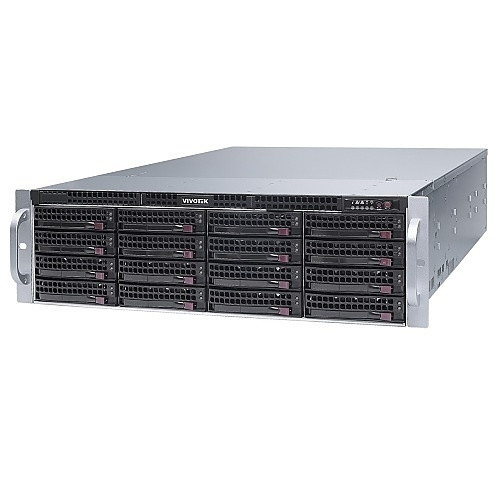
Storage architecture diverges sharply. The NR9682-V3 ships with 16 hot-swappable 3.5" SATA bays and supports RAID 0, 1, 5, 6, 10, 50, and 60; maximum installed capacity is subject to Vivotek's supported HDD list (no absolute ceiling stated in the provided specs). The WRT-P-3104W has three drive bays with 8TB installed and a stated maximum of 16TB, plus a 256GB M.2 SSD for the OS/cache. Hot-swap and RAID capability are not listed for the Hanwha unit.
The NR9682-V3 also lists a remote client video throughput of 650 Mbps and supports seamless recording and recording data encryption—specs absent from the Hanwha listing. The Hanwha unit's storage ceiling of 16TB is a practical constraint for deployments requiring extended retention at higher bitrates.
How do the two units compare in processing platform, physical form factor, and operating environment?
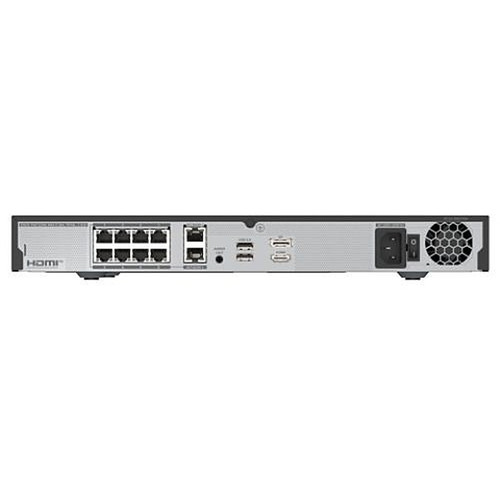
The Hanwha WRT-P-3104W is built on a 14th Gen Intel Core i3 CPU with 16GB DDR4 RAM in a mini-tower form factor (372.9 mm H × 173 mm W × 420 mm D, 10.68 kg). It runs a full desktop-class OS—either Windows 11 IoT Enterprise 2024 or Ubuntu Linux 22.04 LTS—giving integrators a familiar management surface and the ability to install third-party software directly on the appliance.
The Vivotek NR9682-V3 specs list an Intel Core i7 processor and 8GB of RAM running Embedded Windows 10. Its 19" rack-mount chassis measures 132 mm H × 437 mm W × 647 mm D and weighs 33 kg without drives, reflecting the 16-bay storage enclosure. It supports redundant 100–240V AC power input and carries an 80 Plus Platinum rating; maximum draw is 920 W. The Hanwha unit uses a single 500W 80 Plus Platinum PSU with no redundancy listed.
Operating temperature range is 10–35°C for the Hanwha unit and 5–35°C for the Vivotek, giving the NR9682-V3 a modest 5°C lower-bound advantage in cooler environments. Vivotek lists safety certifications of CE, FCC, VCCI, C-Tick, UL, CB, BSMI, and BIS; Hanwha does not specify certifications in the provided data.
Which platform offers broader software integration, VMS licensing, and analytics support out of the box?
The Hanwha WRT-P-3104W ships with Wisenet WAVE VMS and 4 Professional channel licenses pre-installed. The open-OS design (Windows 11 IoT or Ubuntu) allows integrators to load alternative VMS platforms or supplemental tools directly. ONVIF compliance is confirmed. Local storage via microSD is listed; the practical use case (edge failover vs. configuration backup) is not specified.
The Vivotek NR9682-V3 is an embedded appliance running its own NVR firmware on Embedded Windows 10. It natively supports up to 192 channels with additional licensing, hardware and software watchdog, UPS integration, failover, LPR, VCA counting, Smart Search I & II, deep search, E-Map, POS integration (ARCH), and cybersecurity management. It integrates with Vivotek's Shepherd and VSS Pro software and the iViewer mobile app (iOS/Android). User management supports up to 4,096 users with Windows AD integration.
Display output breadth favors the Vivotek unit: HDMI (4096×2160), DisplayPort (7680×4320), DVI, and VGA versus the Hanwha's dual DisplayPort with HDMI adapter. Fisheye dewarp modes (1O, 1P, 1R, 1O3R, 4R, 2P, 4R Pro, 1O8R) and 2-way audio are confirmed on the NR9682-V3; neither is specified for the WRT-P-3104W in the provided data.
Which should you choose: the P-3104W or the NR9682-V3?
Our take: The NR9682-V3 is the stronger choice when storage density, recording throughput, and purpose-built NVR feature depth are the primary criteria. Its 512 Mbps recording bandwidth is 3× the Hanwha's 170 Mbps, its 16 hot-swappable bays with RAID 0/1/5/6/10/50/60 dwarf the Hanwha's 3-bay/16TB ceiling, and its native feature set—failover, LPR, VCA, 192-channel expansion, redundant power, and four video output types—requires no additional software spend. The WRT-P-3104W is better suited where a full general-purpose OS matters: its Windows 11 IoT / Ubuntu dual-boot design lets integrators run any VMS or third-party tooling natively, and its mini-tower form factor fits spaces without rack infrastructure. The included 4 WAVE Professional licenses also reduce day-one VMS cost for Hanwha-ecosystem shops. Buyers standardizing on Wisenet WAVE in smaller facilities should evaluate the WRT-P-3104W; large-site integrators requiring high sustained throughput, deep storage, and embedded reliability should favor the NR9682-V3.
Side-by-Side Comparison
Spec-for-spec, from manufacturer data.
| Specification | Hanwha P-3104W | Vivotek NR9682-V3 |
|---|---|---|
| Max Channels (native) | 64 | 64 |
| Max Channels (with license) | — | 192 |
| Recording Throughput | 170 Mbps | 512 Mbps |
| Remote Client Throughput | — | 650 Mbps |
| Drive Bays | 3 (+ 1× 256GB M.2 SSD) | 16 hot-swappable |
| Installed Storage | 8TB | Not included (sold separately) |
| Max Storage | 16TB | Per Vivotek HDD supported list |
| RAID Support | — | RAID 0, 1, 5, 6, 10, 50, 60 |
| Network Interfaces | Dual 1GbE | Dual 2.5GbE |
| Processor | Intel Core i3 (14th Gen) | Intel Core i7 |
| RAM | 16GB DDR4 | 8GB |
| Operating System | Windows 11 IoT Enterprise 2024 / Ubuntu 22.04 LTS | Embedded Windows 10 |
| Video Outputs | Dual DisplayPort (HDMI adapter) | HDMI, DisplayPort, DVI, VGA |
| Redundant Power | — | Supported (100–240V AC) |
| Operating Temperature | 10°C to 35°C | 5°C to 35°C |
| Warranty | 5 years | 3 years |
Frequently Asked Questions
Which should you choose: the P-3104W or the NR9682-V3?
The NR9682-V3 is the stronger choice when storage density, recording throughput, and purpose-built NVR feature depth are the primary criteria. Its 512 Mbps recording bandwidth is 3× the Hanwha's 170 Mbps, its 16 hot-swappable bays with RAID 0/1/5/6/10/50/60 dwarf the Hanwha's 3-bay/16TB ceiling, and its native feature set—failover, LPR, VCA, 192-channel expansion, redundant power, and four video output types—requires no additional software spend. The WRT-P-3104W is better suited where a full general-purpose OS matters: its Windows 11 IoT / Ubuntu dual-boot design lets integrators run any VMS or third-party tooling natively, and its mini-tower form factor fits spaces without rack infrastructure. The included 4 WAVE Professional licenses also reduce day-one VMS cost for Hanwha-ecosystem shops. Buyers standardizing on Wisenet WAVE in smaller facilities should evaluate the WRT-P-3104W; large-site integrators requiring high sustained throughput, deep storage, and embedded reliability should favor the NR9682-V3.
Is the Hanwha WRT-P-3104W or the Vivotek NR9682-V3 better for large deployments with many high-resolution cameras?
For large deployments with high-bitrate cameras, the NR9682-V3 has a clear throughput advantage at 512 Mbps versus the WRT-P-3104W's 170 Mbps. Its 16-bay hot-swappable storage with full RAID support also provides far greater retention capacity than the Hanwha's three-bay, 16TB maximum. The NR9682-V3 is also expandable to 192 channels with additional licensing, while the Hanwha is fixed at 64.
Can I use either NVR with cameras from other manufacturers, or am I locked into one ecosystem?
Both units declare ONVIF compliance in their provided specifications, which allows connection of third-party ONVIF-conformant cameras. The NR9682-V3 additionally specifies ONVIF Profile S. The Hanwha WRT-P-3104W runs a full Windows 11 IoT or Ubuntu OS, which can host alternative VMS software beyond the bundled Wisenet WAVE, giving it broader third-party flexibility at the software layer.
Which unit is easier to service and maintain in a live production environment?
The Vivotek NR9682-V3 provides hot-swappable drive trays, redundant power supply support, hardware and software watchdog, and a UPS integration spec—all features that allow drive replacement and power-path servicing without taking the unit offline. The Hanwha WRT-P-3104W does not list hot-swap, redundant power, or watchdog capability in the provided specifications, making it less suited to environments where continuous uptime during maintenance is a hard requirement.
Get a Second Opinion on Your Camera Choice
Share your site layout, coverage goals, and budget. Our team will validate the camera selection, flag anything we would change, and recommend products that match the use case.