
Hanwha P-3104W vs Hanwha PRN-6400DB4: Specification Comparison
Both the Hanwha WRT-P-3104W-8TB and the Hanwha PRN-6400DB4 are 64-channel NVRs from the same manufacturer, targeting professional surveillance installations. The WRT-P-3104W is a Windows/Linux PC-based appliance running Wisenet WAVE VMS on a 14th-Gen Intel Core i3 platform, while the PRN-6400DB4 is a purpose-built embedded Linux recorder with dedicated hardware decoding. Buyers considering either unit are typically evaluating recording bandwidth, maximum storage capacity, redundancy features, and platform openness for a 64-channel deployment.
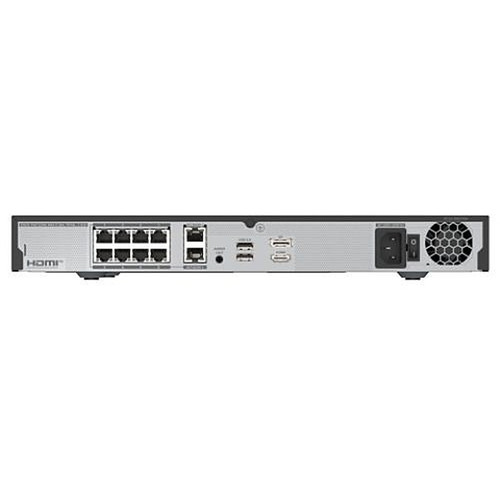
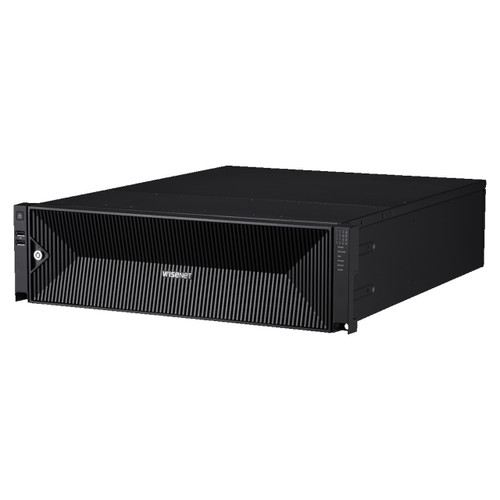
In This Guide
- Which NVR delivers more recording bandwidth and higher-resolution support across 64 channels?
- How do the two units compare on maximum storage capacity, drive bay configuration, and data-protection features?
- What are the differences in platform openness, software ecosystem, power environment, and physical installation requirements?
- Which should you choose: the P-3104W or the PRN-6400DB4?
- Side-by-Side Specs
- FAQ
Which NVR delivers more recording bandwidth and higher-resolution support across 64 channels?
The PRN-6400DB4 specifies a maximum recording bandwidth of 400 Mbps and supports camera resolutions up to 32MP (8K), with a local display decode path reaching 32MP at 15 fps (H.265). The WRT-P-3104W specifies 170 Mbps of recording bandwidth across its 64 channels, and no maximum per-camera resolution is stated in the provided specifications.
For simultaneous playback, the PRN-6400DB4 supports up to 112 channels (64 local, 16 per remote user across up to 3 remote users), and its playback bandwidth is specified at a maximum of 64 Mbps across 64 channels. The WRT-P-3104W's playback bandwidth and simultaneous playback channel count are not specified in the provided data.
On transmission bandwidth alone, the PRN-6400DB4's 400 Mbps ceiling is more than double the WRT-P-3104W's 170 Mbps, making it the higher-throughput platform when camera counts approach 64 at elevated bitrates or high resolutions.
How do the two units compare on maximum storage capacity, drive bay configuration, and data-protection features?
The PRN-6400DB4 provides 16 hot-swappable SATA drive bays with a stated maximum raw capacity of 160TB (non-RAID mode) and supports RAID 5 and RAID 6 across two arrays of 8 HDDs each, plus iSCSI external storage expansion. It also specifies N+1 failover redundancy and Automatic Recovery Backup (ARB). Individual HDD support is listed at up to 10TB per drive.
The WRT-P-3104W ships with 8TB installed across 3 SATA drive bays and expands to a maximum of 16TB internally, plus a 256GB M.2 SSD for the OS. No RAID capability, hot-swap support, failover, or external storage expansion is mentioned in the provided specifications.
For storage depth, the PRN-6400DB4's 160TB raw ceiling and RAID 5/6 with hot-swap represent an enterprise-class data-protection tier; the WRT-P-3104W's 16TB maximum and absence of stated redundancy features position it for smaller or less retention-intensive deployments.
What are the differences in platform openness, software ecosystem, power environment, and physical installation requirements?
The WRT-P-3104W runs Windows 11 IoT Enterprise 2024 or Ubuntu Linux 22.04 LTS and ships with Wisenet WAVE VMS including 4 Professional licenses, offering a general-purpose OS environment with flexibility for third-party software. It uses dual 1GbE network interfaces (on-board plus PCIe), dual DisplayPort outputs (with HDMI adapters), USB 3.2 Gen 2 and USB 2.0 ports, and a 500W 80 Plus Platinum power supply in a mini-tower form factor. Operating temperature is 10–35°C and weight is 24 lbs (10.68 kg). Warranty is stated as 5 years.
The PRN-6400DB4 runs embedded Linux and relies on Hanwha's native client ecosystem (Webviewer, Smart Viewer, Wisenet Mobile, CGI/SUNAPI). It provides three 1GbE RJ-45 ports (LAN/WAN), dual HDMI outputs (4K@30Hz and 1080p@60Hz), 4 USB ports (2× USB 2.0 front, 2× USB 3.0 rear), 8 alarm inputs and 4 alarm outputs, dual AC power inlets (dual SMPS), and a maximum power draw of 285W with 16 HDDs loaded. Operating temperature is 0–40°C and weight is approximately 14.3 kg (31.5 lb) without HDDs. No warranty term is stated in the provided specifications.
The PRN-6400DB4 has a wider operating temperature range (0–40°C vs. 10–35°C), dedicated alarm I/O, dual AC power inlet redundancy, and native PTZ controller support (SPC-2000). The WRT-P-3104W offers OS-level flexibility and a 5-year stated warranty, but alarm I/O, dual PSU redundancy, and operating temperature floor are not matched in the provided specs.
Which should you choose: the P-3104W or the PRN-6400DB4?
Our take: The PRN-6400DB4 is the stronger choice when the deployment demands maximum throughput, large on-site retention, hardware-level redundancy, and enterprise alarm integration. Its 400 Mbps recording bandwidth is 2.4× the WRT-P-3104W's 170 Mbps ceiling; its 160TB maximum storage via 16 hot-swap bays dwarfs the WRT-P-3104W's 16TB limit; and it adds RAID 5/6, N+1 failover, dual SMPS power inlets, and 8 alarm inputs that are absent from the WRT-P-3104W's stated specifications. Conversely, the WRT-P-3104W suits buyers who need a general-purpose OS (Windows 11 IoT or Ubuntu), the flexibility of Wisenet WAVE on an open PC platform with a bundled 4-license VMS package, and a 5-year warranty—none of which are confirmed in the PRN-6400DB4 specs. Choose the PRN-6400DB4 for high-channel-density, high-resolution, or retention-critical enterprise sites; choose the WRT-P-3104W for WAVE-centric, software-flexible deployments with modest on-site storage needs.
Side-by-Side Comparison
Spec-for-spec, from manufacturer data.
| Specification | Hanwha P-3104W | Hanwha PRN-6400DB4 |
|---|---|---|
| Max Channels | 64 | 64 |
| Recording Bandwidth | 170 Mbps | 400 Mbps |
| Max Camera Resolution | Not specified | 32MP (8K) |
| Drive Bays | 3 × 3.5" SATA | 16 × SATA (hot-swap) |
| Installed Storage | 8TB | Not included (bays only) |
| Max Internal Storage | 16TB | 160TB (non-RAID) |
| RAID Support | Not specified | RAID 5/6 (2 × 8-HDD arrays) |
| External Storage | Not specified | iSCSI |
| Redundancy / Failover | Not specified | N+1 failover + ARB |
| Operating System | Windows 11 IoT Enterprise 2024 / Ubuntu 22.04 LTS | Embedded Linux |
| Included VMS / Licenses | Wisenet WAVE — 4 Professional licenses | Native Hanwha clients (no standalone VMS license stated) |
| Network Interfaces | Dual 1GbE (on-board + PCIe) | 3 × 1GbE RJ-45 (LAN/WAN) |
| Video Outputs | 2 × DisplayPort (HDMI adapter) | 2 × HDMI (4K@30Hz + 1080p@60Hz) |
| Alarm I/O | Not specified | 8 inputs / 4 outputs |
| Power Supply | 500W 80 Plus Platinum (single) | Dual SMPS; max 285W (with 16 HDDs) |
| Operating Temperature | 10–35°C | 0–40°C |
| Weight | 24 lb (10.68 kg) | 31.5 lb (14.3 kg, HDDs not included) |
| Warranty | 5 years | Not specified |
Frequently Asked Questions
Which should you choose: the P-3104W or the PRN-6400DB4?
The PRN-6400DB4 is the stronger choice when the deployment demands maximum throughput, large on-site retention, hardware-level redundancy, and enterprise alarm integration. Its 400 Mbps recording bandwidth is 2.4× the WRT-P-3104W's 170 Mbps ceiling; its 160TB maximum storage via 16 hot-swap bays dwarfs the WRT-P-3104W's 16TB limit; and it adds RAID 5/6, N+1 failover, dual SMPS power inlets, and 8 alarm inputs that are absent from the WRT-P-3104W's stated specifications. Conversely, the WRT-P-3104W suits buyers who need a general-purpose OS (Windows 11 IoT or Ubuntu), the flexibility of Wisenet WAVE on an open PC platform with a bundled 4-license VMS package, and a 5-year warranty—none of which are confirmed in the PRN-6400DB4 specs. Choose the PRN-6400DB4 for high-channel-density, high-resolution, or retention-critical enterprise sites; choose the WRT-P-3104W for WAVE-centric, software-flexible deployments with modest on-site storage needs.
Is the WRT-P-3104W or PRN-6400DB4 better for larger deployments with high-resolution cameras?
Based on the provided specifications, the PRN-6400DB4 is better suited to larger or higher-resolution deployments. It supports up to 32MP (8K) camera inputs and a 400 Mbps recording bandwidth ceiling, compared to the WRT-P-3104W's 170 Mbps limit with no stated per-camera resolution maximum. The PRN-6400DB4 also offers substantially more storage headroom at up to 160TB versus the WRT-P-3104W's 16TB maximum.
Does either NVR include built-in redundancy or RAID to protect recorded footage?
Yes, but only the PRN-6400DB4 specifies redundancy features in the provided data. It supports RAID 5 and RAID 6 (two arrays of 8 HDDs each), hot-swappable drives, N+1 failover, Automatic Recovery Backup (ARB), and dual AC power inlets. The WRT-P-3104W's specifications do not mention RAID, hot-swap capability, failover, or redundant power.
Can the WRT-P-3104W be used with third-party VMS software, and what software does the PRN-6400DB4 support?
The WRT-P-3104W runs Windows 11 IoT Enterprise 2024 or Ubuntu Linux 22.04 LTS, which are general-purpose operating systems that can, in principle, host third-party software alongside the included Wisenet WAVE VMS (4 Professional licenses). The PRN-6400DB4 runs embedded Linux and is tied to Hanwha's native client suite—Webviewer, Smart Viewer, Wisenet Mobile, and CGI/SUNAPI—with no mention of third-party VMS support in the provided specifications. Buyers requiring platform openness should factor this distinction into their decision.
Get a Second Opinion on Your Camera Choice
Share your site layout, coverage goals, and budget. Our team will validate the camera selection, flag anything we would change, and recommend products that match the use case.